


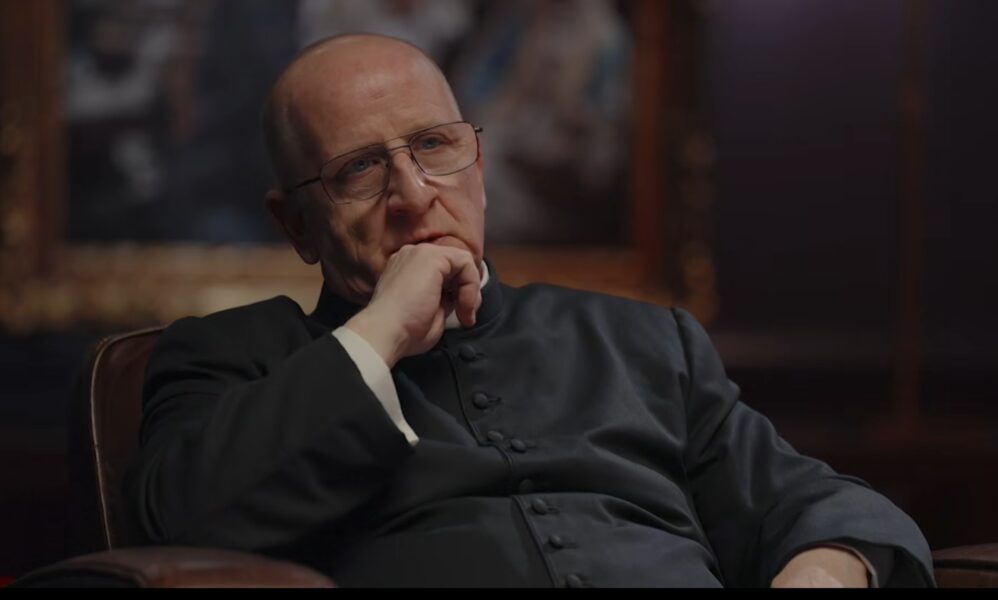
The Rev. Chad Ripperger, traditional exorcist and founder of the Doloran Fathers, grants nearly three hours of interview to the Shawn Ryan Show—one of the most-watched podcasts in the United States—and delivers a masterful catechesis on Thomistic angelology, spiritual warfare, and the power of the Holy Sacrifice.
Rarely does secular American television open its doors wide to Catholic doctrine without concessions. This week, the Shawn Ryan Show—the podcast of the former Navy SEAL and ex-CIA contractor who has interviewed presidents and heads of state—did so with Fr. Chad Ripperger as guest (episode #324, released July 23, more than two hours and forty minutes of conversation). The result is one of the most serious expositions of Catholic theology—St. Thomas in hand—that has ever been presented to an audience of millions.
The interview opens with a surprising confession from the host: “I’m going to be honest. I came originally with a completely different agenda: to tear apart two politicians in the current administration who are going to exaggerate their loyalty to the Catholic Church to scrape the Catholic vote. And I’m not going to do it. These past weeks I’ve come to understand that the battle is not for the country, nor even for the world: it is for our souls and for our minds.”
Ripperger nods: “About ten years ago I said at a public conference that this is no longer a battle of ideas. It is a battle of good against evil. Many of the psychological patterns we see in people under diabolical influence are seen in those who run the government.” And he closes with an image that needs no translation: “You can rearrange the deck chairs on the Titanic, but it’s still going to sink if people don’t confront this spiritually.”
Beelzebub’s confession during Holy Mass
The moment that gives the episode its title comes when Ripperger recounts a case centered on Our Lady under the title of Mirror of Justice. The exorcist first explains, with scholastic precision, the structure of sacrifice—offertory, immolation of the victim, and consummation—as God taught it to Israel and as Christ fulfilled it on the Cross, and recalls that under the virtue of justice lies the virtue of religion, one of whose acts is to offer sacrifice to God: to give Him the best we have, like Abel and unlike Cain.
Then he tells what happened. The exorcism sessions always began with Holy Mass: “Every time the demon manifested while I was celebrating Mass it was because God had told him he had to reveal something to me.” After forty-five minutes of imprecatory prayers—“first you bombard, then you send in the infantry,” the exorcist explains in military language—Beelzebub confessed his nature:
“I convince people that they cannot separate themselves from a particular good.”
That is: the demon destroys the offertory, the moment when the soul must be ready to detach itself from the lesser good in order to attain the greater. And the demon added:
“That is how I made Adam and Eve fall. That is how I am making your Church fall. That is how I brought down your government. It is at the root of every sin and every defect of every human being.”
Later he would add that it is “the cause of mediocrity in every man.” Anyone who has ever seriously tried to fast knows that the demon, for once, was not lying.
A lesson in angelology that is no longer preached
A large part of the interview is simply St. Thomas’s treatise on the angels explained to a former Navy SEAL: the nine choirs created instantaneously and in hierarchy; infused knowledge; the three “instants” of the angelic trial; the fall “like lightning” of a third of the angels; the angelic will fixed forever in its choice. “Even in session the demons say: yes, it was a bad choice, but I would do it again,” Ripperger relates.
The doctrine—both traditional and forgotten—that the saints surpass the angels in hierarchy is not missing: “It is the tradition of the Catholic Church that, under Christ, the first is Our Lady; then the apostles… and they are above even the seraphim.” Men, he explains, can occupy by holiness the places left vacant by the fallen angels.
Regarding the guardian angel, Ripperger offers pearls of practical theology: the angel’s involvement in our life “is based above all on our asking him,” and his ordinary action is so discreet that “the more normal our life seems, the more it is a sign that the angels are acting.” And he recounts the case of a possessed woman immobilized by the demon whom he freed by mentally sending her, from an airport boarding line, the angel of his priesthood: “Afterward she asked me: ‘Did you send the guardian angel of your priesthood? He appeared to me and held my hand.’”
UFOs: the operation to supplant Genesis
Ryan brings up the accelerated timeline of the “UFO revelation” of 2026: Vice President Vance’s statements (“UFOs are demons”), the government declassification, the swift dismissal of the Washington exorcist after stating that most sightings are demonic, and the Hollywood premiere that mirrored real events. Ripperger’s thesis is clear: “My suspicion is that many of the people in government are anti-Christian, and their goal is to supplant Christianity with an alternative explanation of our origins.” Alleged alien communications, he notes, always offer the same thing: a salvation for humanity apart from Christ and a total amendment of the Genesis account.
His refutation of extraterrestrial life is not an outburst but a full argument: the principle of the hierarchy of being, the transmission of original sin through the line of Adam—whose blood shed on Calvary, over the tomb of the first man according to the Fathers, redeems precisely that lineage—and the consensus of the best astrophysicists on the energetic impossibility of interstellar travel. “People do not follow the principle of evidence,” the exorcist concludes.
“Sometimes being merciful to someone is bad for him”
Asked why Christianity is the only religion that can be vilified with impunity, Ripperger does not hide: “Satan is the prince of this world” and the demons “know, no longer by faith but by deduction, that this is the true religion: no other was founded by God Himself.” But the other half of the blame is ours: “We have been conditioned to believe that turning the other cheek means letting people do whatever they want.” And he dispatches false mercy with St. Thomas: one must always forgive, but “that does not mean extending the effects of that forgiveness to someone if it confirms him in his sin. Sometimes being merciful to someone is bad for him.”
His prescription for Catholics today sounds like a call to arms: know the faith (“many Christians fight poorly because they do not know what they are talking about”), be willing to “wield the axe” and to “break the ice”: “Until a man rises and says ‘this is a hoax, and I will explain why,’ no one else dares to speak. You have to be willing to be that man. But make sure you have the virtue to withstand the beating… and that you really know what you are talking about.”
The Rosary, “the weapon,” and the prayer that obtains what it asks
The final stretch is a small manual of spiritual combat: the Rosary—“the weapon,” as Padre Pio called it—with the reminder of Lepanto and St. Pius V; deliverance prayers for the laity (Ripperger is the author of the well-known Deliverance Prayers for Use by the Laity); the principle that “prayer begets what it signifies: what you ask is what you are going to obtain,” with the advice to ask for very specific things; and even the recommendation—which will make more than one businessman smile—of asking the angels to “keep hidden” one’s own work from the wrong people.
There are also moments of moving rawness: Ryan recounts live a suicide attempt from a decade ago from which he emerged alive in an inexplicable way, and an encounter in Sedona with an old man who “read his mind from beginning to end” and led him to Christ. “Could it have been my guardian angel?” “Yes, it could be,” answers the exorcist, “and one of the signs is that you will never meet that man again.”
The interview closes as it began: with prayer. Ripperger gives thanks for “all the knowledge communicated by divine revelation, which has come to us through the tradition of the Catholic Church,” and asks for the grace to “follow the truth no matter the personal cost.”
Almost three hours that are worth a theology course. And a hopeful realization: when Catholic doctrine is presented whole, without complexes and with St. Thomas as guide, millions of people listen.