


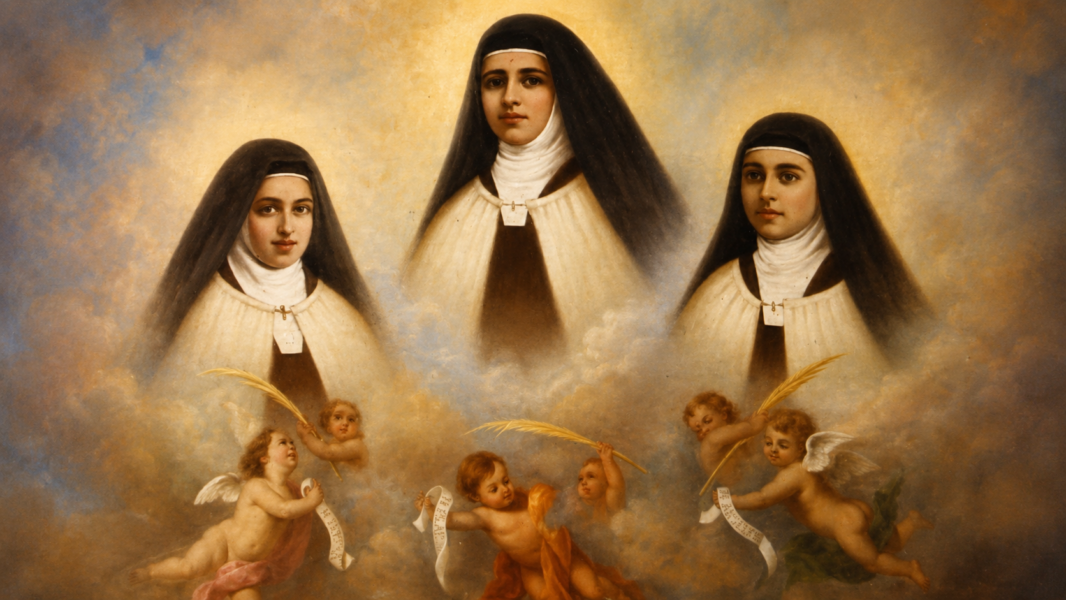
On July 24, 1936, in the streets of Guadalajara, three Discalced Carmelite nuns were pursued and shot dead. The eldest was fifty-eight; the other two barely thirty. “Shoot them—they’re nuns!” No more was needed to know the crime, the sentence, and the cause of death. Their names were not asked, their pockets not searched, nor were they checked for hidden weapons, documents, or slogans; it was enough to recognize in those three women, clumsily disguised in lay clothes, something they had not managed to conceal: they were religious. They did not die for what they had done, but for what they were; they were not part of a commando unit, nor did they carry rifles or defend a military position; they defended, without words, the right of Jesus Christ to possess entirely a human heart. The three died separated by only a few minutes and a few hundred meters, yet they had walked together a much longer path: that of humble, daily, and hidden fidelity. For their martyrdom did not begin with the shots: it had begun many years earlier, in the cell, in the choir, in the refectory, in accepted obedience, in fraternal recreation, in the small renunciations of each day. The final minutes are striking: the rifles, the shouts, the bodies fallen on the street; but those women prepared for their supreme hour in the small hours. For one does not learn to say yes before a firing squad if one has lived saying no to God in daily life; one does not suddenly give one’s blood if one has haggled every day over the small drops of sacrifice, nor does one uphold the name of Jesus amid gunfire if one has habitually been ashamed of Him. These three knew that martyrdom is attained by sweeping well, keeping silence, arriving punctually at the choir, obeying without drama, accepting monotony, smiling in recreation, and beginning again after every weakness.
María Pilar, forgiveness; Ángeles, silence; Teresa: Long live Christ the King!
The monastery of San José in Guadalajara traces its roots to the early expansion of Saint Teresa’s reform. The community had been founded in Arenas de San Pedro in 1594 and moved to Guadalajara in 1619, under the patronage of the Duchess of the Infantado. Seeking a life entirely hidden with Christ in God, for centuries generations of women passed through its doors to disappear from the world with the desire to save it. For enclosure is not indifferent forgetfulness; one who enters Carmel does not abandon men: she introduces them into her prayer; she withdraws from the surface to descend to the place where the true battles are fought. In July 1936, the community consisted of eighteen nuns living in a Spain tense, wounded by ideological hatred, political violence, and growing hostility against the Church. In the first days of the Civil War, religious persecution manifested itself with a brutality that made no distinction between combatants and nuns, between armed men and women enclosed behind a grille. On July 22, Guadalajara fell into the hands of revolutionary forces, and the Carmelites had to abandon their convent precipitously for fear that it would be assaulted and set on fire. Dressed in civilian clothes, they left two by two to take refuge in the homes of known families. For a Carmelite, the habit is the memory of a covenant, the visible sign of a belonging, the poor livery of the Virgin; those women had to replace it with other garments, but beneath the lay dress their consecration remained intact. When speaking of “the three Carmelites,” it might seem that their holiness was uniform, as if they were three identical figures cut out against the same background. But grace does not produce copies: God leads each soul along an unrepeatable path. They were three women distinct in age, character, formation, and sensibility, whom blood united in the end because before that a single vocation had united them.
María Pilar de San Francisco de Borja, known in the world as Jacoba Martínez García and born in Tarazona in 1877, the eldest of the three, was the last of eleven siblings, eight of whom died in childhood, and the survivors were one priest and two Carmelites in the same convent. When martyrdom came, she had already lived many years of religious life, many apparently identical days, many fidelities that no one had recorded. For holiness usually requires duration; not everything is resolved in an initial enthusiasm; there are virtues that are acquired only after repeating the same acts of love for decades: after going to Matins when the body is heavy; after accepting a correction or persevering in prayer when the soul feels nothing; sustaining the vocation when it has lost all sensible novelty. María Pilar’s blood was not the improvisation of a heroic afternoon but the last line of a life written slowly. In her community conversations she had expressed how she imagined martyrdom: if that hour came, she said, they would go singing “Sacred Heart, Thou shalt reign.” The reign of Christ was for her not a political slogan nor a decorative expression, but the certainty that His pierced Heart would conquer precisely when everything seemed to defeat it. She could not sing that hymn when she received the shots; she uttered words still higher: “Long live Christ the King! My God, forgive them!” Gravely wounded, she fell in the street. Seeing that she was still alive, they shot her again and also attacked her with a bladed weapon. A guard managed to take her first to a pharmacy, then to the Red Cross, and finally to the Provincial Hospital. There she died holding a crucifix and repeating forgiveness for those who had destroyed her. Is a political interpretation of this martyrdom possible? Granted: one could shout “Long live Christ the King!” with a certain exaltation, but only grace allows one to add: “Forgive them.” The Kingdom that María Pilar proclaimed did not resemble the kingdoms of this world: her King wore a crown of thorns, her throne was a cross, her victory consisted in loving when hatred seemed to have all the weapons. María Pilar did not die cursing, but interceding for Spain; not asking for punishment, but for mercy. If they had broken her body, they did not succeed in inoculating hatred into her heart. There lies the true triumph of the martyr: not simply to endure violence, but to prevent violence from taking possession of him inwardly.
Sister Teresa of the Child Jesus and of Saint John of the Cross (Eusebia García García), born in Mochales, Guadalajara, in 1909, the second of eight siblings, is the youngest of the three martyrs. After reading the “Story of a Soul” by Saint Thérèse of the Child Jesus, she entered Carmel at the age of sixteen in 1925 and pronounced her solemn vows in 1930. Her religious name sums up a vocation stretched between two peaks of Carmel: the spiritual childhood of Saint Thérèse and the nakedness of Saint John of the Cross. From the first she learned that holiness consists in surrendering with confidence; from the second, that true love reserves nothing. Of strong character, she used to say: “I do not like the lives of saints in which only their virtues are spoken of, hiding their faults and struggles. When I die, do not hide my defects so that the mercy of Jesus toward me may shine more brightly.” Before the persecution she had expressed the desire to die proclaiming “Long live Christ the King!” And she said that the martyrs would have in heaven a particular love for their executioners, because they had opened the door of eternal happiness for them, handing the martyr over to Life. Only a heart completely possessed by Christ can look upon the enemy not as someone to hate, but as someone for whom to intercede. On July 24, when the situation of the house where they were hiding began to become dangerous for those who concealed them, Teresa offered to seek another lodging. She went out accompanied by María Pilar and María Ángeles toward a friendly house on Francisco Cuesta Street, but on the way they were recognized and a militiawoman alerted the others: “Shoot them—they’re nuns!” María Ángeles fell first; María Pilar was shot down next; Teresa witnessed the death of both, but the shots did not reach her. She tried to take refuge, was intercepted, and a man pretended to lead her to a safe place, but instead directed her toward the cemetery and other militiamen joined the group. As they tried to break her and make her shout a revolutionary slogan, Teresa opened her arms in the form of a cross, began to run, and shouted with all the strength of her youth: “Long live Christ the King! Long live Christ the King!” while a volley from behind ended her life. She had desired to give all her blood to Christ, and Christ took her seriously. Her final race was not a flight: she was running toward death, yes, but in reality she was running toward the Bridegroom. She opened her arms to resemble the Crucified one for the last time. She, who had lived with her arms gathered in prayer, occupied in work, crossed beneath the scapular, opened them when she no longer intended to keep back a single drop of blood. The day after her martyrdom, her priest uncle, Florentino García Andrea, was arrested in the parish of San Pedro de Sigüenza and shot at the place called La Hortaza, on the road to Barbatona, at dawn on August 11.
María Ángeles de San José was called Marciana Valtierra Tordesillas. She had been born in Getafe in 1906, the youngest of eleven siblings, six of whom died as children. She lost her mother when she was three years old, and to care for her father she was unable to enter the Carmel of San José until the age of twenty-four. The reading of the “Story of a Soul” by Saint Thérèse of the Child Jesus contributed to the awakening of her Carmelite vocation. Desiring to enter the Young Carmel of the Cerro de los Ángeles, whose prioress, Saint Maravillas of Jesus, having no vacancies, directed her to San José of Guadalajara; she received the habit in 1930 and pronounced her solemn vows in 1934, barely two years before her death. In recreations, when possible martyrdom was discussed, María Ángeles considered dying for Christ an immense grace, of which she judged herself unworthy. And she added: “It must be attained by fidelity in small things.” When she came out of the doorway on Francisco Cuesta Street, she was the first to receive the shots. She fell mortally wounded and died there, in silence. We do not know a final phrase spoken by her; perhaps that silence is her last teaching. Not all martyrs die preaching, but all preach by dying. In María Ángeles, her fallen body said all that was necessary: that she preferred to die rather than be ashamed of being the spouse of Jesus Christ. She had been identified as a nun; that was enough to kill her, and that is enough for the Church to venerate her.
The historical truth: the crime of shouting “Long live Christ the King!”
The Carmelites of Guadalajara were not killed in the midst of combat nor struck by stray bullets: they died out of hatred for the faith. The determining cause of the aggression was their religious condition, expressly recognized and denounced. That reality was what allowed the Church to formally recognize their martyrdom. The phrase “they’re nuns” functioned as a complete accusation. If in other times it would have provoked respect, that afternoon it provoked the volley. Why is a nun so unbearable to a totalitarian ideology? Because a contemplative is a woman who has placed herself outside the market of human powers; she cannot be bought with honors, seduced with promotions, nor threatened with the loss of a future she has already surrendered. She lives by a relationship that the State does not administer; she obeys an authority that does not arise from ballots or rifles; she loves an invisible Spouse, yet more real to her than all the rulers of the earth. A cloistered nun seems defenseless, and precisely for that reason she is dangerous to every power that claims to be absolute. By her existence she affirms that man does not belong to the State, that he is not realized solely through what he produces; that there is a fruitfulness that is not biological and a freedom higher than autonomy. That there is an eternal King before whom all the powers of the earth are provisional. They had to make them disappear because totalitarianism is not content with expelling God from public buildings; it needs to expel Him from memory, from conscience, from language, and even from the bodies that belong to Him. The three Carmelites died because their persons were temples of a Presence that could not be requisitioned.
To speak of the martyrs of 1936 requires truth, serenity, and justice: neither is one honoring the dead by manipulating history, nor serving reconciliation by concealing crimes. Spain had arrived at July 1936 torn by social, political, and military confrontations, by violence coming from various sectors, and by a collective inability to preserve coexistence. But recognizing the complexity of the context does not lead to blurring the specificity of religious persecution. Thousands of priests, religious, nuns, and laity were murdered not for military actions, but for their Catholic identity. Churches, images, archives, and convents were destroyed. Wearing a cassock, possessing a crucifix, hiding a priest, or having professed in a community could become a death sentence. The Church, in beatifying martyrs, does not canonize a war, a side, or a political project; it does not declare saints all those who died on one side, nor does it deny the sins committed by Catholics, but rather, after studying concrete lives and deaths, it recognizes that certain persons were murdered out of hatred for Christ and accepted death with faith, fortitude, and forgiveness. In the case of Guadalajara, the motivation was laid bare in a single exclamation: “They’re nuns.” The noun contained the crime.
Saint Teresa desired from childhood to go to the land of the Moors to shed her blood for Christ. When she understood that she was not called to that exterior martyrdom, she converted her entire life into a martyrdom of love: dying to herself, suffering for the Church, surrendering to prayer, and founding small “schools of Christ” where a few women would sustain the world from within the cloister. Saint John of the Cross did not die violently, but he suffered imprisonment, incomprehension, abandonment, and a purifying night that made his entire existence an oblation. Saint Thérèse confessed her desire to suffer all martyrdoms, although she knew that her true martyrdom would be that of love lived in littleness. The three Carmelites of Guadalajara unite these three currents. In María Pilar appears Teresian firmness and zeal for the reign of Christ. In Teresa, the total Johannine spirit: to keep nothing back, to give all one’s blood, to go out of oneself to enter into God. In María Ángeles, the Teresian-Lisieux little way of hidden fidelity. The three show that Carmel is the image of Calvary. Silence taught them to listen to the voice of the Bridegroom; poverty took away their supports; chastity unified their hearts; obedience taught them not to belong to themselves; enclosure showed them that God alone suffices. Thus, when death came, they had already rehearsed it. Only the final act of obedience remained.
The martyrs of Guadalajara are an echo of the eschatology of the reign of Christ and of the reparative spirituality of the Sacred Heart. María Pilar imagined the community on the way to martyrdom singing “Sacred Heart, Thou shalt reign.” Teresa desired to die—and she achieved it—proclaiming “Long live Christ the King!” Both expressions belong to the spiritual climate of a Spain that had received with force the devotion to the Sacred Heart and the doctrine of the social reign of Jesus Christ. But it is fitting to understand them well. Christ the King is not a heavenly chieftain placed at the service of our temporal preferences: His Kingdom is not imposed with rifles; it needs no avengers nor conquers plazas: it conquers hearts. By shouting “Long live Christ the King!” while she was being murdered, Teresa showed that they adored a King who conquers by allowing Himself to be wounded and reigns from a tree. María Pilar linked the cry of victory with forgiveness, without which “Christ the King” can become a slogan. The Sacred Heart reigned because three victims loved to the end. He reigned when María Pilar forgave. He reigned when María Ángeles was silent. He reigned when Teresa opened her arms in the form of a cross. If the reds controlled the street, Christ reigned in those three hearts. And the empire of His Love lasts eternally, while any control of a city comes to an end.
The savor of martyrdom, indomitable femininity, and modesty under fire
The Carmelites spoke of martyrdom in their convent recreations, while sewing, conversing, and mutually encouraging one another, in a communal pedagogy of martyrdom: each nourished the faith of the others; the eldest shared her ardor; the young one confessed her desire; the most timid recalled the need to be faithful in small things. Christian charity is like this: to lend faith to the one who falters, memory to the one who forgets, hope to the one who grows weary, and courage to the one who fears. Our three martyrs carried within them the words of their sisters: María Ángeles had heard of forgiveness; Teresa, the organist, had listened to the singing of the reign of the Heart; María Pilar had contemplated the ardor of the young. When they went out together, they carried with them the faith of the entire community. This challenges our families, parishes, seminaries, and convents. What do we speak of when we are together? Do we help one another to desire holiness or do we mutually confirm one another in mediocrity? Do we nourish courage or cultivate fear and the compromise of political correctness, also in the ecclesial sphere, so watered-down today and so far from apostolic and martyrial parrhesia? Do our conversations make it easier to be faithful to Christ or more comfortable to distance oneself from Him? Those recreations prepared martyrs; many current conversations prepare deserters, silent apostates, or pious bourgeois.
The three martyrs also offer a necessary reflection on the freedom and dignity of women. Often religious life is presented as a denial of feminine autonomy. The nun is imagined as a woman annulled by a structure, deprived of experiences, and subjected to rules that prevent her from realizing herself. But who was truly free that afternoon? The men and women subjected to collective hatred, incapable of looking at three persons without reducing them to a label, or the religious who had consciously chosen to Whom to surrender their life and remained faithful when that choice cost them blood? The world claims to liberate woman from all bonds, except those that the world itself imposes upon her. It accepts that she surrender her body to the market, to fashion, to pleasure, or to productivity, and does not understand that she surrender it to God. The three Discalced Carmelites of Guadalajara were murdered because, outside the ideological project that surrounded them, they had made an irreversible and scandalous decision: not to be available for any other absolute than Jesus Christ.
Teresa showed extraordinary firmness when a man tried to take her by the arm. She did not accept a false protection that would compromise her freedom and her consecration: she walked warily, repeating the name of Jesus, until she understood the trap and responded by opening her arms in the form of a cross. She was not a passive woman: she was a consecrated woman. For if passivity allows itself to be used, consecration immolates itself; it does not allow itself to be possessed.
The agony of María Pilar, lying on the counter of a pharmacy with a kidney exposed, contains a delicate and terrible detail: upon hearing Doña María Carrasco speak, she said to her: “Do not leave me, madam, do not let them touch me; forgive them, Lord!” In the midst of extreme pain, she preserved the modesty of a woman who had belonged all her life to Christ. Her Christian modesty was not fear of the body but awareness of its greatness. For the Carmelite, the body is not something that can be manipulated without respect: it has been consecrated; it has fasted, kept vigil, worked, knelt, and received Holy Communion. It is the body of a spouse of Christ and a temple of the Holy Spirit.
Our age speaks continually of the body, and yet rarely treats it as sacred. It exhibits, modifies, commercializes, medicalizes, exploits, and discards it. These martyrs remind us that the Christian body possesses a dignity that not even violence can abolish. The shots destroyed their bodies but did not profane them inwardly, because dignity does not depend on the aggressor recognizing it: it depends on God, who has deposited it in us.
The beatification: John Paul’s freedom and relevance
Saint John Paul II beatified the three Carmelites on March 29, 1987, in Saint Peter’s Square. That celebration had singular historical importance: they were the first martyrs of the religious persecution of 1936 to be raised to the altars. The Pope presented them to the Church together with other great Spanish figures—the Blesseds Marcelo Spínola and Mosén Sol—and exhorted the faithful to live and witness the faith coherently in society. The date marked a decisive change, for during decades the memory of the martyrs of the Spanish Crusade—now absurdly called “of the twentieth century”—had remained enveloped in political wounds, conflicting interpretations, and interested silences. The beatification did not aim to reopen a war; it came to liberate the victims from ideological exploitation and to place them in their true place: before the altar of God.
John Paul II did not proclaim victors some Spaniards against others, but three Christian women who forgave, not presenting them as fuel for resentment, but as medicine for reconciliation. For the martyr recalls the truth of the crime, but does not perpetuate hatred. Christian memory is not amnesia: it knows who killed, why they killed, and how the victim died, but it carries that truth to the cross, where justice is not denied and mercy does not become sentimentality.
In the subsequent Angelus, John Paul II asked that the life of Spanish Catholics be attuned to the will of God and that they be witnesses of Christ in society. And he expressly extended his greeting and blessing to the Carmels of Spain.
The three Carmelites are blessed virgins and martyrs, and their proper liturgical memorial is July 24, the date of their martyrdom. Although not yet canonized, we await a universal recognition that, without adding anything to their glory in heaven, would extend their cult to the whole Church. They must be invoked, known, and their intercession sought, so that their testimony may go beyond the limits of local memory.
If Compiègne possesses Bernanos and Poulenc and the French guillotine became universal literature, that of Guadalajara—despite the early portrait by none other than Cristina de Arteaga—is a less well-known story. Is it not time for these three women to cease being only “the martyrs of Guadalajara” and become spiritual teachers for all of Spain? By dying because their Christian condition was visible, they teach us that faith cannot be reduced to a private sentiment. Today a faith enclosed in conscience is tolerated with relative ease, provided it does not affect decisions, language, morality, or public life. It is accepted that someone “has his beliefs” as long as he lives as if he did not have them. The Carmelites did not deliver political speeches; their very existence made public the sovereignty of God. The Catholic of today does not need to seek provocations nor adopt an aggressiveness improper to the Gospel, but neither can he indefinitely camouflage his belonging to Christ. There comes a moment when one must allow oneself to be recognized. If not by a habit, then by an honest decision, a clean word, the refusal to participate in an injustice, fidelity to marriage, the defense of life, the way of treating the weak, the courage to make the sign of the cross, the manner of forgiving. Even today one may hear, with other accents: “He is a Christian.” The question is whether that identification shames us or honors us.
For courage is not improvised. We would like to think that we would be heroic in a persecution. But martyrdom does not magically transform a negligent soul. Whoever does not know how to renounce a comfort will hardly renounce life; whoever is always silent for fear of social judgment will not easily speak before a tribunal; whoever harbors resentment for a small offense will not spontaneously forgive the one who shoots him. Great grace is prepared through fidelity in small things, and each day offers a training for martyrdom: rising when one should; fulfilling duty without applause; mastering a harsh word; renouncing a curiosity; guarding purity of gaze; confessing the faith without boasting; forgiving before going to bed; praying when one does not feel like it; being faithful to Holy Mass; not negotiating with conscience. Perhaps we will never be asked for our blood, but all of us are called to surrender our will. And perhaps it costs more to die to oneself each day than to die once.
The three martyrs teach us that forgiveness does not erase the truth. María Pilar did not say that nothing had happened. Her body was torn apart; she knew who had attacked her and asked, with the disconcerting simplicity of innocence, what harm she had done them. But she forgave. Christian forgiveness does not declare the unjust just; it does not turn the murderer into an innocent nor dispense from the duty of reparation; but it renounces returning hatred for hatred and hands over the final judgment to God. Spain needs this lesson so as not to build memory without forgiveness nor ask for forgiveness without truth. Our martyrs unite both things. The truth: they were murdered for being nuns; and forgiveness: they died without hating. Only upon those two pillars can a reconciliation be built that is neither propaganda nor oblivion.
Pilar, Teresa, and Ángeles remind us that Christ must reign first within us. If it is easy to acclaim Christ the King, it is not so easy to allow Him to govern. He reigns when He dominates our pride and resentment, our sensuality, our ambitions, our tongue. He does not truly reign in one who shouts His name and refuses to keep His commandments. Teresa proclaimed “Long live Christ the King!” after a life of obedience; María Pilar, by forgiving. There lies the measure. Before asking that Christ reign in the laws, we must ask ourselves if He reigns in our homes; before lamenting that society rejects Him, we must examine how many chambers of our heart remain closed to Him. For the social reign of Christ begins in a kneeling conscience.
The three martyrs had been born in Christian homes and had received a faith strong enough to mature into vocation. The official documentation of the cause underlines precisely the value of the Christian family environment in the formation and growth of the faith. Today we ask for vocations, but we educate young people as if total surrender were a misfortune; we want priests, but not our son; nuns, but not our sister. We admire the martyrs when they are already on the altars, although perhaps we would have tried to dissuade them when they knocked on the convent door. A Church without generous families ends up being a Church without attended altars, without living convents, and without missionaries. Vocations do not fall from heaven like meteorites; they grow where one prays, where consecration is spoken of, where Holy Mass is loved, and where parents understand that their children have been entrusted to them, not delivered into their ownership.
Christ deserves the whole of life!
The death of the Carmelites dismantles three great modern lies. The first, that religion weakens woman: those three women were freer and stronger than those who surrounded them armed. The second, that the cloister removes one from reality: when the most real hour of their existence arrived, they were prepared to face it. The third, that faith divides and generates hatred: those who died for Christ were the ones who forgave, while those who sought to build a society without God fired upon defenseless women. If ideology demands hatred, faith gives forgiveness. Ideology requires slogans, worn-out and sophistical, and faith responds with the name of Jesus. Ideology comes to take away life and, in exchange, faith gives eternity.
The three Carmelites of Guadalajara died without trial or sentence. It was a disordered, street-level, brutal martyrdom. And yet holiness does not develop in perfect scenes: there is no time to prepare words, adopt a solemn posture, gather the community; sometimes God arrives in the midst of chaos and a bullet interrupts the phrase, a door does not open, a supposed protector becomes a threat, the sister walking at your side falls to the ground. Then, only what you carried within remains: María Ángeles, silence; María Pilar, forgiveness; Teresa, the name of Christ. What lived in them came out of them.
Guadalajara preserves the places of that journey, with its streets turned into a Way of the Cross: Francisco Cuesta Street, the area around San Juan de Dios, the San Antonio bridge, the road to the cemetery. Places through which daily life circulates today without perhaps noticing that there fell the blood of martyrdom. Christianity possesses the mysterious capacity to transform geography. A sidewalk on which someone dies for Christ becomes memory; a hospital, a sanctuary; the road to the cemetery, a via sacra. It would not be useless for the Catholics of Spain to make more pilgrimages to those places. We travel far in search of religious emotion and sometimes ignore the sanctuaries of martyrdom that we have beside us. Spain is sown with convents, ditches, walls, and cemeteries where someone pronounced the name of Jesus for the last time. Not to cultivate resentments or reopen trenches of hatred toward the persecutors, but to ask for courage, to close wounds in truth, and to learn from the martyrs to forgive.
In 1941, the remains of the martyrs were recovered from the common grave and taken to the monastery of San José. Today they rest beside the main altar, beneath the images of those three women who one day left the cloister compelled and dressed as laywomen, hiding their identity, and returned publicly recognized as martyrs. They escaped seeking refuge and returned to become themselves a refuge for those who would ask their intercession. They left as fugitives and returned as victors.
Spain needs to look at these women because today it suffers other forms of persecution and of cowardice. We are not threatened with rifles, but with ridicule; we are not taken to the cemetery, but we can be led to social irrelevance; we are not required to shout “Long live communism,” but we are constantly urged to repeat the “cultural dogmas” of the season. And many Catholics, yielding before anyone asks them, hide the faith, soften the doctrine, apologize for the morality of the Gospel, speak of “values” without naming Christ, want to be accepted at any price, vote for any party, flirt in any environment.
The martyrs of Guadalajara were not aggressive: they did not provoke, nor insult, nor seek death. But when death came, they did not buy a few more minutes of life at the price of denying the Bridegroom. That is the question they pose: Is there something we are not willing to sell? Does there exist in us a non-negotiable fidelity? Or would an ironic glance, an economic loss, a hostile headline, or a professional threat suffice for us to hide the scapular of the soul?
God willed that the three die in different ways. María Ángeles fell in silence. María Pilar had time to forgive. Teresa ran proclaiming Christ the King. Three forms of one and the same confession. Silence says: I belong to You. Forgiveness says: I love as You do. The cry says: You reign over me. Not all of us are called to the same externalization of faith. There are silent saints, saints who console, and saints who proclaim. But in all there must exist the same root: an absolute belonging to Jesus Christ. The Church of today needs these three graces: the silence of María Ángeles before empty noise; the forgiveness of María Pilar before resentment; the courage of Teresa before shameful apostasy.
If that morning they had dressed in lay clothes to hide that they were nuns, by evening their blood had restored the habit to them. Martyrdom clothed María Ángeles with silence, María Pilar with mercy, Teresa with fortitude. The bullets tore their borrowed garments, but laid bare their true identity as spouses of Christ. Nothing more. Nothing less. Women who had surrendered their life before anyone came to take it from them. Therefore, when the shots came, they found very little to seize: their lives already belonged to Christ. And what has been definitively placed in His hands can be wounded, persecuted, torn apart, and buried, but it cannot be lost. The streets of Guadalajara heard for a few seconds the roar of gunfire; Carmel continues to hear the silence of María Ángeles, the “forgive them” of María Pilar, the “Long live Christ the King!” of Teresa. Three lilies cut down. Three lamps lit before the Lamb. And a heartbeat for our time: Christ deserves the whole of life!