


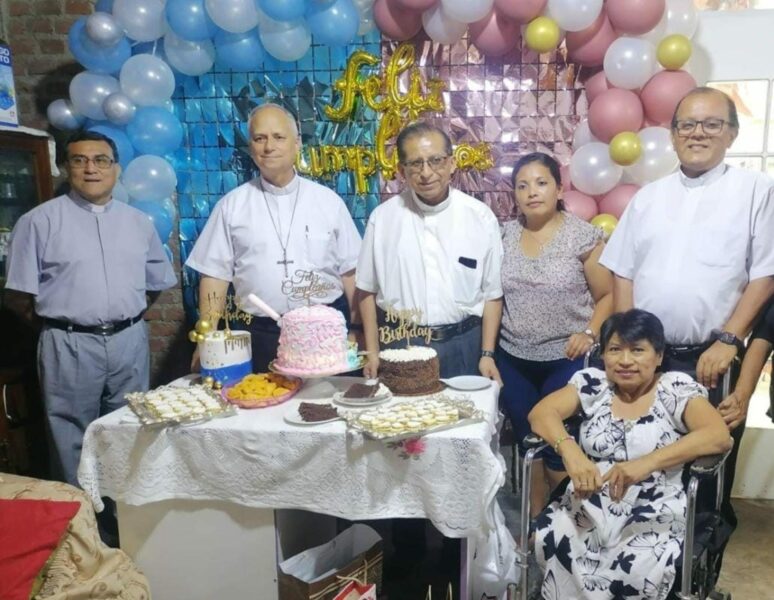
The priest Ricardo Yesquén Paiva, aged 59, one of the two clerics of the Diocese of Chiclayo accused of abusing minors in the case involving Robert Prevost, now Pope Leo XIV, since his time as bishop of that diocese, has died in Ferreñafe, Peru. Yesquén dies without any canonical or civil investigation having been opened against him in the six years since the first complaint was filed with Prevost himself in 2020.
The news of his death was reported this Tuesday by local media in Ferreñafe, the town where diocesan records listed him as parochial vicar of the parish of Santa Lucía. The Diocese of Chiclayo has not issued an official statement so far.
A complaint that was never investigated
According to case documentation accessed by InfoVaticana, the incidents attributed to Yesquén date back to 2006, when the priest, then 39 years old, allegedly imposed libidinous kisses on a 10-year-old girl at the parish house in La Victoria (Chiclayo), in episodes that reportedly repeated for at least a year. The complainant is Ana María Quispe, who years later made her story public after realizing that her complaints to the Church produced no effect.
In that same parish house, priest Eleuterio Vásquez Gonzales, known as “Padre Lute,” lived with Yesquén; he was accused by the same victims of extremely serious acts: the testimonies describe the transfer of 9- and 11-year-old girls, under the pretext of supposed missionary activities, to an isolated dwelling in the mountains of Ferreñafe, six hours from their homes, where the priest spent the night alone with them in a single bed and performed sexual rubbing. As former apostolic administrator Guillermo Cornejo publicly acknowledged, Vásquez admitted the facts.
The first notitia criminis regarding Yesquén reached then-bishop of Chiclayo Robert Prevost in March 2020, via a telephone call from the victim. Canon 1717 of the Code of Canon Law obliges the Ordinary to open an official preliminary investigation upon any plausible report of a crime. The response the complainant says she received was an instruction to pursue the civil route, which in Peru had already been time-barred for years. In the canonical forum, however, the offense had not prescribed: the period is twenty years counted from the victim’s majority, and the Dicastery for the Doctrine of the Faith may additionally dispense it. No investigation was opened.
In April 2022, the three complainants were received by Prevost at the bishop’s office. Regarding Yesquén, according to their testimony, the bishop told them that the priest was “depressed” and removed from his duties, so no action was warranted. Public records paint a different picture: in June 2020, five months after the first complaint, Yesquén carried the monstrance with the Blessed Sacrament in a public procession through Chiclayo; official diocesan publications listed him as parochial vicar of Santa Lucía de Ferreñafe at least until January 2023; and his presence at the 2023 Chrism Mass is documented, as a diocesan priest acknowledged in a recorded conversation.
No precautionary measure was ever imposed on Yesquén. Against Vásquez, Prevost’s April 2022 decree did impose measures, but its content, read in full by the case instructor before the victims and revealed by this outlet, was limited to two restrictions: removal from his office as pastor of Ciudad Eten and prohibition from hearing confessions. He was not suspended from public ministry, and it is graphically documented that he continued to celebrate Mass, even concelebrating with the bishop in the cathedral.
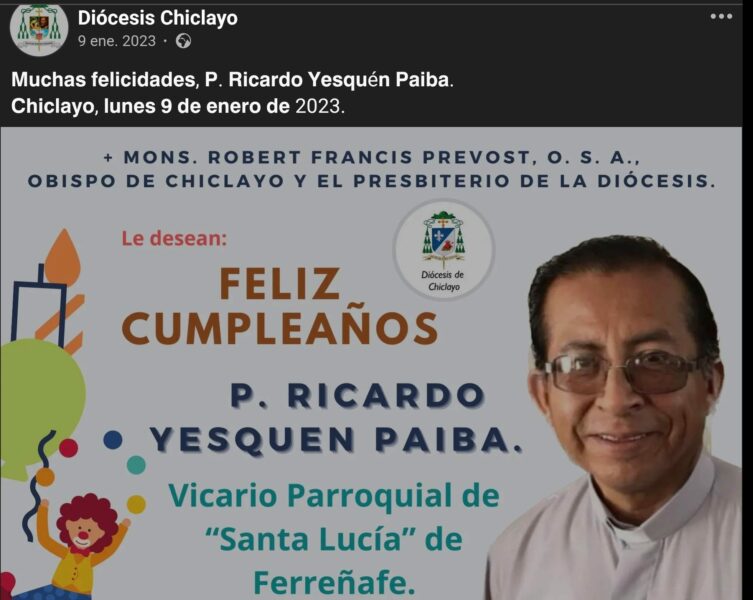
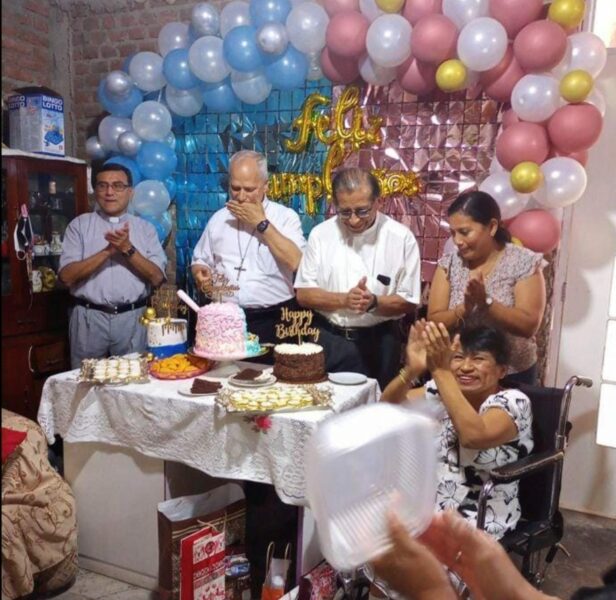
There are also photographs circulated on social media, dated January 12, 2023, showing then-bishop Prevost at a birthday celebration alongside Yesquén, dressed in clerical attire, and other diocesan priests: almost three years after the first complaint and nine months after the second.
An alleged incapacity never proven
When the case reached the Peruvian media at the end of 2023, the diocese explained that Yesquén was “in delicate health,” in a rest home, and that no charges would be brought against him. In September 2024, an official communiqué specified that the priest suffered from a “serious degenerative illness” that prevented him from defending himself, “so no case can be opened against him,” and added that “for years he has not exercised priestly ministry,” a claim that contrasts with the 2023 diocesan records cited above.
That incapacity was never proven to the victims through an independent medical expert report, as provided for in canons 1574 and 1577. In October 2025, the complainants formally requested the Dicastery for the Doctrine of the Faith to add Yesquén’s clinical documentation to the file: a 2020 medical report proving the alleged incapacity and an updated one determining his current condition. The request has received no response.
The victims do not accept the false closure of the case
Yesquén’s death extinguishes the possibility of proceedings against him personally, but it does not settle the case. The victims maintain that neither this outcome nor the handling of Vásquez’s file—closed in 2025 without trial or judgment on the merits through the dispensation from the clerical state requested by the priest himself and signed by Leo XIV, despite the complainants’ express request that the cause reach its conclusion—constitute closures in accordance with the law, and that the responsibility remains intact for the way both files were managed: the failure to fulfill the duty to investigate imposed on the Ordinary by canon 1717, the insufficiency of the precautionary measures, the repeated referral to a time-barred civil route, and the denial of access to documentation maintained since 2022. Current pontifical norms—from Vos estis lux mundi to Come una madre amorevole—contemplate the negligence of ecclesiastical authorities in handling abuse complaints as conduct that is itself sanctionable.
It is not only the complainants’ assessment. The case’s own delegate instructor, Giampiero Gambaro, described the preliminary investigation conducted under Prevost before the victims as “a mockery”, “very poorly done,” with “many errors” and “much superficiality.”
To date, the victims continue constant legal actions, both canonical and civil, to ensure the case proceeds and justice is done: requests for access to the file, petitions for investigative steps never taken, and submissions to various instances of the Holy See. The response, for months now, has been a sepulchral silence from the various institutions addressed.
The “conspiracy” thesis that does not hold
Since the case gained international relevance with the election of Leo XIV, it has been portrayed as the result of an operation by the Sodalitium of Christian Life or “ultraconservative” sectors against the Pope. This is the thesis contained in the authorized biography of the Pontiff signed by Elise Ann Allen and replicated by outlets such as El País or Religión Digital, which have preferred to focus on the supposed interests of those reporting the case rather than on the documented facts of the file.
That version does not withstand comparison with what has been proven: the 2020 and 2022 complaints predate any conclave context; the facts and omissions are documented in official records, diocesan communiqués, and recordings of the ecclesiastical officials themselves handling the case; and the negligence of the investigation has been acknowledged by the instructor appointed by the current diocese. The victims, who already presented their situation by letter to Pope Francis in October 2024, are not part of any conspiracy: through the Church’s own legal channels, they demand what they have been asking for since day one—truth, a real investigation, and access to their own file—and the case should advance along that path.
Last March, Vásquez reappeared publicly at a parish celebration in Chiclayo accompanied by priest Edward Tocto, the canonist who served as his defense counsel in the process, current associate judicial vicar of the diocese, and a person of known personal closeness to Robert Prevost since his years in Chiclayo.
With Yesquén’s death, neither of the two accused priests will ever have appeared before any tribunal, canonical or civil. The questions the victims keep open before the Holy See remain, all of them, pending response.