


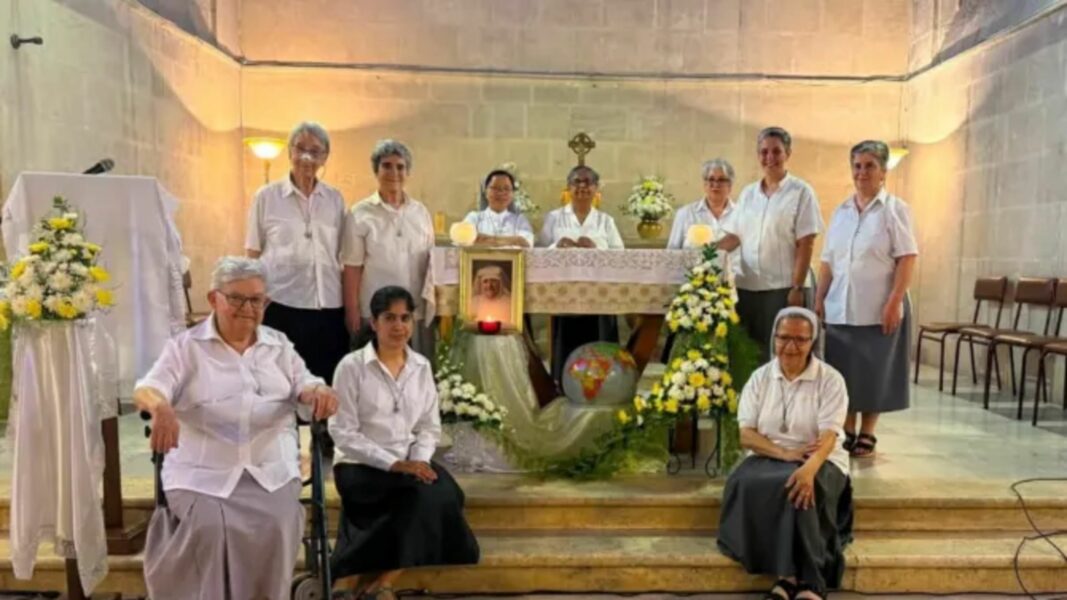
After more than a century of presence in Aleppo, the Franciscan Missionaries of Mary will end their mission in the Syrian city, closing one of the country’s most emblematic female religious works. The congregation will hand over its convent and the school in the Sabil neighborhood to the Salesians for an initial period of three years, ending a presence that began in 1914 and that profoundly marked the educational, healthcare, and pastoral life of Syria’s second most important city.
The decision, explained by the congregation as an internal reorganization motivated by the decline in vocations and the aging of its communities, has been received with concern by numerous Christians in Aleppo. Although the sisters insist that their departure is not due to political or security reasons, various members of the community believe it also symbolizes the progressive weakening of the Christian presence in a city deeply transformed by war and emigration.
A reorganization due to lack of vocations
Sister Pierrette Jabbour, regional councilor of the Franciscan Missionaries of Mary for the Middle East, explained to ACI MENA that the decision was adopted during the congregation’s regional chapter held in 2018 and is part of a reorganization process that also affects communities in Egypt and Lebanon.
According to her, the decrease in the number of sisters, the aging of the communities, and the scarcity of new vocations have forced a redistribution of the congregation’s presence. In addition, the institute’s constitutions establish that each community must have at least four sisters.
The apostolic vicar for Latin-rite Catholics in Syria, Bishop Hanna Jallouf, explained that the sisters have decided to strengthen their presence in Hasaka, in the northeast of the country, where they constitute the only stable Catholic female congregation providing service, as well as in Damascus.
On the contrary, Aleppo continues to have various male and female religious communities, so, in coordination with the Holy See, the Salesians will assume the continuity of the mission in the convent and in the school of the Sabil neighborhood for an initial period of three years.
Both Sister Pierrette Jabbour and Bishop Jallouf also rejected speculations linking the decision to the recent visit of French President Emmanuel Macron to Syria, insisting that it is exclusively an internal reorganization.
A presence that marked the history of Aleppo
The Franciscan Missionaries of Mary arrived in Aleppo in 1914 at the invitation of the city’s Maronite bishop. Although they had to leave the country during the First World War, they returned in 1919 to resume a work that would eventually become a reference for generations of Christians and Muslims.
They first opened a school in the Aziziyah neighborhood and later founded the Franciscan convent and school of Sabil, inaugurated in 1929. Over the decades, the educational center became one of the most prestigious schools in Aleppo.
Their mission went far beyond teaching. The sisters cared for orphans, assisted needy families and refugees, promoted female scouting, and developed numerous initiatives aimed at fostering coexistence between Christians and Muslims.
They also carried out a prominent healthcare and assistance work. For decades they administered Al Razi Hospital and directed the Sheibani orphanage, which took in numerous orphaned children after the massacres perpetrated during the final years of the Ottoman Empire.
After the nationalization of the school in 1967, the congregation continued its apostolate through catechesis, pastoral work with children and university students, welcoming ecclesial groups, and various vocational training programs in the Sheikh Maqsoud neighborhood.
The decline of the Christian presence
The sisters’ farewell has reopened the debate on the future of Christianity in Aleppo. For many faithful, the closure of a community with more than a century of history constitutes a new reflection of the profound demographic change experienced by the city in recent years.
Christian intellectual Fadi Hallisso, founder of the humanitarian organization Basmeh wa Zeitooneh and former member of the Society of Jesus, told ANSA that the departure of the sisters should serve to open “a serious debate on the future of the Christian presence in Syria.”
“The Christian community of Aleppo is dying,” he warned, while expressing concern that other religious communities may be forced to leave the city in the coming years.
The figures reflect the magnitude of the exodus. Before the start of the civil war in 2011, Aleppo had around 250,000 Christians. Today, between 20,000 and 25,000 remain, mostly elderly people.
The reduction affects the entire country. According to a report by the foundation Aid to the Church in Need (ACN), Syria’s Christian population has gone from more than two million people before the conflict to around 300,000 today.
In this context, various members of the Christian community express concern about the future of the country and believe that the persistence of political uncertainty, the economic crisis, and the consequences of more than a decade of war continue to drive the emigration of numerous families.
Despite the closure of the Aleppo community, the Franciscan Missionaries of Mary have reiterated that they are not abandoning Syria and will continue their work in Damascus and Hasaka. However, for many Christians in Aleppo, the end of this centenary presence represents much more than the transfer of a religious community: it symbolizes the loss of an institution that accompanied the life of the city for more than a century and the progressive retreat of one of the historic Christian communities of the Near East.