


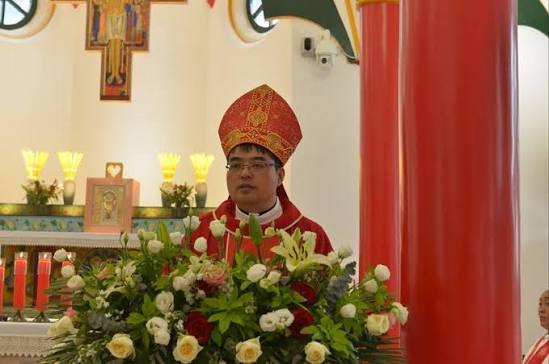
The Holy See has announced the episcopal ordination of Msgr. Giuseppe Chang Yanfeng as the new bishop of Chifeng, a diocese located in the Inner Mongolia Autonomous Region, in northeastern China. According to the Vatican, Leo XIV approved his appointment on June 15 within the framework of the Provisional Agreement between the Holy See and the People’s Republic of China.
However, the appointment was not publicly announced in the press bulletin of the Press Office dated June 15; it was only made public on the very day of the episcopal ordination, an unusual circumstance in episcopal appointments that once again highlights the singular manner in which these designations are handled under the Sino-Vatican agreement.
Beijing omits all reference to the Pope
In its communiqué, the Holy See specified that Chang was appointed bishop “after his candidacy was approved within the framework of the Provisional Agreement between the Holy See and the People’s Republic of China.”
By contrast, the information released by the Chinese Catholic Patriotic Association, a state-controlled body, makes no reference to papal approval. The official Chinese statement indicates only that Chang received approval from the state authorities and that he had been elected by the official Church bodies in China on March 20.
The ordination ceremony was presided over by several bishops belonging to the ecclesial structures recognized by the Chinese government, including Meng Qinglu, vice-president of the Chinese Catholic Patriotic Association, along with Pei Junmin and Yao Shun.
Formation in South Korea and pastoral career
According to the curriculum vitae released by the Holy See, Giuseppe Chang Yanfeng was born on April 4, 1984, in Beizhen, in China’s Liaoning province. Between 2000 and 2006 he studied at the Shenyang Theological Seminary and later completed a pastoral internship at the parish of Lindong.
From 2007 to 2010 he studied at the Catholic University of Daejeon in South Korea, where he earned a licentiate in Biblical Theology. He was ordained a priest on November 18, 2010, for the diocese of Chifeng.
Since then he has held various ministries in the diocese: he worked in the diocesan curia and in several parishes between 2010 and 2013; he served as pastor of Chifeng Cathedral from 2013 to 2019; he later served as pastor of Lindong until 2021 and, from October 15 of that year, he was diocesan administrator.
While the Holy See highlighted only his ecclesial career, the Chinese authorities also noted that Chang is director of the Catholic Patriotic Association of the city of Chifeng, a detail that does not appear in the biographical note published by the Vatican.
An agreement still shrouded in secrecy
This is one of the first bishops appointed by Leo XIV under the provisional agreement signed between the Holy See and China. The pact, concluded in 2018 and renewed in 2024 for a new four-year period, remains confidential, as its text has never been made public.
Although the Vatican maintains that the agreement fosters dialogue with Beijing and allows the Pope to approve candidates for the episcopate, various experts, members of the underground Chinese Church, and Western political leaders question its effectiveness and believe that Chinese authorities continue to exert decisive influence in the selection of bishops.
The agreement has been repeatedly defended by the Holy See as an instrument to keep dialogue with the Chinese government open. However, since its signing it has drawn criticism from Catholics of the underground Church, experts on religious freedom, and Western leaders, who argue that it has not halted the persecution of the faithful who remain in communion with Rome nor the “sinicization” policies promoted by the Xi Jinping regime.