


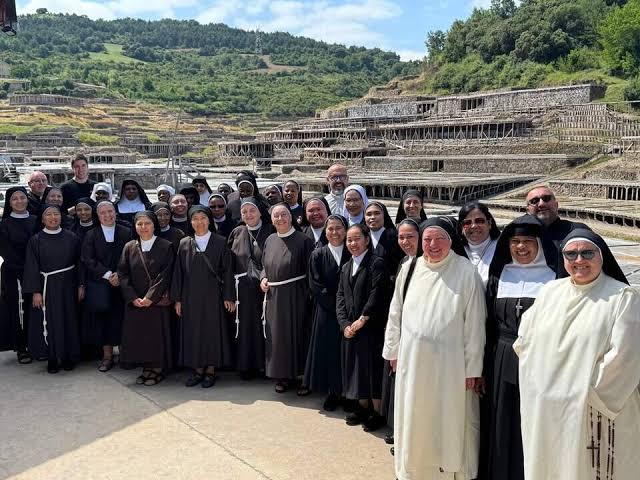
The community of the Poor Clares of Agurain (Salvatierra, Álava) has elected sor Mertxe Iradi as the new mother abbess of the monastery of Santa Clara. The election took place on July 14 during the conventual chapter held after the Eucharist and the prayers prescribed by the tradition of the Order, with the participation of the nineteen religious sisters who currently make up the community.
Sor Mertxe succeeds sor María Inés Fernández de Quincoces, who has served as abbess during the last triennium and will continue to be part of the monastery’s government as vicar. The Diocese of Vitoria has publicly thanked the outgoing superior for her work and has expressed its closeness to the new abbess at the beginning of this new stage.
A contemplative community with a missionary outreach
Born in Alsasua (Navarra), sor Mertxe entered the monastery in June 1987 and has since developed her entire religious life in this community.
A few days after her election, she took part in the 78th Spanish Week of Missiology, held in Burgos, where she presented the experience of founding a Franciscan community in Ecuador, a project promoted three decades ago from the monastery of Agurain. During her presentation, she reviewed the origin and evolution of this project, one of the community’s main missionary fruits, which allowed the charism of the Poor Clares to extend beyond Spain.
In addition to the life of prayer and the work proper to the enclosure—among which the artisanal production of sweets and other monastic products stands out—the sisters maintain vocational pastoral initiatives. From August 8 to 11, they will organize gatherings for women of legal age interested in learning about contemplative life, sharing for several days the prayer, work, silence, and fraternal life of the monastery.
A history dating back to 1446
The monastery of Santa Clara traces its roots to 1446, when Doña Juana García de Lequedana left in her will her house and the church of San Pedro to be used for a community of consecrated women. From that provision, a beaterio was born which, in 1552, was incorporated into the Third Order of Saint Francis following the Rule of Saint Elizabeth.
The community suffered the fire that devastated the town of Salvatierra in 1564, rebuilt the convent with its own resources, and went through a long period of economic difficulties at the end of the 16th century. In 1611, when only four beatas remained, the Franciscan provincial promoted the foundation of the present monastery of Poor Clares with the arrival of religious sisters from the convent of Santa Clara in Vitoria, and the community was constituted under the Rule of Saint Clare on June 29 of that year.
Throughout the 18th and 19th centuries, wars forced the sisters on several occasions to temporarily abandon the convent and take refuge in other nearby communities. Despite this, the monastery has maintained an uninterrupted presence in Agurain since its origins and continues to be one of the oldest contemplative communities in the Basque Country.
A new triennium at the head of the monastery
With the election of sor Mertxe Iradi, the community begins a new triennium of governance in a monastery that combines contemplative life with missionary and vocational initiatives. Almost six centuries after its origins and more than four hundred years after its incorporation into the Order of Saint Clare, the monastery of Agurain continues to develop its religious life in the same location where its history began.