


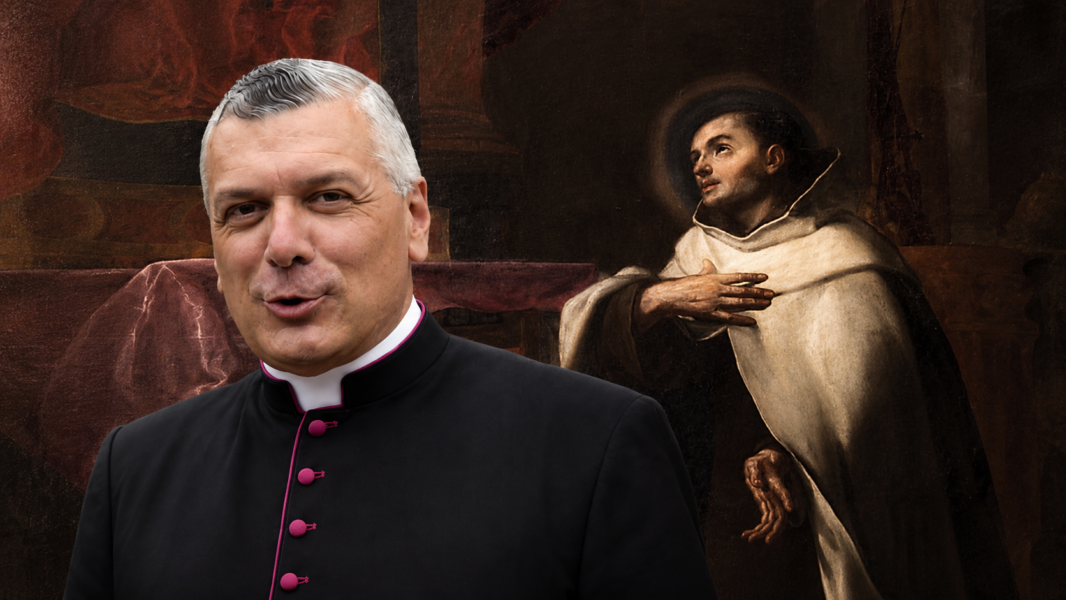
Monsignor Alberto José González Chaves considers that the spirituality of Saint John of the Cross remains fully relevant for the twenty-first-century Christian and offers answers to some of the main challenges of contemporary spiritual life. In the second part of an interview with María Rabell García published by El Debate, the priest delves into issues such as the universal call to holiness, the centrality of Jesus Christ in contrast to the pursuit of extraordinary experiences, and the true meaning of Christian detachment.
After warning in the first installment of the risk of an excessively man-centered pastoral approach, González Chaves maintains that the teaching of the Mystical Doctor is not reserved for religious or specialists in spirituality, but constitutes a path for any baptized person who aspires to live faithfully their vocation amid the ordinary circumstances of life.
Holiness is built in everyday life
One of the main misconceptions about Saint John of the Cross, the priest affirms, is to think that his teaching belongs only to monasteries or to people called to extraordinary mystical experiences. In his view, the Carmelite saint actually describes “the normal path of growth for every Christian life.”
“An injustice is done to Friar John by turning him into an author for specialists,” states González Chaves, who recalls that all his teaching leads to learning “to love God in any state of life.”
In this context, he cites a well-known letter from the saint in which he summarizes service to God as “to walk in His things as best we can,” an expression he interprets as a call to discover holiness in daily fidelity. “God does not ask us to do extraordinary things, but to do ordinary things extraordinarily well,” he notes.
According to his explanation, union with God does not require abandoning family, professional, or social responsibilities. On the contrary, “authentic contemplation does not distance us from our responsibilities, but enables us to live them with greater freedom, serenity, and self-giving.” From this perspective, the mysticism of Saint John of the Cross does not consist in fleeing the world, but in living it “with a free heart.”
“In Christ God has already said everything to us”
Another aspect addressed in the interview is the tendency of some faithful to constantly seek private revelations, extraordinary phenomena, or new spiritual experiences.
For González Chaves, Saint John of the Cross would respond to this attitude by recalling that the fullness of Revelation has already been given in Jesus Christ. Citing the Ascent of Mount Carmel, he recalls the saint’s words: “In giving us, as He gave us His Son, who is His Word, He spoke everything to us together and at once in this single Word.”
From this text, he maintains that whoever lives continually seeking spiritual novelties “has not yet discovered all the richness contained in Christ.” Although the Church recognizes the possibility of extraordinary graces, he insists that these cannot become the foundation of the spiritual life.
In this sense, he emphasizes that the ordinary path of the Christian remains “dark and true faith,” a faith that does not depend on visions or emotions, but on trust in the Word of God.
“The great problem is not that God has stopped speaking; it is that we have lost the ability to listen,” he affirms, recalling another expression of Saint John of the Cross: “One Word the Father spoke, which was His Son, and this Word speaks always in eternal silence; and in silence must it be heard by the soul.”
Detachment as freedom to love
In the final part of the interview, González Chaves addresses one of the most characteristic concepts of the spirituality of Saint John of the Cross: detachment.
Far from interpreting it as a rejection of the world or of human affections, he explains that Saint John of the Cross proposes ordering love so that no created reality occupies the place that belongs solely to God.
“The saint does not teach us to love creatures less, but to love them better,” he affirms. He also recalls that the author of the Spiritual Canticle viewed creation as a reflection of the Creator’s beauty, which is why his poetry is filled with references to mountains, forests, rivers, gardens, and dawns.
For this reason, he interprets the well-known motto of Saint John of the Cross—“forgetfulness of the creature, remembrance of the Creator”—not as an invitation to despise the world, but to avoid turning temporal realities into absolutes.
In his judgment, detachment does not impoverish love but purifies it. “The opposite of love is not detachment, but idolatry,” he states, because only those who do not need to possess people or things can give themselves with true freedom.
From this perspective, he concludes that the spiritual proposal of Saint John of the Cross retains special relevance for contemporary man. “Whoever places God above all discovers that, far from losing the world, he receives it anew, transfigured by the light of the Creator,” he maintains, thus summarizing a doctrine he considers fully valid for Christian life today.