


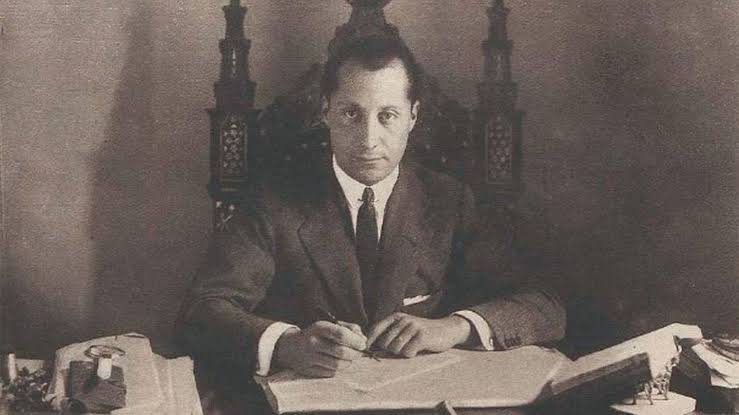
Eighty-nine years after his execution by firing squad, anyone approaching the figure of Primo de Rivera still finds it difficult to discover his religious dimension. The document he signed hours before dying leaves no room for ambiguity.
There are historical figures whose thought is cited often and read little. José Antonio Primo de Rivera is one of them. His prose—whose brilliance even his most honest adversaries acknowledge—has been reduced to slogans, and his faith, when not ignored, is dismissed as a rhetorical ornament of his time. It is therefore worth returning to the documents. Among them, one admits no tendentious reading: the will he wrote in his own hand in Alicante’s provincial prison on 18 November 1936, sentenced to death, at five in the afternoon.
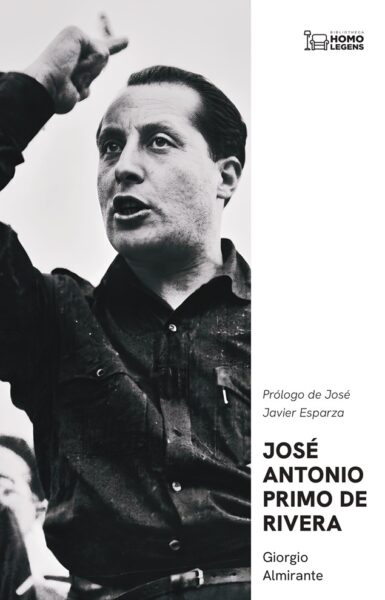
The recent biography that Homo Legens has recovered—the one Giorgio Almirante wrote about the founder of Falange, with a foreword by José Javier Esparza—has the merit of reproducing that will in full. Its reading leads to an uncomfortable conclusion for the narrative that presents José Antonio as merely political, a national thinker for whom religion was peripheral. The man who writes in the face of death leaves no room for that interpretation.
A document that does not seek the gallery
The first thing that surprises about the will is what it does not do. José Antonio, who knew how much weight each of his words would carry, expressly renounces the heroic gesture. He defended himself before the tribunal, he writes, “with the best resources of my lawyer’s craft,” and not in order “to win, with tinsel gallantry, the posthumous reputation of a hero.” Whoever expected from him the pose of the romantic martyr is mistaken about the man. Precisely for that reason his faith cannot be read as imposture: he is not performing for anyone.
Against that background of sobriety, the references to God are not ornamental but structural. The text opens by commending himself:
“Condemned to death yesterday, I ask God that, if He does not yet exempt me from reaching that pass, He may preserve in me to the end the decorous conformity with which I foresee it, and that, in judging my soul, He may not apply the measure of my merits but that of His infinite mercy.”
This is not the phrase of a cultural deist. It is that of a Catholic who believes in particular judgment, in merit and in mercy, and who knows himself a sinner: he asks that his death be accepted “insofar as it is a sacrifice to compensate in part for what has been selfish and vain in much of my life.” It is the exact grammar of Christian reconciliation at the end.
Forgiveness without exception
The will does not limit itself to hoping for God’s forgiveness: it practices it as we pray in the Our Father. On the same page on which he orders his death, José Antonio pauses to settle accounts with men. He asks no clemency for himself nor curses those who have condemned him. He forgives:
“I forgive with all my soul all those who may have harmed or offended me, without any exception, and I beg that all those to whom I owe reparation for some grievance, great or small, may forgive me.”
The formula “without any exception” is not a pious turn of phrase. It is written by a man imprisoned by his adversaries, tried by a Popular Tribunal, hours from being shot. The forgiveness therefore extends to his own executioners. It is accompanied by the inverse request—that they forgive him—which reveals a conscience that does not consider itself innocent or superior to anyone. Almirante also records the extreme gesture at the scaffold, when José Antonio addresses those about to kill him: “I do not hate you. Why do you hate me, why do you kill me?” It is not the bravado of the hero, but the literal echo of the Gospel’s forgiveness spoken before those carrying out the sentence.
The clause that says it all
If any doubt remained, it is dispelled by the first of the dispositive clauses, the one that opens his last legal will:
“I wish to be buried according to the rite of the Catholic, Apostolic, Roman Religion which I profess, in blessed ground and under the protection of the Holy Cross.”
The verb is decisive: I profess, in the present tense. Not “the religion in which I was educated” nor “that of my parents,” but the one he holds as his own at the moment of greatest truth a man can know. And there is a detail almost never cited that is even more revealing, because it is not a declaration of principles but an act: among the instructions to his executors, José Antonio orders the destruction of “any books prohibited by the Church or of pernicious reading that might be found among mine.” He subjected his own library to the judgment of the Church. It is difficult to imagine a more eloquent gesture of doctrinal obedience—and less suspect of posturing—than that of a man condemned to death concerned that nothing contrary to the faith should survive among his papers.
The letters: rosary and confession
The will is not an isolated rapture of piety. The letters of those last two days, which Almirante collects, confirm it. To his nun aunt he writes with almost luminous serenity: “I am prepared to die well, if God wills that I die, and to live better than until now, if God disposes that I live.” And to “tía Ma” he confides, with the naturalness of one describing a habit, not an exception:
“I have confessed and am very calm… Besides, since they put us in this ferocious process, I have been preparing myself, in case this moment should come. Every day I have prayed and recited the rosary.”
Sacramental confession, daily prayer, recitation of the rosary: the ordinary practice of a Catholic, sustained in prison without an audience to applaud it. On the night of the will he is also visited by an elderly priest who is also a prisoner, Father Planelles, who days later would be murdered in the same prison. José Antonio dies, in short, as one who has ordered his soul before his goods.
“Would that mine were the last blood”
From forgiveness springs the highest part of the document, and what most clearly separates it from his contemporaries. José Antonio does not close his will by asking for vengeance or promising retribution for his own. He asks the opposite: that the war end, beginning with him.
“Would that mine were the last Spanish blood shed in civil discord. Would that the Spanish people, so rich in deeply good qualities, might already find in peace the homeland, bread and justice.”
It is worth measuring the moral distance of this phrase from the climate that surrounded it. In a Spain hurtling toward indiscriminate slaughter, where the adversary’s blood was counted as victory and more was demanded, the condemned man of Alicante offers his own with the express hope that it may be the last. He does not ask that more blood be shed in his name: he asks that none be shed. Against those who made hatred a program and another’s blood a merit, José Antonio leaves written the desire for a people reconciled in “the homeland, bread and justice.” It is the same logic he had already expressed in life when he called for his movement to wage “a battle not of vengeance but of vindication,” and when he proclaimed as a motto that “what matters is to be sure that one obeys a law of love.” One may disagree with his politics; one cannot, without failing the truth, place those words on the side of rancor.
Against two manipulations
Once his personal faith is acknowledged, honesty with history also requires pointing out its limits, because José Antonio’s religiosity has been exploited in two opposite directions. The first denies it: it presents a lay politician whose faith would be anecdotal. The documents refute it without effort. The second, more subtle, over-exploits it: it turns his Catholicism into a cover for a political project, as if his creed were enough to baptize his entire doctrine without nuance.
José Antonio himself put a brake on that second temptation. He refused to make Falange “a confessional movement linked to the hierarchy,” distinguishing the order of politics from that of the Church. His famous statement that “there are only two serious ways of living: the religious way and the military way” belongs to an aesthetic of heroic existence as much as to a theology, and deserves to be read with that double light. Caution is due: one thing is to note that José Antonio was Catholic—he was, and deeply so—and quite another to annex his faith to an earthly cause. The first affirmation is sustained by the will; the second exceeds what a document can prove, and the prudent reader will do well not to confuse them.
Why it matters today
Restoring José Antonio’s religious dimension is not an exercise in partisan piety but of intellectual honesty. A thinker is betrayed equally when what he was is amputated from him as when what he did not say is attributed to him. The Alicante will is not a pamphlet: it is the last will of a thirty-three-year-old man who forgives his enemies, entrusts himself to God’s mercy, and asks to be buried under the Holy Cross. Reading it in full—which this biography finally allows the Spanish reader to do—is the best vaccine against manipulations. Documents, when read without haste, have that uncomfortable habit of saying what they say.

Giorgio Almirante, José Antonio Primo de Rivera, with forewords by José Javier Esparza and Blas Piñar, is available from Bibliotheca Homo Legens.