


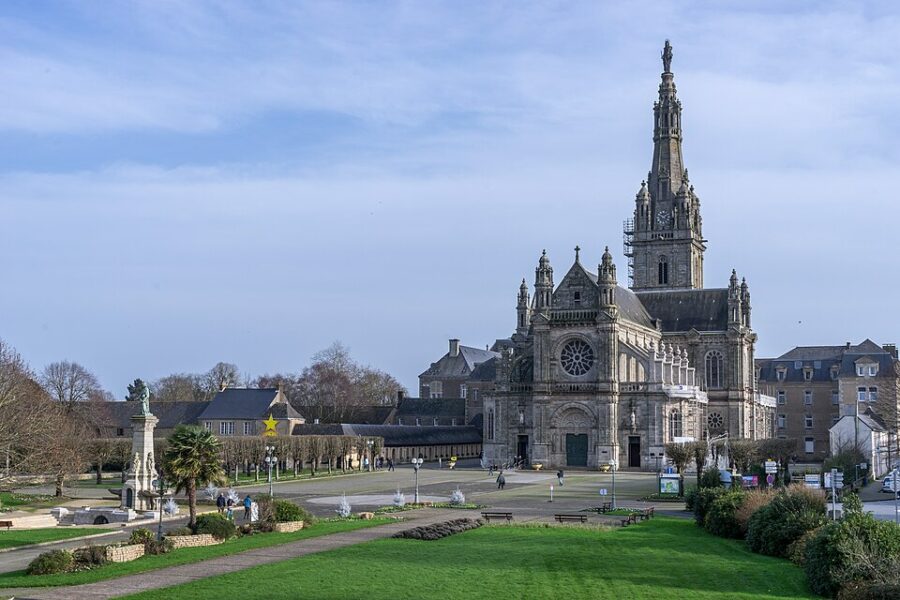
Thousands of pilgrims will gather on July 25 and 26 at the shrine of Sainte-Anne-d’Auray in Brittany (France) to take part in the Great Pardon of Saint Anne, the main pilgrimage dedicated to the mother of the Virgin Mary and one of the most important expressions of popular religiosity in the country. The celebration will take place just two weeks after the French Parliament approved the law legalizing euthanasia and assisted suicide, a context that will inevitably mark this edition of the pilgrimage.
The Great Pardon will be presided over this year by Bishop Matthieu Dupont of Laval and will bring together thousands of faithful, priests, religious, and families over two days for a program of liturgical celebrations, processions, confessions, eucharistic adoration, and acts of popular piety.
Four centuries of devotion to Saint Anne
The shrine of Sainte-Anne-d’Auray is the main pilgrimage center dedicated to Saint Anne in the world. Its origins date back to the apparitions that, according to tradition, the mother of the Virgin Mary made to the peasant Yvon Nicolazic between 1623 and 1625 in the Breton village of Keranna, now Sainte-Anne-d’Auray.
During the apparitions, Saint Anne asked to be honored in that place, where an ancient image of hers that had remained hidden for centuries was later discovered. Since then, the shrine has become the main spiritual center of Brittany and has continuously welcomed generations of pilgrims. Saint John Paul II visited it in September 1996, and last year the Diocese of Vannes commemorated the fourth centenary of the apparitions.
A broad liturgical program
The celebrations will begin on Saturday, July 25, with the opportunity to receive the sacrament of reconciliation, followed by the procession through the streets of the shrine, the recitation of First Vespers, the celebration of the Eucharist, and a torchlight vigil dedicated to the account of the apparitions, which will conclude with a night of eucharistic adoration.
On Sunday, July 26, the feast of Saint Anne and Saint Joachim, the program will include the recitation of Lauds, a Mass in the Breton language, the traditional grand procession, and the pontifical Mass presided over by Bishop Dupont. The day will conclude with solemn Vespers, the blessing with the Blessed Sacrament, a fest-deiz, a traditional expression of Breton culture, and a final eucharistic celebration.
The memory of Cardinal Sarah’s homily
This year’s edition comes just days after the final approval of the French law on euthanasia and assisted suicide, a circumstance that has led to recalling the homily delivered at the Great Pardon of 2025 by Cardinal Robert Sarah.
During the celebration, the Guinean cardinal urged French Catholics to remain steadfast in the defense of life and warned of the consequences of legislation contrary to human dignity. Among his words, he stated: “Do not profane France with your barbaric and inhuman laws,” an intervention that takes on special relevance following the approval of the new law on July 13.