


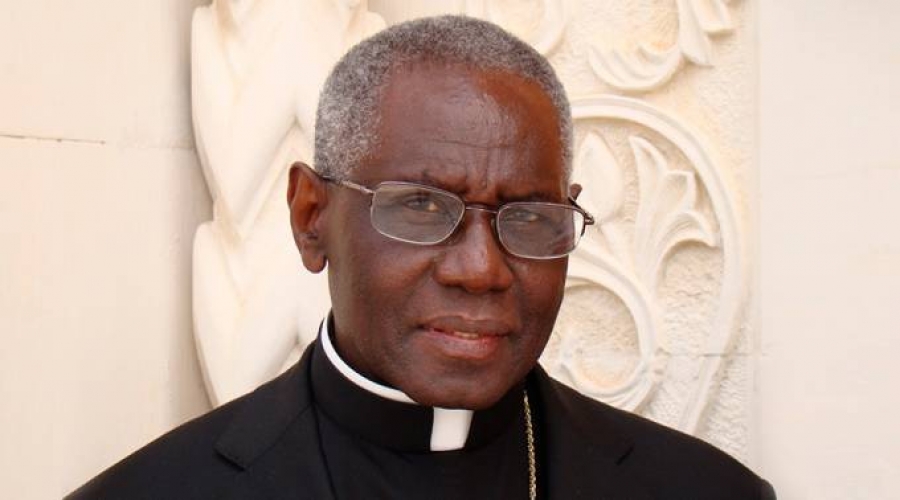
Cardinal Robert Sarah has called for the openness shown by Leo XIV toward priests and communities linked to the Traditional Mass not to be limited to France, but to extend to all bishops of the Roman rite. In an interview given to journalist Diane Montagna, the prefect emeritus of the Congregation for Divine Worship maintains that the letter sent by the Pope to the French bishops should become a pastoral criterion for the entire Church.
“What was written to the French bishops must be applied to all bishops,” Sarah states, who believes there is no reason to maintain an attitude of hostility toward a liturgy celebrated for centuries, sanctified by generations of the faithful, and linked to the lives of numerous saints. The interview, conducted on June 29, at the conclusion of the second extraordinary consistory of Leo XIV’s pontificate, also addresses synodality, the report of Study Group number 9 on homosexuality, the liturgical crisis, the presence of Pachamama in the Vatican, and the future of the Church.
“What was written to the French bishops must be applied to all”
Sarah positively values that Leo XIV has encouraged the French bishops to show greater openness toward the vetus ordo. In his view, the Traditional Mass cannot be treated as something foreign or harmful to the Church.
“It is a Mass we have celebrated for centuries,” the cardinal recalls, before citing the principle defended by Benedict XVI according to which what was sacred for previous generations continues to be so today.
The prelate maintains that it is not possible to “erase” a liturgy that has nourished the faith of the Church for centuries and has borne fruits of holiness. “This Mass has been celebrated by the saints; it has produced so many saints. Why would it not be possible today?” he asks.
Sarah therefore calls on the bishops for a “more paternal” and open attitude. He recalls that in the Latin Church different rites coexist, such as the Mozarabic or the Ambrosian, and questions the attempt to prevent a liturgical form that is part of the Roman tradition.
“I do not know what authority we have to prevent a liturgy that has been celebrated for centuries,” he states. For the cardinal, the application of Leo XIV’s letter should not be limited to the French episcopate: “What was written to the French bishops must be applied to all bishops: to be more open, so as not to create divisions without reason.”
He also points out that many young people are drawn to this liturgy because they find in it “something positive,” especially silence, recollection, and a sense of the sacred. “Why create division over the liturgy? That does not please the Lord,” he adds.
Sarah hopes that Traditionis Custodes will gradually disappear
Asked about the restrictions imposed by Traditionis Custodes, Sarah avoids framing the issue solely as a confrontation between pontificates. He recalls that Benedict XVI expanded the celebration of the traditional liturgy through Summorum Pontificum, that Francis subsequently introduced restrictions, and that Leo XIV is now encouraging greater openness.
In light of this scenario, he believes that bishops should follow the current Pontiff’s guidance and cease opposing “something holy, something beautiful, something that fosters recollection.”
Sarah expresses his desire that Traditionis Custodes be overcome, but does not consider it essential for Leo XIV to issue a formal document of abrogation. In his view, the Pope can promote a pastoral openness that causes the restrictions to gradually lose their application.
“Perhaps, even if there is no document repealing Traditionis Custodes, it could disappear little by little, day by day, year by year,” he explains.
The cardinal also expresses reservations about the practice of one Pope nullifying what was established by another. “I am not really in favor of one Pope saying one thing and another canceling it: the Church is continuity,” he states.
For Sarah, there is no reason to cancel a previous provision unless doctrinal or moral issues are at stake. His proposal is that Leo XIV allow things to continue and that, in practice, the restrictive text eventually disappear: “Let us leave it and say: ‘continue,’ and this text will disappear little by little.”
The liturgy, an urgent matter for the Church
The defense of the Traditional Mass is part of Sarah’s broader concern for the state of the liturgy. The cardinal regrets that this issue was not addressed at the recent consistory, despite having been previously considered among possible topics for discussion.
In his opinion, the liturgy should occupy a central place in the upcoming meetings of the College of Cardinals because it expresses man’s relationship with God and conditions the life of faith in the Church.
“If we do not live the liturgy well, we cannot have a solid faith,” he maintains, recalling the principle lex orandi, lex credendi. For Sarah, the Church’s priority cannot be reduced to the world’s social or political problems, but must include the examination of its mission, evangelization, the priesthood, the sacraments, and the transmission of the faith.
The cardinal insists that the liturgy must lead man to kneel before God, to adore Him, to listen to Him, and to submit to His will. When that relationship weakens, he explains, human relationships also deteriorate.
For this reason, he warns against a liturgy turned into “play” or “entertainment.” “A sacred liturgy, not a game, not a spectacle,” he affirms in defending that divine worship must keep God at the center.
“I have never understood” the synodal Church
The interview also addresses the synodal process and its implementation phase. Sarah acknowledges that he has never understood the change in language that leads to speaking of a “synodal Church.”
In his view, tradition has defined the Church as the Mystical Body of Christ, Mother, Teacher, and Spouse—expressions that reflect her true nature. “I do not understand why we must give her another name,” he states.
The prelate maintains that the term “synodality” does not appear with that meaning in the Church’s tradition or in the documents of the Second Vatican Council. He recalls that historically reference was made to the Synod of Bishops and warns against transforming the synod into a general assembly in which doctrine or morality could be put to a vote.
“Doctrine is not something that is voted on,” he affirms. “A moral teaching cannot be voted on; it is a teaching received from God.”
Sarah considers synodality an abstract term lacking a sufficiently clear definition. He adds that it is difficult to translate into numerous African languages and asks what a “Church that walks” really means, when the Church’s own identity is to be sent and missionary.
In additional statements to the interview, he called for a precise definition of its meaning, competencies, limits, and mission, without altering the doctrine, morality, nature, or structure of the Church.
Calls on Leo XIV to examine the report on homosexuality
Sarah also refers to the report prepared by Study Group number 9, linked to the implementation of the Synod on Synodality and issues related to homosexuality.
The cardinal believes that Leo XIV should personally study the document before allowing its dissemination in the dioceses. In his view, any proposal must remain faithful to Revelation, to the Catechism of the Catholic Church, and to natural law.
He also warns against the possibility that a specifically Western perspective might be imposed on the universal Church. Sarah compares that risk to the tensions caused by Fiducia Supplicans and asks that a similar situation not be repeated.
“The Holy Father should really examine this document before allowing it to be published for the whole world,” he states. Sarah maintains that the text should be reviewed by competent persons, faithful to doctrine and aware of the Church’s cultural diversity.
The prelate expresses confidence in Leo XIV’s prudence and believes that he will not allow the dissemination of a document that has not been previously examined and carefully approved.
Pachamama and “the paganism that enters the Church”
In the final part of the interview, Sarah presents some of the concerns developed in his new book, 2050, published in French. The work analyzes the crisis of faith, the priesthood, the liturgy, the family, and the Church’s capacity to continue being a light for the world in twenty-five years.
Speaking about inculturation, the cardinal warns that no culture can encompass or dominate the mystery of the Eucharist. It is not the Gospel that must submit to cultures, he maintains, but rather cultures that must be purified by Christ.
In that context, he denounces the entry of pagan elements into the life of the Church and recalls the presence of Pachamama during the 2019 Synod for the Amazon.
Sarah states that he then wondered why an image of the Virgin venerated in Latin America, such as Our Lady of Guadalupe, had not been chosen to preside over the synod. Instead, he maintains, “they brought an Inca idol” that entered St. Peter’s Basilica and was carried in procession to the Paul VI Hall.
“Pachamama remained there throughout the synod,” he recalls. The cardinal compares this scene to the experience of missionaries in Africa, who asked new Christians to abandon and destroy the idols associated with their former beliefs.
“And now we bring Pachamama into the basilica,” he laments. For Sarah, these events reflect the risk that paganism may penetrate the Church under the guise of cultural adaptation.
“The Church belongs to Christ; it is not ours”
Despite the gravity of his diagnosis, Sarah rejects a hopeless vision of the future. The Church, he affirms, will continue to be a light in 2050 because it does not belong to men, nor to the bishops, nor even to the Pope, but to Christ.
The cardinal criticizes the tendency to imagine a Church fashioned according to the categories of each era: a “synodal Church,” a “Church for the poor,” or any other formula that seeks to redefine her identity.
“The Church is not mine,” he states. “No Pope can say: ‘I want a Church like this,’ because the Pope is only the rock on which Christ builds His Church. The Church belongs to Christ; it is not ours.”
Sarah assures that the Church will continue to be the light of Jesus Christ, but adds that this requires the conversion of men to Christ, and not the adaptation of Christ to contemporary ideas.
“We must convert to Christ; it is not Christ who must convert to us, to our ideas, to our paradigm shift,” he affirms.
The cardinal concludes with an affirmation of confidence: “Christ will not abandon His Church. He will remain with her until the end of the world.”