


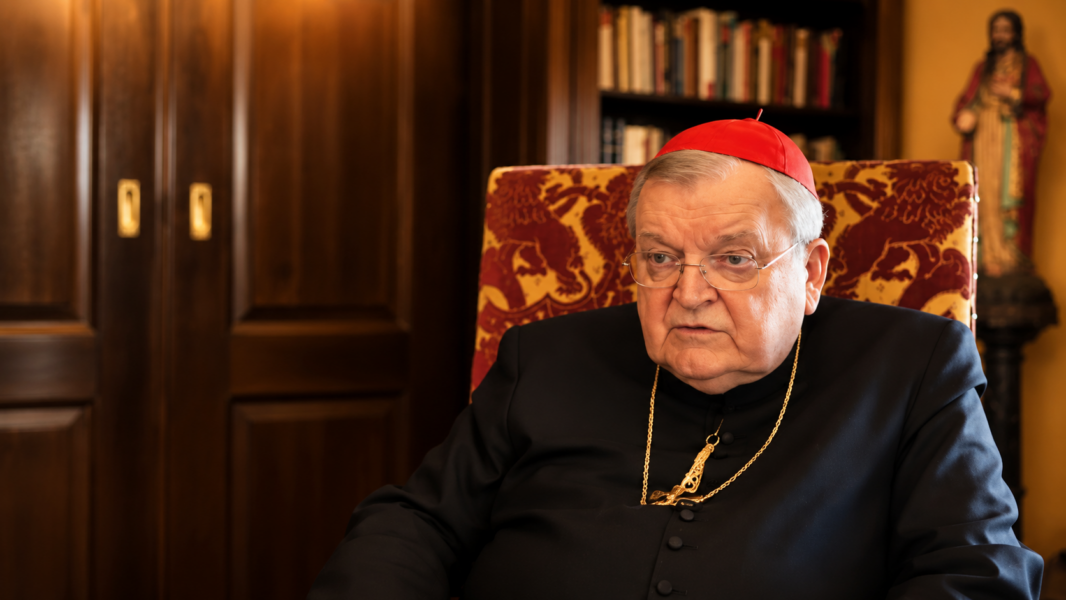
Cardinal Raymond Leo Burke has called for the current synodality process to be halted and subjected to an in-depth theological and historical study, and has proposed the creation of a dicastery of the Holy See dedicated to the faithful attached to the traditional liturgy. In an interview granted to The College of Cardinals Report, the American prelate expands on the reflections he had already expressed after the consistory at the end of June and also addresses issues such as the report of Synod Study Group 9 and the future of Traditionis Custodes.
For Burke, synodality, as it is currently developing, lacks a clear definition and a solid foundation in the Church’s tradition. “We have to insist that this whole matter of synodality be stopped and that a very serious study be carried out, because we are talking about the very life of the Church and the salvation of souls,” he states.
Criticism of the Study Group 9 Report
One of the central aspects of the interview is his assessment of the report prepared by Synod Study Group 9 on Synodality, a document that will be sent again to the dioceses during the implementation phase of the synodal process.
Burke considers that this report contains positions incompatible with Catholic doctrine on sexual morality and especially criticized the references made to the Courage apostolate, dedicated to accompanying persons with same-sex attraction who wish to live chastity in accordance with the Church’s teaching.
According to the cardinal, the statements contained in the document about this apostolate were not properly verified before publication. “How is it possible that the Church publishes a report for the whole Church without checking whether what is said about Courage was true?” he asked.
In his view, this kind of approach encourages some bishops to give the impression that the Church would be changing its doctrine on homosexuality. Burke also described as “completely irresponsible” the attribution to Pope Leo XIV of an alleged intention to change the Church’s moral teaching simply because he has not publicly addressed certain issues.
The prelate was especially critical of the decision to send the Study Group 9 report back to the dioceses during the implementation phase of the Synod. “That is iniquitous; it should not happen,” he stated.
A Review of Traditionis Custodes
Burke also returned to an issue he considers a priority: the situation of the faithful attached to the traditional liturgy.
The cardinal reiterated his criticisms of the restrictions introduced by Traditionis Custodes, which he again described as “persecution” of those who find spiritual nourishment in the older form of the Roman rite.
He recalled that Benedict XVI had defined this liturgical form as a permanent good for the Church and expressed his hope that Leo XIV might review the current legislation, noting that pontifical documents can be modified by their successors.
“It is a form of the Roman rite that was celebrated for more than fifteen centuries. It is simply so beautiful, and the faithful have been spiritually nourished by this form of the Latin rite. It should be freely permitted,” he stated.
As a stable response to this situation, Burke proposed the creation of a specific dicastery within the Roman Curia to attend to the faithful attached to the traditional liturgy and to guarantee access to the sacraments according to the liturgical books prior to the post-conciliar reform.
“The Church does not have paradigm shifts”
In his statements, Burke also insisted that the Church cannot adopt the logic of so-called “paradigm shifts,” which, in his opinion, frequently appear in some synodal debates.
Appealing to St. Paul’s teaching on the transmission of the faith received, he maintained that doctrinal continuity is an essential element of the Church’s life and warned of the risk of excessively adapting the ecclesial mission to contemporary cultural categories.
Despite his criticisms, the cardinal concluded by expressing his confidence in Christ’s assistance to his Church. “Our Lord is always the head of the Church. We must remain with Him and have the courage to face these issues in order to arrive at the truth,” he noted.