


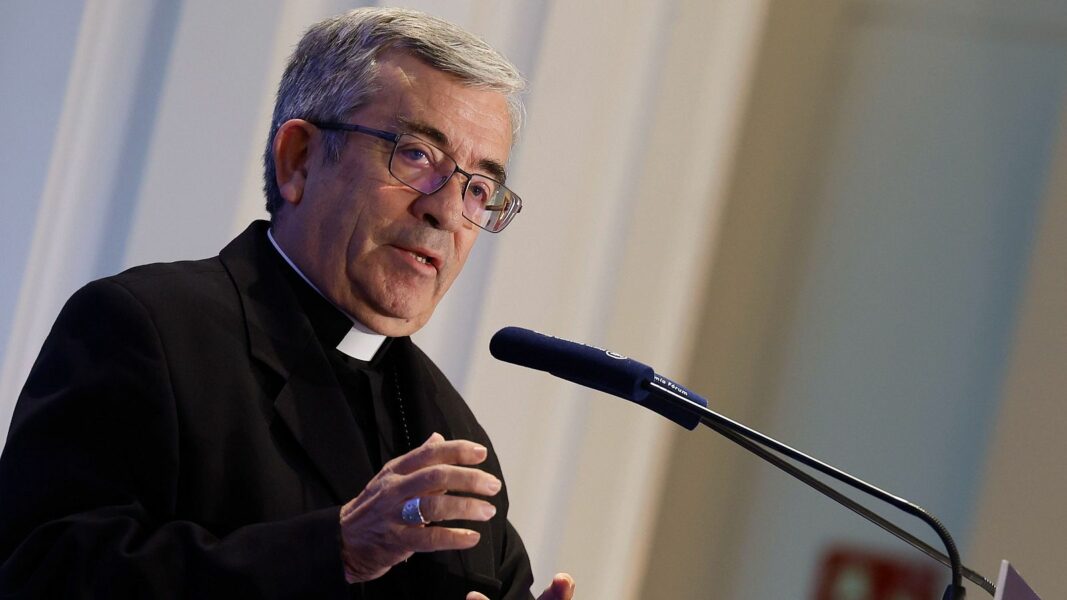
The president of the Spanish Episcopal Conference (CEE) and archbishop of Valladolid, Monsignor Luis Argüello, has defended the administrative regularization of immigrants already residing in Spain and reiterated that the Church’s priority regarding the Valley of the Fallen is to preserve its status as an abbey and pontifical basilica. He made these remarks in the second part of the extensive interview given to Javier Arias for Religión Confidencial, conducted on the occasion of the first-year assessment of his presidency of the Spanish Episcopal Conference.
Read also. Argüello, after clash with Bolaños: “I try to offer an integral Catholic discourse”
“There is no doubt that it is positive that this regularization has taken place”
Argüello placed the Church’s stance on immigration within a broader framework than mere administrative regularization. “We have always spoken of the right of immigrants not to leave their land, to examine the causes of migration, to combat mafias, and then to address the situation of those already here,” he stated.
Regarding the extraordinary regularization of immigrants, he explained that the initiative responded to a reality observed by parishes and Cáritas: people who had been living in Spain for years, many working in the informal economy and with their children already enrolled in school.
“There is no doubt that it is positive that this regularization has taken place,” he maintained, considering that it will allow many immigrants to obtain a work contract, contribute to Social Security, and leave behind irregular employment.
However, he also warned of the possible consequences of such measures if they are not framed within a common migration policy. “It is true that, if this is not done in agreement with the European Union and taking other possibilities into account, it may produce unintended effects,” he noted.
The president of the CEE added that “the matter of a major national European debate on migration remains pending” and recalled that the decline in birth rates is another factor that must be considered in this debate.
“We want the Valley of the Fallen to continue being an abbey and basilica”
When asked about criticism from those who believe the Church could have done more to defend the Valley of the Fallen, Argüello replied that “it is always possible to do more,” although he insisted on the position the Church has maintained.
“What we have wanted, and I reiterate, is that the Valley of the Fallen continue to be an abbey and basilica, that the Cross be that sign of a Victim and serve as reconciliation for all,” he affirmed.
The archbishop explained that the Church continues to defend “the independence and respect for the basilica as such” and added: “The Holy See is on this, I know, and so is the cardinal of Madrid.”
He also recalled that the Valley houses a pontifical basilica, so any eventual agreement must have Rome’s approval. “Being a pontifical basilica, it is the Holy See that will have to validate if any type of agreement is reached,” he indicated.
Argüello also referred to the different sensitivities surrounding the monument. “There are positions in defense of the Valley that, defending the Valley to the utmost, think that any type of action or intervention will constitute an offense,” he commented, before reiterating that “the Cross constantly calls for a look of reconciliation.”
Other matters
During the interview, Argüello described the proposal to repeal the crime of offenses against religious feelings as “contradictory,” criticized what he defined as an “anthropological confessionalism” of the State in relation to so-called conversion therapies, and explained that the Holy See left the Spanish bishops free to act in reaching the agreement with the Government on the reparation of victims of sexual abuse in the ecclesiastical sphere.