


It may seem that we are going to talk about two different topics; but Catholics do not believe in coincidences, and I see here more causality and intention than initially appeared.
Let us begin with the example of a diocese in its death throes. There are many, unfortunately, especially rural ones, but we will delve into one we already discussed earlier this year: Solsona, in Catalonia. On June 21, a single priest was ordained in this diocese, no less than ten years after the previous priestly ordination; an ordination that was also solitary.
On the other hand, in the same diocese of Solsona, on Sunday, April 19, “the cathedral hosted, for the first time, a celebration of the institution of extraordinary ministers of Holy Communion. A total of forty-five people from different parishes of the diocese received this ministry”. According to official data from the diocese itself, it is an eminently rural diocese, in which 75% of its 169 parishes have no more than 300 inhabitants and the largest do not reach 20,000. Its population is 140,000 inhabitants. It has 39 priests residing in the diocese, 1 outside the diocese, 2 in mission countries, and four extra-diocesan priests. In total, as can be seen, the number of extraordinary ministers of Holy Communion exceeds that of priests.
Conesa’s strategy of celebrating liturgies of the Word (euphemistically known as “celebrations in the absence—or in expectation—of a presbyter”) in an ever-increasing number of churches and towns is the opposite of his predecessor Novell’s policy of concentrating Masses, which had established kilometer radii and minimum numbers of attendees. Novell worked hard for evangelization: he literally said that he was betting everything on the Alpha method and also put many laypeople to evangelize and energize parishes. He did not, however, opt for the generalization of paraliturgies, although he did seek the growth of the group of married permanent deacons.
Be that as it may, it is a diocese practically sterile in priestly vocations in recent decades, thus compromising the maintenance of the ecclesial structure: after only two ordinations in more than fifteen years, there are currently three seminarians in the seminary. As a consequence, surely, Bishop Francesc Conesa continues to increase the number of clericalized laypeople in various functions, because priests are not arriving. Thus, the diocese’s media recently reported on the creation and first actions of a Diocesan Pastoral Motor Team:
“The Evangelization Plan of the Diocese of Solsona proposes identifying laypeople who can exercise ministries at the service of the community and entrusting them with responsibilities in parish and diocesan life. This evangelization plan recommends establishing in each parish its own Motor Team for pastoral action.
To carry out this objective at the diocesan level, the bishop has deemed it appropriate to create a team that serves as a motor for diocesan pastoral work. For this reason, with the favorable opinion of the episcopal council of government, the presbyteral council, and the diocesan pastoral council, he has constituted the Diocesan Pastoral Motor Team (EMPD).
This team has as its main function to energize pastoral action in the diocese, helping to guide it and promoting an organic and evangelizing pastoral approach, based on differentiated co-responsibility. The team is made up of five people chosen by the bishop, for a term of four years. These people are laypeople involved in parish and/or diocesan pastoral work.
On June 18, Bishop Conesa met with the newly created Motor Team to begin working. The Diocesan Pastoral Motor Team will be in close relationship with the diocesan councils, especially the Diocesan Pastoral Council”.
Apart from the fact that I would never attend a parish where gentlemen are mandated by the bishop to “detect” the faithful attending Mass in order to impose on them supposed service tasks that have nothing to do with their vocation, do not think it was easy to rewrite the lines of the Instagram post to make them understandable. It seems that Groucho Marx is the community manager of the diocese of Solsona. As if they did not already have enough problems.
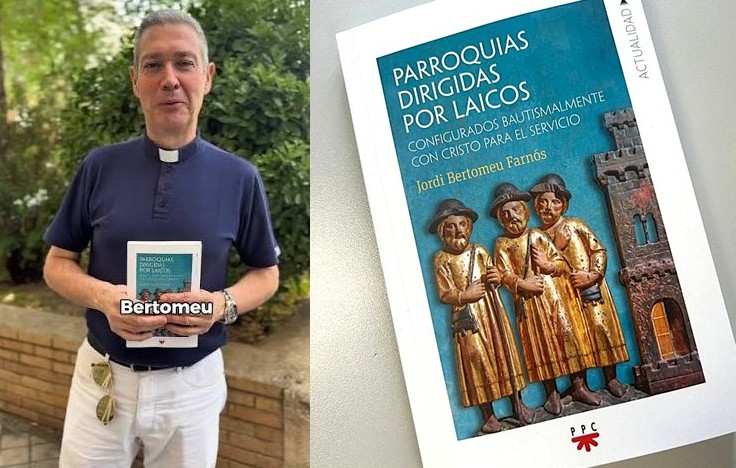
And speaking of people who write poorly, we move on to the second topic that can be read in the title, that of the recent publication by PPC (yes, PPC) of a book by that sinister Tortosa priest of the Congregation for the Doctrine of the Faith, Jordi Bertomeu i Farnós. The title of the book, “Parishes Led by Laypeople”, is undoubtedly too timely, opportunistic, we might say, in the current ecclesial situation, in which the bishops of dying dioceses, as we have just seen in the case of Solsona, entrust themselves to the laity.
The book, we can already state from the outset, is of the lowest quality; what we would colloquially call a bad book. Bertomeu says he wrote it “between airports and flights.” It shows: either he was accumulating fatigue or he wrote it in parts without checking the whole. But the worst is not only that it is a low-quality book, but that it is a bad, toxic book, harmful to the faith and to the Church, because of its content.
On its official Instagram account, the diocesan bookstore of Tarragona presented the book, which appeared at the beginning of last June, in the following way: “Who should sustain the life of our communities? Only the priests? Or the whole People of God? Are we truly synodal? In this brave and rigorous work, Jordi Bertomeu addresses one of the most decisive issues for the future of the Church: the participation of the laity in the pastoral responsibility of parishes. The book reflects on the possibilities offered by Canon Law and the theology of baptism to move toward new forms of service and shared governance. A reading that reminds us that the Church’s mission is born of baptism and that synodality is not merely a word, but a way of walking together. Has the time come for a braver Church? Has the time come for a Church capable of trusting more in its laity and of recognizing all the gifts that the Spirit continues to arouse in the faithful people? This book offers us clues”.
These words, which aim to be an apology for Bertomeu’s book, are sadly true, but in no way should a Catholic see in these circumstances any reason for joy.
It turns out that Bertomeu is a doctor in Canon Law from the Pontifical Gregorian University of Rome with a thesis defended in 2013 entitled “Parish leadership entrusted to the laity: expression of a new ministeriality in the Church? Exegetical study of can. 517 § 2”.
This canon of the 1983 Code of Canon Law states the following: “If, due to a shortage of priests, the diocesan Bishop considers it necessary to entrust a share in the exercise of the pastoral care of a parish to a deacon or to another person who does not have the priestly character, or to a community, he shall appoint a priest who, endowed with the powers proper to a pastor, shall direct the pastoral activity”.
Well, Bertomeu says that in 2018 Pope Francis, his great patron, whom he praises ad nauseam, encouraged him to turn his doctoral thesis into a publication. And so, in the introduction, the priest states: “The new can. 517 § 2 of the 1983 Code of Canon Law, promulgated in the renewing horizon opened by the Second Vatican Council (1962 – 1965), opened a crack through which an air began to filter that spoke of incarnation in reality: the possibility that those who have not been ordained ad sacerdotium – deacons, religious men and women, laywomen and laymen (sic) – not only “cooperate” as they had done for centuries (…), but “participate” effectively in the exercise of the pastoral care of the parishioners. With this new canonical possibility, creative as can be, parish governance ceased to be an area strictly reserved to priests. The legal recognition of this unprecedented form of ecclesial governance or ministerial leadership meant a normative consolidation of practices that were emerging in various realities of the Catholic world, particularly in regions of South America (sic) historically afflicted by a grave shortage of clergy”.
The section of the introduction in which Bertomeu makes these reflections is entitled “creative continuity,” only to end, in two paragraphs, by speaking of an “unprecedented form” and, finally, of a “novelty” that is supposedly a cause for celebration. A break with tradition and a Protestantizing innovation in every sense.
There is a lot of rubbish in this book. My view is that, for spiritual and mental health, it is better not to read it. It has been a great sacrifice and much suffering for me. I imagine that, if the Index of Prohibited Books were still in force, whose purpose was to protect souls from such toxic works, it would have been included. But those times have passed and now heterodoxy and Protestantization are being promoted from the heart of the Vatican. Because this, I believe, is the great danger of this work: promoting Protestantization. It is true that it does not do so from a vacuum, but is supported by nothing less than the current Code of Canon Law, which in 1983 incorporated a canon unthinkable in past times. That creative solution, which as Bertomeu himself acknowledges is a break with tradition, always seeks its justification in mission countries and their lack of priests. They forget that, in mission countries, the lack of priests occurs at the beginning of evangelization, and that the services of catechists and religious in the liturgy must end when there is a sufficient number of priests. In the West we find ourselves in the opposite situation: the lack of priests is due to the generalized apostasy of the baptized, because of the signs of the times and also because of the Church’s betrayal of itself. The much-celebrated incorporation of the laity into the governance of parishes is then a false, Protestantizing solution, which reduces to its minimum expression the celebration of the Holy Sacrifice of the Altar, which is the Mass, and the sacrament of confession in the parishes, and pushes the faithful to receive Communion from the hands of laypeople, of persons who have not received the sacrament of Holy Orders, in the vast majority of cases without having gone to confession beforehand. We have already insisted on this on previous occasions: the bishops are deceiving us. The precept of the Church is to hear Mass. The precept is not to receive Communion. And many bishops are hiding this from the baptized and making them receive Communion without hearing Mass, in a true subversion of the precept. And those who realize this and do not wish to participate in this farce but truly fulfill the precept, in rural areas are forced to travel many kilometers to worship the Lord. And many more kilometers if they wish to do so as God commands, in the Mass of all time.
Bertomeu laments that many bishops are still reluctant to apply canon 517 § 2. Well, this does not seem to be the case with Bishop Conesa of Solsona, whose pastoral bet on the laity we have focused on, although there are dozens of bishops in Spain doing the same. That is why I believe the publication of this book is not a coincidence. The Pontiff does not write it as a magisterial act, nor is it an official document of the Congregation for the Doctrine of the Faith. But it is the work of a murky Monsignor who receives special missions based on personal trust and moves in that ecclesial underworld of sewers, between mafia-like techniques and believing himself above the law. That is why I believe it is not far-fetched to think that, although it is not an official ecclesial document, it will become unofficial, justifying the fact that laypeople occupy all kinds of ministries and positions in the governance of parishes.
Priest Antonio María Domènech recently stated in an interview that “the future of rural churches was closure”. And, sadly, the figures and the situation of rural dioceses prove him right. Bertomeu does not mention it, nor do the bishops, but the gravity of the situation is double when not only priests but also the faithful are scarce. If God does not remedy it, in the short term, the brand-new parish and diocesan motor teams of Solsona, the pastoral agents, and the extraordinary ministers of Holy Communion could be grouped into a single ministry that would ideally be called the Diocesan Delegation of Juan Palomo, because it will be the same clericalized laypeople who will be in the offices, in the sanctuaries, and in the pews of the churches. The rest of the faithful, those who want to truly hear Mass, will dedicate themselves to driving many kilometers every Sunday and holy days of obligation, fleeing from that witches’ sabbath, to protect their souls.
Note: Articles published as Opinion express the views of their authors and do not necessarily represent the editorial line of Infovaticana, which offers this space as a forum for reflection and dialogue.