


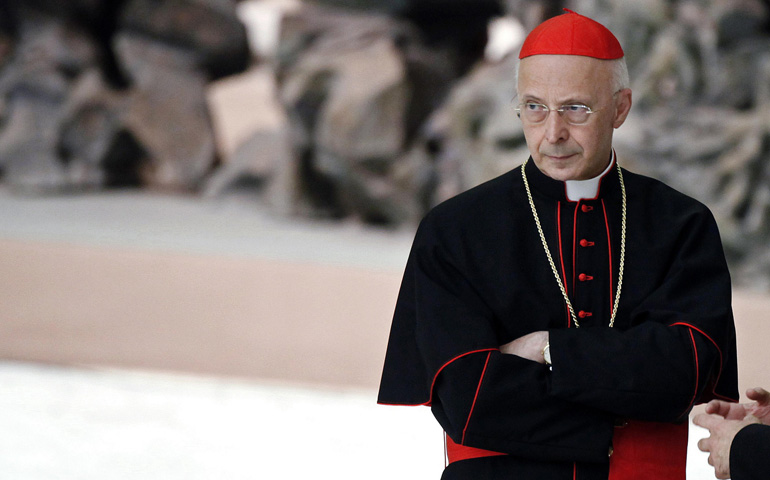
Cardinal Angelo Bagnasco, Archbishop Emeritus of Genoa and former President of the Italian Episcopal Conference and the Council of European Episcopal Conferences (CCEE), has defended the legitimacy of the coexistence between the ordinary form and the extraordinary form of the Roman rite, while recalling that Summorum Pontificum of Benedict XVI did not create a new rite, but rather recognized two ways of celebrating the same Roman liturgy.
In an interview granted to AdVaticanum, the Italian prelate was asked about the growing interest of many young people in the traditional liturgy and how the Church can integrate that sensibility without it becoming a cause of division.
“The unity of the faith is not in question”
Bagnasco began by noting that the growing attraction to deeper forms of spirituality cannot be understood apart from the current cultural context.
“The need for spirituality is very widespread in our time, marked by secularism, that is, by living as if God did not exist,” the cardinal states. In his view, the more contemporary culture tries to relegate God, the more He makes Himself present in the human heart. “Indifference, sooner or later, turns into need,” he maintains.
From that reflection, the Archbishop Emeritus recalled that the Catholic Church has coexisted for centuries with various liturgical rites.
“In the Catholic Church there are many rites; in Milan, for example, there is the Ambrosian rite,” he explains.
In that context, he wished to clarify the scope of the decision made by Benedict XVI in 2007.
“The document Summorum Pontificum does not create a new liturgical rite, but recognizes, within the one Roman rite, an ordinary form and an extraordinary form.”
“If they do not become banners, why not?”
For Bagnasco, the existence of both liturgical forms does not put ecclesial communion at risk.
“The unity of the faith is not in question, but rather legitimate personal sensibilities,” he affirms.
The cardinal warns, however, that these differences must not be absolutized or turned into elements of confrontation within the Church.
“If, in this area, the differences do not become absolutes, banners, or parties, then why not? The good of souls is the mission of the Church.”
The family and vocations
During the interview, the prelate also addressed other matters related to the situation of the Church in Europe.
Regarding the family, he defended that it remains “the first form of society,” taking up a well-known expression of Cicero. He described it as the stable union between a man and a woman, open to children and strengthened by the sacrament of marriage, and lamented that contemporary culture seeks to dilute its meaning.
“There is a systematic desire to broaden and dilute its meaning, as happens with all points of reference. The goal is to leave new generations confused so they can be manipulated for the benefit of power and profit,” he stated.
Regarding priestly vocations, Bagnasco showed moderate hope. He affirmed that he perceives encouraging signs both in Italy and in other European countries and attributed this phenomenon to the fact that “God continues to call.”
In his view, young people are not seeking superficial proposals, but rather lofty ideals capable of giving meaning to an entire life. “Mediocrity does not fascinate them,” the cardinal concluded, convinced that the Church must offer spaces of silence, prayer, and formation where those vocations can mature.