


There are articles that do not call for a theological response, but for an exorcism. Not because one should indulge in caricatures, nor because every progressive absurdity automatically deserves a demonic label, but because sometimes the inversion is so perfect, so complete, so meticulously anti-Christian, that one begins to suspect we are no longer dealing with mere intellectual confusion.
The text published by Religión Digital, taken from katholisch.de and signed by three German theologians, against the veneration of Saint Maria Goretti as a “martyr of purity” belongs to that category. The authors do not limit themselves to calling for pastoral prudence, nor to warning against poorly formulated catechesis, nor to recalling something obvious: that a victim of rape never loses her dignity nor commits sin by suffering an assault. That would be legitimate. That would even be necessary if done from the Catholic faith.
What they do is something else. Much more serious.
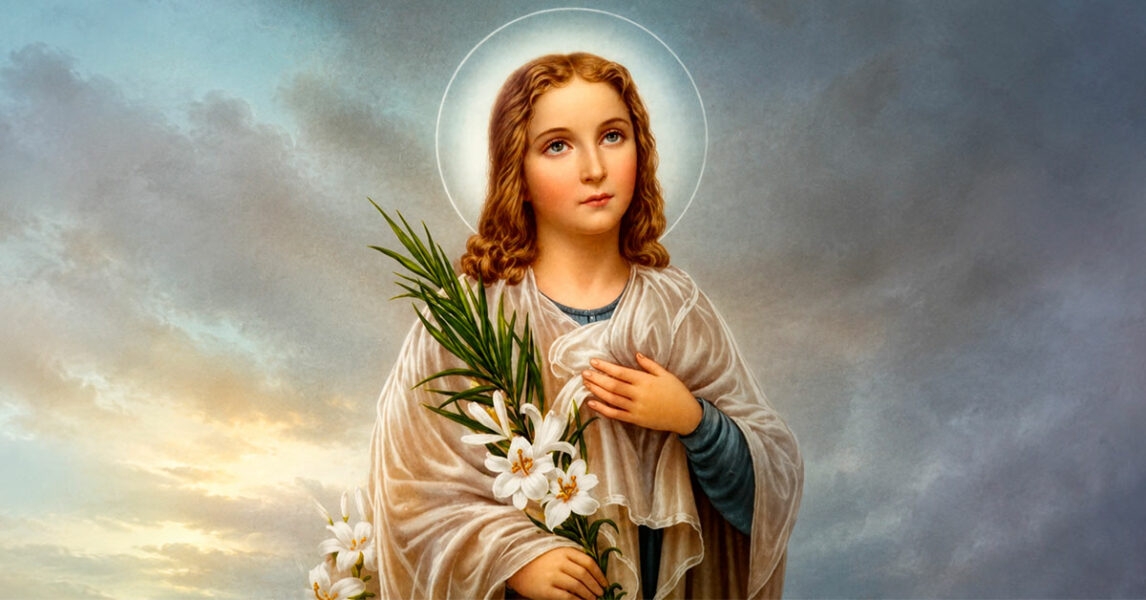
They take an eleven-year-old holy girl, murdered for resisting a sexual assault, and subject her to the tribunal of contemporary ideology. Where the Church has for decades seen a martyr, they see a problematic narrative. Where the faithful have seen purity, they see repression. Where tradition has seen Christian heroism, they see trauma. Where there is forgiveness, they suspect symbolic violence. Where there is grace, they detect a patriarchal construct.
The operation is familiar. First, it is conceded that Maria Goretti was the victim of a brutal crime. Then it is said that the Church, by presenting her as a “martyr of purity,” would have instrumentalized her story to impose an oppressive morality on girls and women. Then the obligatory vocabulary appears: gender, trauma, abuse, power, rape myths, inversion of victim and aggressor. And in the end, as always, the conclusion was already written before it began: the traditional category must fall.
It never fails. Virginity bothers. Purity bothers. Chastity bothers. Martyrdom bothers. Christian forgiveness bothers. Female sanctity is only acceptable if it is first deactivated, if it is turned into a mere victim, if it is emptied of every supernatural dimension. Maria Goretti may evoke pity, but she cannot be a model. She may be mourned, but not venerated. She may be used against the Church, but not presented as a fruit of grace.
Here the real problem becomes visible. It is not Saint Maria Goretti who needs to be reinterpreted by three German theologians. It is those theologians who need someone to explain Christianity to them from the beginning. And, given the result, perhaps with a good exorcist present in the room.
Because there is something deeply twisted in considering a girl’s resistance to sin suspicious and not suspicious the intellectual machinery that needs to dismantle that resistance to make it compatible with the feminist sensibility of the moment. There is something sick in looking at an eleven-year-old martyr and asking not what her fidelity teaches us, but what pedagogical dangers her cult produces. There is something spiritually inverted in presenting purity as a threat and ideological suspicion as liberation.
The Church does not teach that a raped woman loses her purity. It does not teach that a victim of abuse sins by not resisting to the death. It does not teach that surviving is a fault. If someone has preached that, they have preached it badly. Saint Augustine already made clear that chastity is not lost through violence suffered. The sin lies in the aggressor, not in the victim. This is not a modern concession. It is elementary Christian doctrine.
But precisely for that reason it is deceptive to use possible pastoral distortions to attack the very category of “martyr of purity.” Maria Goretti is not a saint because the Church believes that a girl’s dignity depends on a physical condition. She is a saint because, in an extreme situation, she chose not to consent to evil. She is a saint because she preferred to die rather than sin. She is a saint because she forgave her murderer in a Christian way. She is a saint because in her something was manifested that the modern world no longer tolerates: that the soul exists, that sin exists, and that there are goods higher than one’s own survival.
That is the core of the scandal. For the contemporary mentality, the body is the ultimate absolute. For Christianity, it is not. For the contemporary mentality, the supreme good is to go on living. For Christianity, not always. For the contemporary mentality, any discourse on chastity sounds like repression. For Christianity, chastity is a virtue. For the contemporary mentality, forgiving the enemy seems a form of added abuse. For Christianity, forgiveness is one of the highest signs of grace.
That is why the clash is inevitable. We are not facing two pastoral nuances within the same faith. We are facing two distinct religions. One believes in grace, sin, virtue, chastity, forgiveness, and martyrdom. The other believes in trauma, suspicion, structure, gender, power, and the permanent revision of every sanctity that does not fit its dogmas.
And this second religion already has its priestesses.
The most revealing aspect of the article is its inability to look at innocence without dissecting it. Maria Goretti is not contemplated: she is problematized. She is not venerated: she is analyzed. Her testimony is not received: it is subjected to suspicion. The murdered girl ends up turned into one more piece in the general accusation against the Church. The aggressor is condemned, yes, but the true target of the text is not Alessandro Serenelli. The target is the Catholic tradition that has seen in Maria Goretti a martyr.
That is the move.
It claims to defend victims, but ends up stripping a holy victim of her sanctity. It claims to combat victim-blaming, but ends up suggesting that the Church has venerated a harmful image for decades. It claims to speak from theology, but speaks from a conceptual apparatus that has already decided that almost every traditional Catholic category is suspect until proven otherwise. It claims to seek a more human reading, but what disappears is precisely what is most human in Maria Goretti: her freedom assisted by grace.
Because Maria Goretti was not a pious doll nor a symbol manufactured by priests obsessed with sexuality. She was a Christian girl who, faced with evil, said no. And that no continues to resonate more than a century later. It bothers aggressors, of course. But it also bothers those who have built an entire theology to make the word sin impossible.
That is where the matter begins to smell of sulfur.
Not because every pastoral critique comes from the devil. Not because there have not been abuses, silences, blunders, or victim-blaming preaching within Catholic circles. There have been, and some very serious. But one thing is to purify Catholic preaching and quite another is to subject sanctity to the language of the world until it ceases to be recognizable. One thing is to protect victims and another to turn a saint into a problem. One thing is to clarify that rape does not stain the one who suffers it and another to suggest that venerating a girl martyr of purity is no longer sustainable.
The latter is not purification. It is demolition.
And against certain demolitions a footnote is not enough, nor a symposium, nor another document full of “gender perspective.” Something more ancient, more serious, and considerably less German is needed: holy water, Latin, and a priest who knows what he has in his hands.
Because if a theology looks at Saint Maria Goretti and the first thing it sees is a harmful myth, the problem is not with the saint. It is with that theology. If a theology can no longer bear the word purity, the problem is not with the word. If a theology needs to reduce martyrdom to traumatic material, the problem is not with the martyrdom. If a theology turns grace into suspicion and chastity into oppression, it does not need an update: it needs an exorcism.
Saint Maria Goretti should not be rescued from the Church. The Church must rescue itself from those who have lost the capacity to recognize sanctity when it stands before them.