


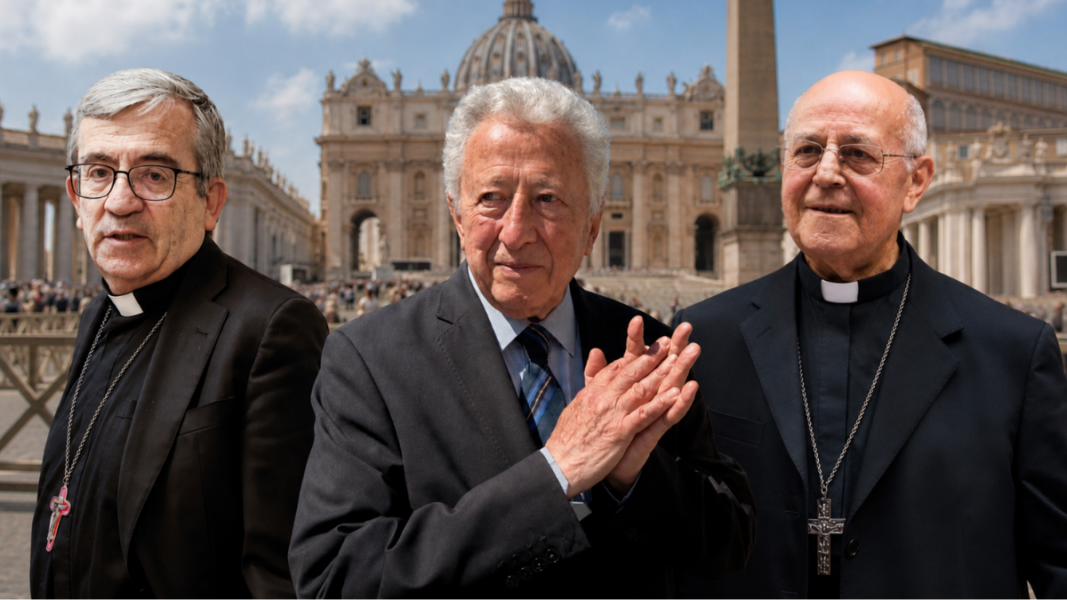
Little has been reported in Catholic and ecclesial media about the criminal proceedings that the priest and veteran Vatican correspondent Antonio Pelayo is facing in Rome since El Mundo published, on January 26, that the Italian justice system had ordered the opening of an oral trial against him for alleged rape. The case returned to the news on May 15, when El Norte de Castilla reported the postponement of the hearing, initially scheduled for that same month, until January 21, 2027, due to technical issues at the Court of Rome.
However, beyond the delay in the proceedings, information has emerged about the explicit support Antonio Pelayo has received from the last two presidents of the Spanish Episcopal Conference. According to El Mundo, both the current president of the CEE, Bishop Luis Argüello, and his predecessor, Cardinal Ricardo Blázquez, sent letters that have been submitted by the defense as part of the judicial proceedings.
The letters do not contain an assessment of the substance of the charges brought by the Italian Prosecutor’s Office; rather, they offer testimony regarding the priestly career and personal reputation of the journalist and priest from Valladolid.
In the letter signed on February 20, 2026, Cardinal Ricardo Blázquez explains that for years he maintained a frequent relationship with Pelayo when the latter traveled to Valladolid. “I was always able to appreciate his cordial belonging to the presbyterate of his diocese as well as a deep-rooted sense of Church,” writes the archbishop emeritus. He then adds that he has been “deeply surprised by the information about some inappropriate behavior,” since, in his view, it contrasts with the opinion he had formed of the priest during their long relationship.
In similar terms, Bishop Luis Argüello expresses himself. The current archbishop of Valladolid states that in the archdiocese “there is no record of any negative news or comment regarding possible inappropriate behavior by Don Antonio.” He further adds that there are “positive references” from people who have coincided with him in Rome and concludes by noting that he signs this testimony “in case it may serve for a better assessment of the person and attitudes of Antonio Pelayo Bombín.”
A pending judicial process
The trial against Antonio Pelayo was to begin on May 14 through the abbreviated procedure provided for under Italian law. However, the hearing was suspended due to technical issues and postponed until January 21, 2027.
According to El Norte de Castilla, Pelayo personally conveyed to Luis Argüello his concern over the prolongation of the process and his desire for the matter to be clarified as soon as possible. The priest, who has declined to make public statements on the advice of his lawyer, continues to maintain his innocence.
The case began after a complaint filed in Rome by a young television producer, who accused Pelayo of having performed “sexual acts” without his consent during a meeting held in May 2025. Following the investigation carried out by the Carabinieri, the Rome Prosecutor’s Office requested the opening of a trial, considering that there was sufficient evidence to support the charges—a request that was accepted by the competent court.
A singular show of support
The presumption of innocence fully protects Antonio Pelayo, and it will be the Court of Rome that determines, after the trial, whether the reported facts have been proven or not.
Nevertheless, the public support of the last two presidents of the Spanish Episcopal Conference constitutes an uncommon circumstance in a criminal proceeding against a priest. The letters sent by Argüello and Blázquez do not question the actions of the Italian justice system nor do they seek to undermine the Prosecutor’s investigation. Their purpose is to vouch for the personal and priestly trajectory of the accused.
Precisely for this reason, it is noteworthy that the highest representation of the Spanish episcopate has chosen to become so directly involved in these proceedings. In other criminal cases involving Spanish priests in recent years, the institutional response has typically consisted of recalling the presumption of innocence, expressing respect for judicial decisions, or remaining silent until the conclusion of the investigations.
This difference in treatment does not prejudge the outcome of the case nor does it undermine Antonio Pelayo’s right to receive support from those who have known him for decades. However, it does introduce an element of reflection on the criteria by which the ecclesiastical hierarchy decides to intervene publicly in favor of certain priests, while others facing similar proceedings do so without comparable institutional backing.
It will ultimately be the Italian justice system that determines the guilt or innocence of Antonio Pelayo. Until then, the presumption of innocence must be fully respected, just as institutional prudence remains one of the main guarantees for preserving the Church’s credibility in matters of this nature.