


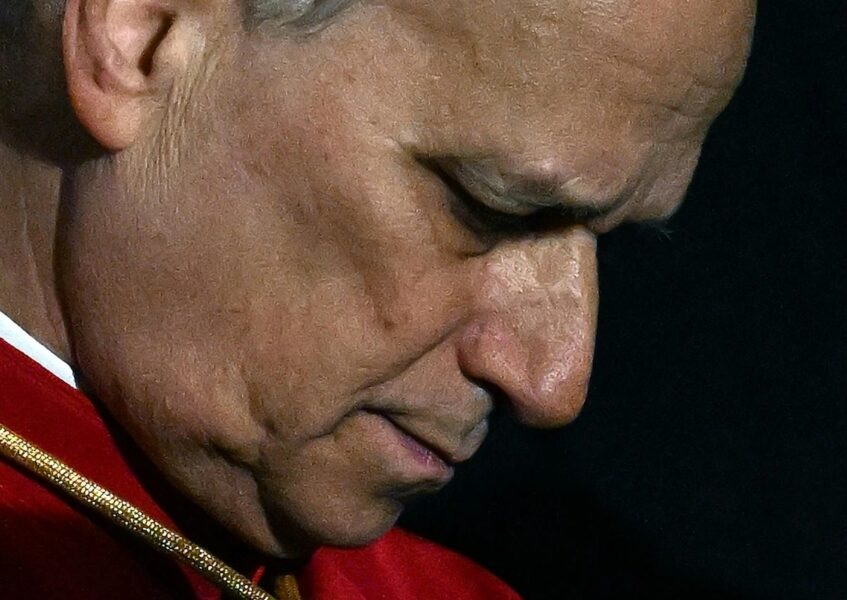
There was a time when excommunication could bring an emperor to his knees or cause an entire nation to apostatize. But excommunication is no longer what it once was, and that is the work of the very Church that today wields it against the FSSPX. History knows these diminished echoes, those tragedies that repeat themselves as farces, as Marx described when he identified Napoleon III as a ridiculous imitation of his uncle. Nor is Leo XIV Gregory VII.
But if farce is already a fairly appropriate term to describe this case, with Tucho Fernández, carrying all his record of absurdities, leading the excommunication, we have an even more fitting term for it. It was given to us by the great Valle-Inclán, and as you may have guessed, the term is esperpento. With the aforementioned cardinal, and with the brand-new pontiff who backs him, Canon Law has gone for a stroll down Callejón del Gato. Yes, there we have the guardian (sic) of the Doctrine of the Faith turned into a grotesque distortion of his own office. The image of the censor of Écône appears at the bottom of the glass, brandishing the Code, after having turned doctrine into something viscous, adaptable, sentimental, contextual, liquid… Such a scarecrow dressed in purple would have delighted Valle-Inclán, who would have known how to make the most of the theatrical effect of that excommunication.
Taking oneself so tragically seriously when one has long since lost all composure provokes an emotion composed of several ingredients, among them astonishment and laughter, even second-hand embarrassment, but certainly not reverential fear. That such a figure should promote an excommunication in the name of the purity of ecclesial communion is simply the height of it all. It is the height of it because one of the aspects that most separates the excommunicated from the excommunicators is that the former denounce, precisely, the extent to which the latter have emptied their acts of meaning.
Doctrine is little more than the report of a working group, always dependent on context; morality has dissolved into that mercy without judgment that accompanies the sinner while trying not to inconvenience him; the liturgy has for decades suffered from parochial creativity; Germany has for years been rehearsing schism in installments, and the Communist Party of China has been ordaining bishops; the Curia appoints cardinals to serve under religious prefects, while homosexual couples are blessed as long as they do not pray in Latin; pastoral care no longer means leading souls toward the truth, but rather sugar-coating that pill until it is completely hidden, and synodality has managed to make old heresies re-emerge, shiny and fresh out of a brainstorming session. It is no surprise that with such an emptying-out, the Doctrine of the Faith has ended up in the hands of a cardinal who, without shame, disputes Ratzinger while flirting with contextual theology.
Yes, for this prefect, backed by the new Pope, ecclesial acts are nothing more than noise. So too is excommunication, despite being the Church’s gravest penalty, for even the most serious weapons become ridiculous when wielded by someone who has turned his own authority into a matter of opinion. How can Rome expect its excommunication to be taken seriously after having spent decades demonstrating that everything, or almost everything, could be nuanced, contextualized, negotiated, tolerated, reinterpreted, or blessed with a footnote? It is Rome itself that has devalued for decades the language with which it now seeks to judge. It should not be surprised that its liquid theology fails to impress. Or is not everyone good, excommunicated or not?
That Rome which disorders its own signs of governance and then expects its penal order to sound terrifying has earned, by its own efforts, that its most solemn gesture may sound, in too many Catholic ears, like the night-watchman’s whistle. They have no right to complain.
Max Weber would have understood the scene instantly: no authority lives on command alone. Rome retains all its power, but it has squandered a great part of the credit of its authority. And that is not easily recovered. It is gained through coherence, proportion, justice, and fidelity to the deposit of faith… And not even the first step has been taken! When one is sunk, what one must do is stop digging, and the digger Fernández never lets go of the shovel. His excommunication fails twice: juridically, because with a Note it attempts to project onto priests, faithful, and adherents the schismatic condition that can only be declared by means of a penal Decree; politically, because it fires from an authority that has for years been wetting its own gunpowder.
Thus, the sentence dissolves into the voluntarism of one who takes as juridical reality what he barely manages to formulate as a threat. Víctor Manuel Fernández has achieved the feat of turning the Church’s gravest penalty into an esperpento of canonical technique and a public confession of impotence.
And with that impotence he also reveals his weakness. Carl Schmitt would surely have smiled at Rome’s action, considering how much it laid bare the seams. Whoever administers the exception points out where he recognizes the danger, and while Rome has created exceptions left and right for what is most inadmissible, it has placed before Écône an impassable boundary. That “selectivity of the exception” betrays the shortcomings of authority: with Germany everything is process; with Écône, an absolute limit.
The post-conciliar Church has finally discovered that Hell is not empty, but it only sees there the followers of Lefebvre. These children are the only ones given a stone when they ask for bread. There is no better way to confess that the problem is not disobedience, but the direction in which one disobeys.
Leo XIV’s inability to manage that disobedience has made me think, by contrast, of the king in The Little Prince. Saint-Exupéry granted this character a prudence that Prevost has not shown. That monarch waited for sunset to order the sun to set. He knew an elementary truth of governance: an order that is born defeated does not ennoble the sovereign, it exposes him, and Leo XIV has inaugurated his pontificate with that exposure. The first great scene of his reign has been the solemn administration of a fracture.
Wishing to appear as guarantor of communion, Prevost has been portrayed as heir to a squandered authority. He received a Rome accustomed to tolerating the intolerable, and after entrusting the delicate task to the man who symbolizes the worst doctrinal drift, he chose to respond to Écône with the severest gesture when his own word had already been publicly ignored. Without restoring order, he has recorded that he had failed to impose it.
If the signature is Tucho’s, the failure is Leo XIV’s.
“We want the faith of the Church in order to remain in the Church. And we want the Church for the faith and in the faith,” Pagliarani has said, and it is something that not even the Pope who excommunicates them calls into question. Écône speaks of preserving, receiving, transmitting; it speaks of priests who celebrate the Mass, preach the faith, and administer the sacraments as the Church received them. And to all this Rome responds with its power of governance.
Showing the muscle of power is easy, but it does not seem the best way to recover authority. Because what is no longer so easily achieved is convincing others that the FSSPX’s concern arose from an intolerable indiscipline and not from a genuine and holy necessity, attended to for the Glory of God, for the good of souls, and for the sanctification of its members and followers, now excommunicated or clumsily threatened with excommunication.
Too many Catholics have suffered the remnants of its fire to accept without further ado that the refugees are the arsonists. Let us hope in Christ for the Pope’s blessing upon his sons of the Fraternity.
Note: Articles published as Tribuna express the opinion of their authors and do not necessarily represent the editorial line of Infovaticana, which offers this space as a forum for reflection and dialogue.