


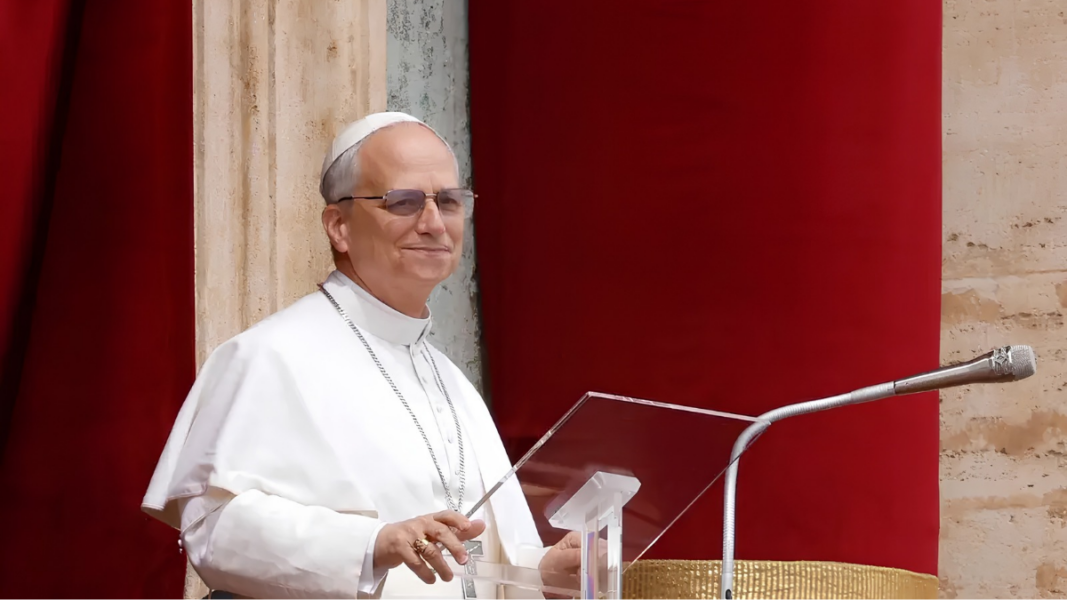
Pope Leo XIV focused his reflection before the recitation of the Angelus this Sunday on true Christian wisdom, contrasting it with intellectual pride and recalling that Christ reveals the face of the Father precisely to the little ones and the humble. Commenting on the Gospel of the XIV Sunday in Ordinary Time (Mt 11:25-30), the Pontiff stated that “the wisdom the Lord gives us is an announcement of salvation” and that “his yoke lifts us up in every fall.”
Before the faithful gathered for the Marian prayer, the Pope explained that the thanksgiving raised by Jesus to the Father manifests God’s own style, which reveals himself to those who welcome the Gospel with simplicity. He warned, however, of the risk of a purely human wisdom that ultimately turns into pride.
“Human wisdom then becomes arrogance and doctrine degenerates into pride. True wisdom of God, on the other hand, is revealed in the humility of the flesh,” said Leo XIV, recalling Christ’s invitation: “Come to me, all you who are weary and burdened.”
The yoke of Christ is self-giving out of love
The Pontiff explained that the “yoke” Jesus speaks of in the Gospel is not an oppressive burden, but the giving of one’s own life out of love. “Self-giving out of love is Jesus’ ‘yoke,’ that is, the synthesis of his teaching and the heart of his wisdom,” he noted.
Leo XIV also answered the question of how the weight of the cross can become light. According to him, the reason is that Christ carries it first and never abandons man in the midst of suffering.
“The wisdom He gives us is an announcement of salvation, and his yoke lifts us up in every fall,” he affirmed.
A school of freedom
The Pope insisted that following Christ does not mean embracing a spirituality of mere mortification, but walking an authentic path of freedom.
“Following Christ, our path is not an asceticism that mortifies: it is a school of freedom, which takes the drama of history seriously and always illuminates its meaning, especially in the darkest moments,” he said.
In the final part of his reflection, Leo XIV summarized the core of the Christian message with a series of statements linking Christ’s redemptive work to the wounds of the present world: “In slavery, Christ is liberation. Under the scourge of war, Christ is hope. In the hour of sin, Christ is forgiveness.”
Before concluding, the Holy Father invited the faithful to entrust the needs of the Church and the world to the Virgin Mary, asking for “the intercession of Mary, Queen of Peace, for the good of the Church and of the whole world.”
Below we reproduce in full the catechesis delivered by Leo XIV before the recitation of the Angelus.
Dear brothers and sisters, happy Sunday!
The Gospel of today’s liturgy (Mt 11:25-30) invites us to share in the praise that Jesus raises to the Father, “Lord of heaven and earth” (v. 25). The Son of God, made man, manifests his love by involving every creature in this act of thanksgiving.
The simplicity of such a spontaneous and joyful gesture corresponds to God’s style, who loves to reveal himself “to the little ones,” while remaining hidden “from the wise and the learned” (cf. v. 25). These, in fact, are so full of their own ideas that they do not recognize the presence of Christ, the Messiah who visits his people. Human wisdom then becomes arrogance and doctrine degenerates into pride. True wisdom of God, on the other hand, is revealed in the humility of the flesh, and his teaching is directed to those who suffer most: “Come to me, all you who are weary and burdened” (v. 28), says the Lord. Going to Jesus means responding to his love and sharing his life even to the cross, as he himself explained to us: “If anyone wants to come after me, let him deny himself, take up his cross and follow me” (Mt 16:24). Precisely self-giving out of love is Jesus’ “yoke” (cf. Mt 11:29), that is, the synthesis of his teaching, the heart of his wisdom, burning with charity toward all.
Brothers and sisters, how can the weight of the cross be “light” and “easy” (cf. v. 30)? Only for one reason: because the Lord carries it first and with all of us, never leaving us alone before what crushes us. As the true Teacher, Jesus takes upon himself humanity wounded by evil in order to care for it. The wisdom He gives us is therefore an announcement of salvation, and his yoke lifts us from every fall. Following Christ, our path is not an asceticism that mortifies: it is a school of freedom, which takes the drama of history seriously and always illuminates its meaning, especially in the darkest moments. Indeed, only in the cross of Jesus is evil redeemed; only in his passion does our mortal weariness find consolation and redemption.
In slavery, Christ is liberation. Under the scourge of war, Christ is hope. In the hour of sin, Christ is forgiveness. This is true wisdom, that is, the path we want to walk together, united as disciples in his name. Jesus teaches it to us as the Son, making himself our brother: with the power of the Holy Spirit, he himself reveals to the Church the truth of God and of man, because “no one knows the Father except the Son and anyone to whom the Son chooses to reveal him” (v. 27).
Dear brothers and sisters, while we give thanks to the Lord for this trust full of love, let us ask for the intercession of Mary, Queen of Peace, for the good of the Church and of the whole world.