


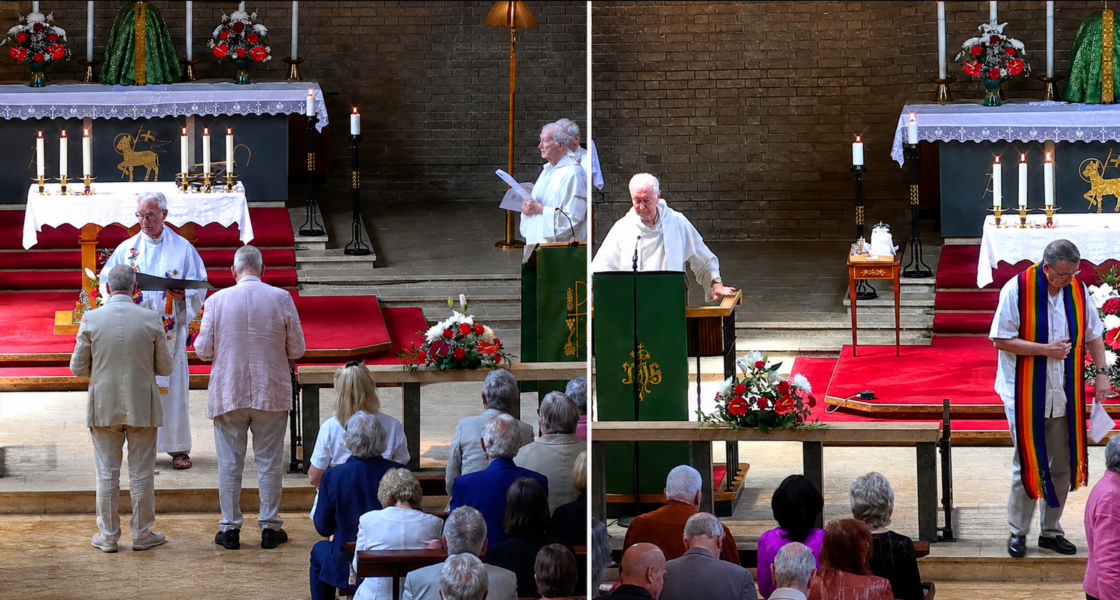
The ceremony, held at the Church of the Holy Apostles in London, included a formal blessing of the couple at the end of the Mass, in apparent contradiction with the limits that the Dicastery for the Doctrine of the Faith itself set in Fiducia supplicans.
On June 13, the Church of the Holy Apostles, in central London, hosted a “Mass of thanksgiving for 50 years of friendship, union and commitment in the pursuit of justice” in honor of Julian Filochowski and Martin Pendergast, two well-known gay Catholic activists who have lived together as a couple since 1976 and formalized their civil union in 2006. The event was enthusiastically celebrated by New Ways Ministry, the U.S. organization for LGBT activism within the Church.
More than 150 people from Spain, Italy, the United States, South Africa, Guyana and Taiwan attended the celebration. The main celebrant was Fr. Jim O’Keefe, and concelebrants included Radcliffe, two English emeritus bishops—John Crowley of Middlesbrough and John Rawsthorne of Hallam—along with Canon Chris Vipers of the parish.
The homily was delivered by Cardinal Timothy Radcliffe, O.P., a prominent figure at the recent Synods on Synodality and known for decades for his support of LGBT pastoral care. In his preaching, Radcliffe presented the relationship of the two men as “a participation in the life of God”: “Every true, faithful and well-lived friendship is a participation in the life of God,” he stated, without any reference to the Church’s teaching on chastity or on the nature of homosexual relationships.
A ritual blessing within the Mass
The most striking moment came at the end of the celebration, when all the clergy present at the altar imparted a blessing to the couple using a fixed text, adapted—according to the organizers themselves—from a form “recently authorized by the Belgian bishops”: “We ask, O God of love, that your grace descend upon Julian and Martin on the 50th anniversary of their relationship.”
It is worth recalling that the declaration Fiducia supplicans (2023), even in its controversial opening to blessings for “couples in irregular situations,” expressly excluded any ritualized blessing with a fixed text, given in a liturgical context or that could resemble a validation of the union. What took place in London—a Mass convened expressly to commemorate the union, with a public renewal of commitment by the couple and a collective blessing by the clergy according to a prepared form—appears to fall outside those limits. The 2021 Responsum ad dubium of the then Congregation for the Doctrine of the Faith had been even clearer: the Church “does not have the power to bless unions between persons of the same sex.”
During the Mass, moreover, the Gospel—the passage of Emmaus—was proclaimed “in dialogue form” by laypeople, including U.S. religious sister Jeannine Gramick and gay theologian James Alison, a practice contrary to current liturgical norms, which reserve the proclamation of the Gospel at Mass to an ordained minister.
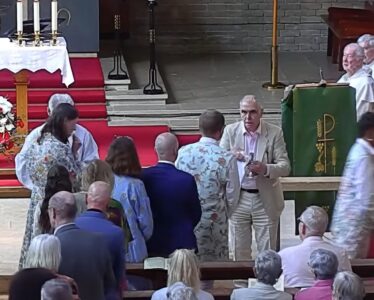
In the full video of the celebration released by the organizers, it can also be seen that one of the two honorees distributed the Blood of Christ to the congregation during Communion, in the presence of Cardinal Radcliffe. The norms on extraordinary ministers of Communion, set out in the instruction Redemptionis Sacramentum, require that those who perform this function stand out for their Christian life and not give occasion for scandal, a condition hardly compatible with someone who publicly and notoriously lives in a union contrary to the Church’s teaching.
New Ways Ministry and Sister Gramick
The presence of Sister Jeannine Gramick is no minor detail. Co-founder of New Ways Ministry, she was the subject in 1999 of a Notification from the Congregation for the Doctrine of the Faith, signed by Cardinal Ratzinger and approved by John Paul II, which permanently prohibited her from any pastoral work with homosexual persons because of the “errors and ambiguities” of her approach, contrary to the Church’s teaching. The organization was likewise disavowed at the time by the U.S. episcopate. In recent years, however, Gramick has been publicly received and praised in Rome.
From Ratzinger’s intervention to normalization
The organizers’ own account illustrates the change of climate in the Church in England. When the couple celebrated a similar Mass for their 25th anniversary in 2001, Cardinal Cormac Murphy-O’Connor ordered the bishop who was to preside to withdraw. According to the weekly The Tablet, months later Cardinal Joseph Ratzinger conveyed to Murphy-O’Connor the Holy See’s disappointment at the “timid” response of the English episcopate and asked for Filochowski’s dismissal as director of CAFOD, the official cooperation agency of the bishops of England and Wales. Murphy-O’Connor refused: “Non posso e non lo farò” (“I cannot and I will not”).
Twenty-five years later, the same celebration that then provoked the direct intervention of the future Benedict XVI takes place with two bishops concelebrating, a cardinal preaching, and, for the moment, no recorded reaction from the Diocese of Westminster or the Holy See.
The Church’s doctrine, set out in the Catechism (nos. 2357-2359), has not changed: homosexual acts are “intrinsically disordered” and “under no circumstances can they be approved,” without prejudice to the respect and welcome due to persons, who, like every believer, are called to chastity. What happened in London once again raises the question of who today safeguards that teaching when bishops and cardinals are the ones carrying out its practical denial.