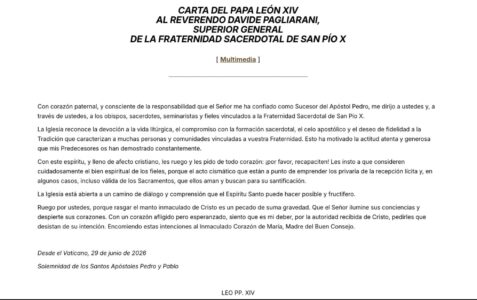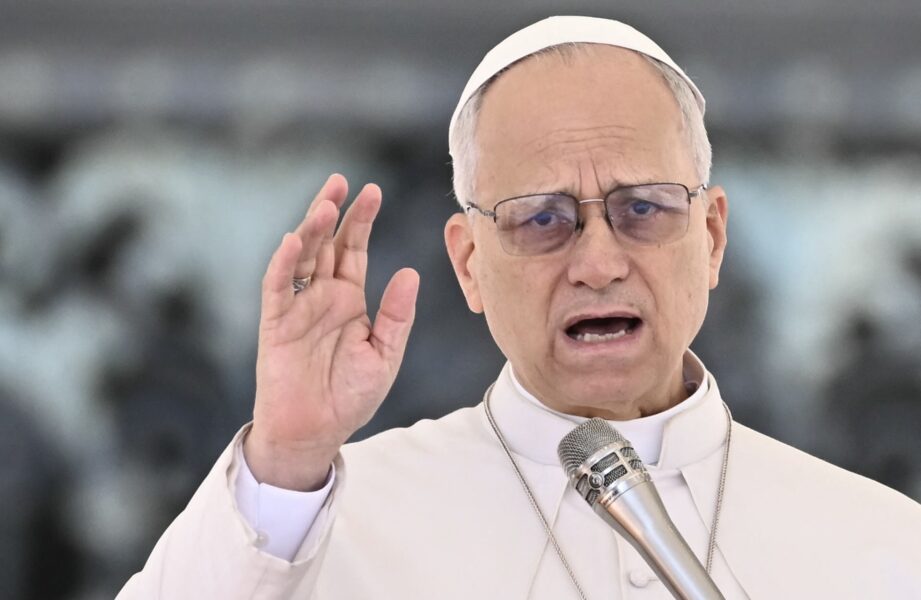
The Pope has addressed a letter to the Superior General of the Priestly Fraternity of Saint Pius X, Fr. Davide Pagliarani, in which he acknowledges the attachment to Tradition of its members but firmly warns them that a “schismatic act” would deprive them of the licit—and in some cases valid—reception of the sacraments. The letter, dated June 29, 2026, the Solemnity of Saints Peter and Paul, constitutes the first direct statement by Leo XIV on the canonical situation of the Fraternity.
The document, written in Italian and addressed personally to Pagliarani, is extended through him “to the bishops, priests, seminarians, and faithful linked to the Priestly Fraternity of Saint Pius X.” The Pontiff states that he writes “with a paternal spirit” and “aware of the responsibility the Lord has entrusted to me as the Successor of the Apostle Peter.”
Leo XIV expressly recognizes what Rome has rarely admitted with such clarity: “The Church acknowledges the attachment to the liturgical life, the commitment to priestly formation, the apostolic zeal, and the desire for fidelity to Tradition that characterize many persons and communities linked to this Fraternity.” This recognition, he notes, has motivated “the attitude of attention and benevolence” that his predecessors—Benedict XVI and Francis—maintained toward the institute founded by Archbishop Marcel Lefebvre.
An unequivocal warning
However, the paternal tone gives way to an unambiguous warning. The Pope begs and asks “with all his heart: return to your steps!”, urging Pagliarani to “carefully consider the spiritual good of the faithful.”
“The schismatic act you would commit would deprive you of the licit and in some cases even valid reception of the Sacraments that they love and seek for their own sanctification”
The reference to sacramental validity is especially significant. Until now, Rome had maintained that the ordinations of the SSPX, although illicit, were valid, and that the faithful could approach them for confession in cases of necessity. A formal rupture—a “schismatic act,” in the Pope’s words—would alter this delicate canonical balance.
Open dialogue, but without receiving them
Leo XIV insists that “the Church is open to a path of dialogue and understanding that the Holy Spirit can make possible and fruitful.” Nevertheless, the framework of the dialogue is clearly defined: it is not a matter of negotiating doctrine, but of the Fraternity abandoning its “attempt”—a term suggesting that Rome considers some move from Menzingen imminent.
The letter concludes with a theologically grave invocation: “To tear the seamless garment of Christ is a sin of extreme gravity. May the Lord enlighten your consciences and awaken your hearts.” The Pope entrusts these intentions “to the Immaculate Heart of Mary, Mother of Good Counsel.”
A context of growing tension
The letter arrives at a moment of uncertainty about the future of relations between the Holy See and the Fraternity. Since the death of Francis, who had granted the SSPX the faculty to validly hear confessions and celebrate marriages, doctrinal dialogue had remained stalled. The election of Leo XIV—Cardinal Robert Prevost of the United States—had generated mixed expectations: some hoped for a pragmatic rapprochement; others, a definitive clarification of the canonical status of the Fraternity.
The date chosen for the letter is not accidental. The Solemnity of Saints Peter and Paul, patrons of Rome, underscores the Petrine dimension of the appeal: it is the Successor of Peter who speaks, expressly invoking his authority. It remains to be seen how Menzingen will respond to this letter which, under the guise of fatherhood, contains a warning whose canonical consequences could be irreversible.