


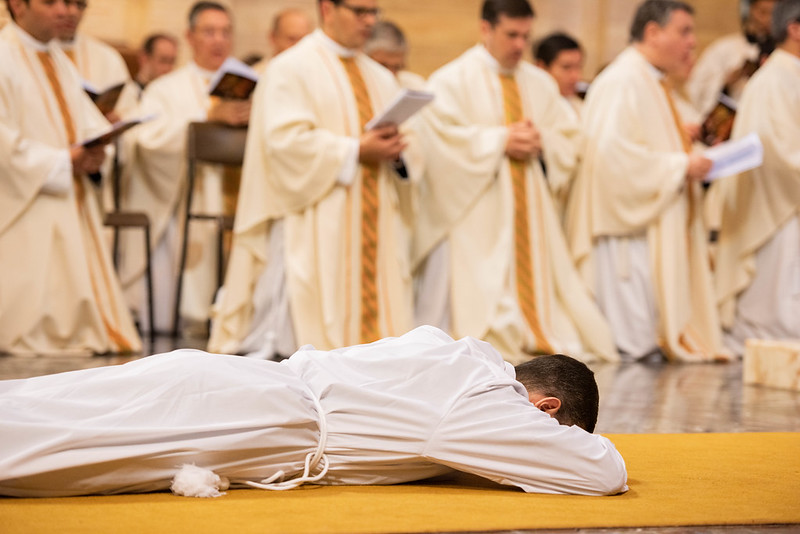
The Church in France will celebrate 84 priestly ordinations this year, compared to the 30 planned in Germany. Although both countries continue to record a long-term decline in vocations, the figures reflect very different realities within the European Church. Poland, for its part, will once again rank far ahead with 196 new priests.
The solemnity of Saints Peter and Paul will once again serve as the usual setting for priestly ordinations in much of Europe. Data published in recent days by the episcopal conferences and compiled by the KNA agency show an uneven picture among the continent’s main Catholic countries.
Read also: The Pope celebrates Saints Peter and Paul by conferring the pallium on 35 archbishops
France will celebrate a total of 84 priestly ordinations in 2026, while Germany will have only 30 new diocesan priests. Poland, for its part, will record 196 ordinations, a figure higher than the combined total of France and Germany.
France consolidates an advantage over Germany
Although the figures for both countries are not fully comparable—since German statistics only include diocesan priests, while French ones initially incorporate religious and members of communities—even when using only diocesan clergy data, France maintains a clear advantage.
Of the 84 priests to be ordained this year in France, 66 will belong to the diocesan clergy, compared to the 30 new priests planned in the German dioceses.
The French episcopate considers especially encouraging the increase in candidates entering the propaedeutic year of the seminaries, the stage prior to the start of priestly formation. Between 2023 and 2025, admissions rose from 99 to 145 aspirants, an increase of nearly 47 %, which the bishops interpret as a positive sign for the future of vocations.
Paris and Fréjus-Toulon lead the ordinations
The ecclesiastical province of Paris will be the one to incorporate the most priests this year, with 18 new ordinations. The Archdiocese of Paris alone will have seven new presbyters, including three Assumptionists and one member of the Emmanuel Community.
Close behind is the province of Marseille, with 14 new priests, driven especially by the diocese of Fréjus-Toulon, which will contribute ten ordinations, the highest figure of any French diocese.
Several religious communities also stand out. The Community of Saint Martin will ordain ten priests, while the Augustinians of the Assumption and the Chemin Neuf Community will each welcome five.
Germany remains at historic lows
Germany shows a slight recovery compared to the low recorded in 2025, when there were only 25 diocesan ordinations. This year there will be 30, although the figure remains far from those recorded just a few decades ago.
The diocese of Rottenburg-Stuttgart tops the list with five new priests, followed by the Archdiocese of Berlin with four. Eichstätt, Cologne, and Munich-Freising will each ordain three presbyters.
However, eleven of Germany’s twenty-seven dioceses will have no priestly ordinations this year. Among them are Münster, Essen, Hamburg, Mainz, Hildesheim, Erfurt, and Limburg—the latter presided over by the former president of the German Episcopal Conference, Bishop Georg Bätzing, who has now gone four consecutive years without new priests.
The diocese of Fulda was unable to provide a definitive figure yet, although it recalled the March ordination of a Ukrainian priest of the Byzantine rite assigned to the pastoral care of the Ukrainian Greek-Catholic community.
Poland maintains its leadership, although it also declines
Despite experiencing a sustained decline in recent decades, Poland will continue to be Europe’s main breeding ground for priestly vocations, with 196 ordinations planned for 2026.
The country has a smaller population than France or Germany, but it has a larger number of baptized Catholics and maintains significantly higher levels of religious practice, factors that continue to influence the number of vocations.
A common challenge for the European Church
The figures published this year confirm that the vocations crisis continues to affect much of Western Europe, although with very different intensities depending on the country. While France appears to be partially stabilizing its ordinations and detects hopeful signs in the entry of new seminarians, Germany continues to face an increasingly acute shortage of new priests, with numerous dioceses that will not incorporate any presbyters this year.