


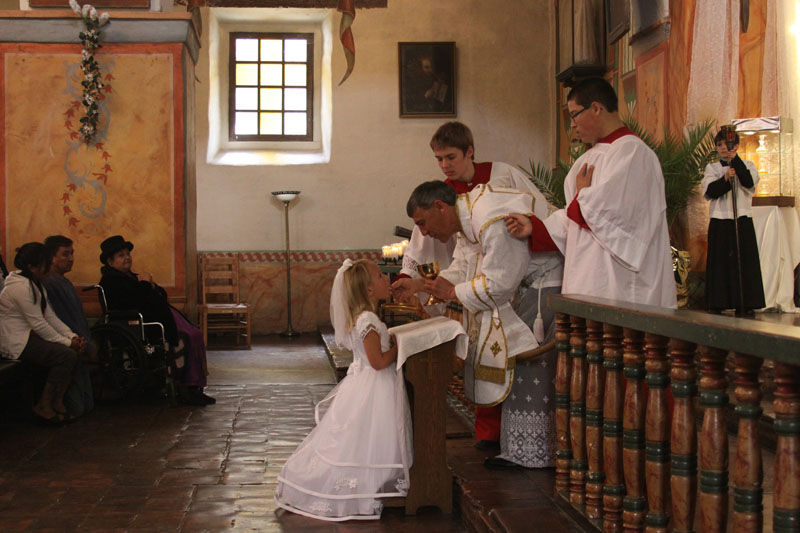
Much is being written about the episcopal consecrations of the SSPX from the lofty perspective of someone discussing the problem with a legal manual. And that is as it should be. But let us not forget that the sacraments are not received in a footnote, but in the parishes. And that the parishes are that place where, when a father—or a mother—gathers the courage to request a traditional rite, discovers, by the priest’s stunned face, that he has asked for something forbidden. It was from that sacristy or parish office that I wanted to write.
If today I wish to receive the sacraments according to the traditional rite of the Church, the widespread reality is that I am forbidden to do so. If I want to baptize my child in that rite, or have him make his First Communion in a liturgy that unites him to his grandparents and great-grandparents, I am forbidden. And it is not forbidden with the cold courtesy of someone applying a regulation: it is forbidden with humiliating explicitness. The priest looks at me as if I had asked him to store a shipment of cocaine in the sacristy. Panic, contempt, fear of reprisal from his diocesan bishop, terror of being marked for the rest of his career—all of that crosses his face. That face of panic is, today, the true practical magisterium on the Traditional Mass. Do all the bishops really think we deserve that treatment?
The problem is specifically the 1962 Missal. Not the Melkite rite, nor the Coptic, nor that of a faithful of any Eastern denomination: if that faithful asks for his rite and there is a priest, he is probably not only granted it, but welcomed with ecumenical affection, with respectful curiosity, with the satisfaction of the parish priest who feels special for receiving him. All the liturgical hospitality in the world is available. All, except one. The only tradition to which the Latin Church denies bread and salt is its own.
Some of us enjoy a privilege—and the word tastes like ashes to me—: living in one of the few dioceses in Spain where a small group, with a special permission, in chapels of their own, does what it can. In almost every case there is not a single diocesan parish, but four walls of their own, sustained by the precarious resources of faithful who pay twice: the diocese with their taxes and their Mass with their alms. There, exceptionally, we can indeed receive the sacraments according to the traditional rite. And with that we must consider ourselves satisfied. With a small tolerated chapel surviving in my city, we must keep silent and be grateful, because that is all we are authorized to aspire to.
Meanwhile, our children scarcely receive catechesis worthy of the name; we scarcely receive the sacraments in the form that most helps our weak faith; it is forbidden, curtailed, watched. And if anyone doubts it, let them try the experiment: let them enter their parish and ask, just once, for a single Mass according to the 1962 Missal. Let them then observe the panic, that terror of the functionary asked to sign something compromising. That terror is the proof. That is the framework to which conservatives and progressives have subscribed by common agreement, the former out of conviction and the latter out of convenience.
After Traditionis custodes, the persecution has only known how to harden. Nothing has been sought to pacify. What has been sought is to liquidate a rite with administrative deadlines, hoping that the old will die and the young will desist.
Because that is, without euphemisms, the Church being prepared for us: one in which the traditional rite is condemned to extinction by starvation; in which the rite of 1969—the one that Bugnini and the liturgists of Paul VI improvised in a couple of seasons in an office—is imposed as the only lawful way to pray, without nuances. That uniformity in modernity is applied with a zeal that is never spent against any abuse.
And when someone insists on keeping that sacramental continuity alive in the face of the certain risk of its disappearance; when there are those who resist saying “we adhere faithfully and disciplinarily to the Holy Father, we believe all that the Church believes, but let us keep the Mass of the centuries and the priesthood of always,” the response is not dialogue: it is anathema. That is what we have come to. That asking for what was universal law until the day before yesterday turns a Catholic into a suspect.
Thousands of faithful live in the humiliation of having to ask in a lowered voice— if one dares at all, because one already knows the script— whether it would be possible, please, with all due respect, to baptize a child, celebrate a First Communion or a funeral according to the 1962 Missal, for the special spiritual good it does us. And we have grown accustomed to those dry, almost offended refusals with which we are answered in the vast majority of parishes and dioceses. And also to leaving there with the strange sensation of having committed a fault. Persecuted. Marginalized. Singled out.
Faced with this, several responses are possible, all respectable. There are those who decide to endure and entrust themselves to Providence, and perhaps that is the holiest path. There are those who opt for the long battle, seeking here and there the most temperate bishop, in some fortified see where a loophole is still tolerated in a corner of the United States, France or Germany. An excellent option for priests. But while the strategists calculate, I enter my parish, ask for the traditional baptism for my son or a vetus ordo funeral for my father or grandfather and leave treated like a criminal. It will happen to me in one hundred percent of the parishes in my diocese, so I return to the tolerated chapel, to the four walls of the one who still, for the moment, has his punctual permission. Blessed be those chapels. That is our life, and that is exactly where we are.
Is this really how we want to wage the battle, meekly surrendering to a diocesan structure that spits on us, marginalizes us and violates us every time we ask for what is ours by right of centuries? If someone believes so, I respect him. What I will not do—not being a member of the Priestly Fraternity of Saint Pius X—is join the chorus of those who call schismatics those who choose to bear the incomprehension, marginalization and even juridical excommunication so that the Mass of all time (and everything it entails) does not die. I will not insult them and I will not hang any labels on them, because the reality we ordinary faithful live—not the one of clerics who have found an umbrella to cover them, but ours—is simply unsustainable. It is shameful. It is insulting. And the defense of the sacraments and of the traditional priesthood is no longer a question of liturgical tastes: it is a state of extreme necessity.
Salus animarum suprema lex, says still the last canon of the Code. One day they will have to be reminded that they wrote it.