


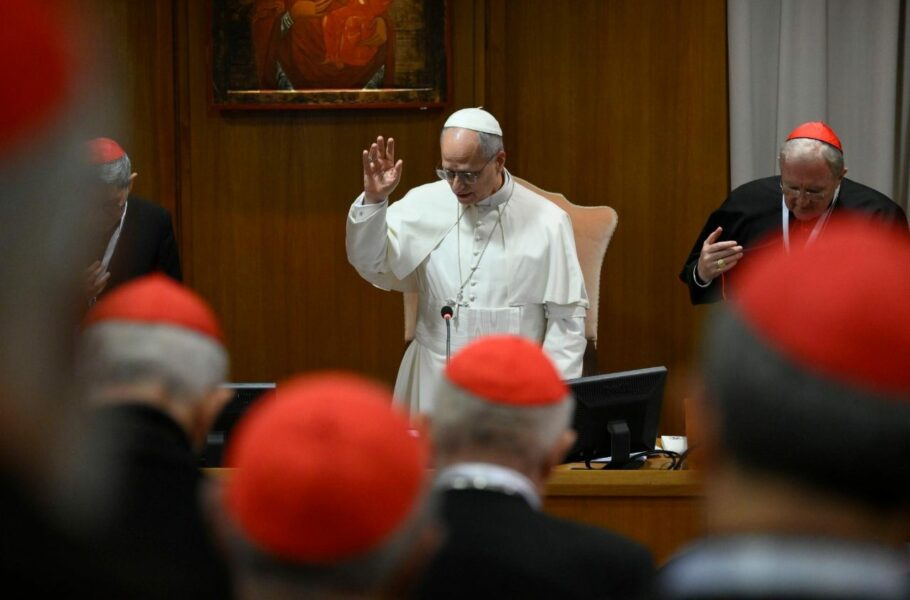
With a speech that goes far beyond a simple summary of the work carried out during the two days of the extraordinary consistory, Leo XIV synthesized the main issues discussed in the sessions and hinted at the pastoral and governance priorities he intends to promote in the coming years.
Far from presenting a catalogue of concrete measures, the Pontiff offered a spiritual and ecclesial reading of the current challenges facing the Church and the world. The implementation of the Synod, the family, peace, the Social Doctrine of the Church, the role of the laity, the accompaniment of young people, and the renewal of the consistory itself were some of the major themes of a speech that helps to understand the direction Leo XIV wants to give to his pontificate.
1. The implementation of the Synod enters a new stage
Leo XIV called on the cardinals to become personally involved in implementing the Synod in the particular Churches.
“I ask you to accompany it with conviction in the Churches you serve, fostering an authentic understanding and encouraging everyone to take part in it: it is about helping our Churches to grow in an increasingly evangelical style.”
The Pope also explained what he considers to be the true question of synodality.
“The question of synodality is not, first and foremost: ‘Who has the power to decide?’ The question is deeper: ‘How do we together safeguard the gift that the Lord has entrusted to his Church?’”
2. Synodality is not a method of work
The Pontiff wished to clarify what he means by synodality.
“Synodality is not a set of meetings nor a method of work. It is a spiritual style.”
He added:
“It is born of encounter, grows in listening, and matures in discernment.”
3. Peace begins in the heart
Reflecting on wars and conflicts, Leo XIV pointed out where violence truly originates.
“Before manifesting itself in history, war is born within us, when suspicion takes the place of trust, fear replaces hope, and the other is perceived as a threat.”
In response, he recalled the Christian path to reconciliation.
“From a reconciled heart can spring disarmed words, new relationships, and a peace capable of reaching peoples as well.”
4. In the face of the culture of power, a culture of cooperation
The Pope warned that the root of conflicts runs deeper than tensions between states.
“War is not merely a conflict between states. It is born much earlier, from a culture of power that runs through our way of thinking, of living relationships, of exercising authority, of using the economy, technology, and even religion.”
As a response, he proposed rebuilding a different culture.
“The response requires rebuilding a culture of cooperation and dialogue, capable of giving new strength also to multilateralism, so that peoples may once again learn to seek together the common good of the entire human family.”
5. The family remains a priority
Leo XIV once again placed the family at the center of social and ecclesial life.
“Wherever the family is supported and accompanied, a school of relationships, solidarity, and hope grows; wherever it is wounded or isolated, the whole of society suffers the consequences.”
He also announced an upcoming meeting to evaluate the reception of Amoris laetitia.
“In October we will hold a meeting with the heads of the Eastern Churches and the presidents of the Episcopal Conferences to evaluate the steps taken after Amoris laetitia.”
6. Young people challenge the Church
The Pope expressed his concern for the suffering experienced by many young people.
“In their questions, but also in the suffering that sometimes leads them to despair—even to the extreme despair of taking their own lives—you have recognized one of the deepest wounds of our time.”
At the same time, he highlighted the value of their search.
“Their search for authenticity, for true relationships, and for meaning reminds us that the Gospel continues to respond to the deepest expectations of the human heart.”
7. The Social Doctrine must occupy a central place
Leo XIV advocated for a greater presence of the Social Doctrine of the Church in the life of communities.
“You have expressed the desire that it become more and more a living heritage of our communities, an ordinary criterion for the formation of consciences and pastoral discernment.”
He also recalled that it does not offer ready-made solutions.
“It does not offer prefabricated solutions, but educates the Church in an evangelical way of inhabiting reality, interpreting it, and responsibly guiding action.”
8. Deepening the understanding of legitimate defense
The Pontiff took up one of the proposals that emerged during the consistory.
“Several groups underlined the need to continue deepening the theme of legitimate defense in light of the profound transformations that have taken place in the nature of contemporary conflicts.”
He added:
“This reflection deserves to be further developed with the necessary theological and pastoral rigor.”
9. The consistory is not a parliament
Leo XIV wished to define the nature these meetings of the College of Cardinals should have.
“Not a parliament, not a congress in which opinions or interests prevail, but an experience of communion at the service of the mission.”
He also confirmed his intention to maintain this format in the future.
“I wish to continue this annual meeting starting next year.”
10. God desires peace for all peoples
The Pope concluded his address with an appeal directed to the entire Church and the whole world.
“God desires peace for every nation and every people. That is why we must not resign ourselves to violence.”
He ended with an invitation to commit actively to reconciliation.
“Violence will not have the last word. God continues to open paths of reconciliation and peace in history. We have the responsibility to walk them with courage and to help the world recognize them.”
Below we provide the full text of Leo XIV’s address:
Before entering into the concluding reflection, I wish to express our closeness—mine and that of the entire College of Cardinals—to the people of Venezuela, who have been so hard hit by the violent earthquake of recent days. We assure our prayers for the victims, for their families, and for all those suffering the consequences of this tragedy. We also commend to the Lord all those engaged in relief efforts and ask that the solidarity of the international community not be lacking toward that beloved nation.
Dear brother cardinals, we now come to the end of these days with a deep sense of gratitude. I thank you for the freedom, fraternity, and ecclesial spirit with which you have taken part in our work. I take with me not only the content of your reflections, but also the experience that made them possible. During these days we have sought together the will of the Lord, convinced that Christ continues to act in his Church: it is he who goes before us, gathers us, speaks through our brothers, and guides us in the mission. Everything comes from him and everything returns to him. That is why seeing cardinals from Churches, cultures, and situations so diverse listening to one another and seeking together what best serves the Gospel has been for me a source of consolation and hope.
We began these days allowing ourselves to be guided by the image of the Good Samaritan: a man who stops before his wounded brother, allows himself to be moved in the depths of his being, and takes responsibility for him. I would now like to bid farewell with another Gospel icon: that of the disciples on the road to Emmaus. They too walk marked by sadness and disappointment, but the Lord becomes their companion on the way, listens to their questions, opens the Scriptures, sets their hearts on fire, and transforms their journey. I like to think that what we have experienced these days also bears something of this encounter: we have walked together, listened to one another, and, if we have made space for the Lord, he has rekindled hope in our hearts and now sends us back to our Churches to resume the journey with a renewed vision.
The concluding reflection on the synodal journey has helped us to reread what we have lived during these days. It seems to me that the question of synodality is not, first and foremost: “Who has the power to decide?” The question is deeper: “How do we together safeguard the gift that the Lord has entrusted to his Church?” When this question becomes the center of our discernment, questions of authority, co-responsibility, and decision-making also find their proper place, illumined by the mission and by common fidelity to the Gospel. Therefore, I once again entrust to you the path of implementing the Synod. I ask you to accompany it with conviction in the Churches you serve, fostering an authentic understanding of it and encouraging everyone to take part: it is about helping our Churches to grow in an increasingly evangelical style.
Allow me to insist, as we heard from Cardinal Grech: synodality is not a set of meetings nor a method of work. It is a spiritual style. It is born of encounter, grows in listening, and matures in discernment. The real question is not how many conversations we will be able to organize, but what evangelical quality our encounters will have. When we listen to one another with humility and freedom, making space for the Spirit, our conversations do not remain a mere exchange of ideas, but become a place of conversion in which we grow together in fidelity to the Lord.
Reflecting on the conversations of these days, I take with me above all the way you have contemplated the world in the first session. Many of you have recounted the sufferings caused by wars, violence, poverty, and the many injustices that mark the lives of peoples. Yet you did not stop at describing them. Behind these dramas you recognized an even deeper suffering: loneliness, the crisis of relationships, the loss of hope, the difficulty of recognizing one another as brothers and sisters. It is a gaze that does not turn away from the wounds of the world but seeks their roots, often recognizing within them a renewed search for meaning, authenticity, spirituality, and community. Many today are seeking hope and true relationships.
I was particularly struck by the way you spoke of young people. In their questions, but also in the suffering that sometimes leads them to despair—even to the extreme despair of taking their own lives—you recognized one of the deepest wounds of our time. But you also knew how to recognize the action of the Spirit in it. Their search for authenticity, for true relationships, and for meaning reminds us that the Gospel continues to respond to the deepest expectations of the human heart. Listening to them and to their families with humility is also a path by which the Lord continues to convert the Church.
Many of you also recalled the family. Wherever it is supported and accompanied, a school of relationships, solidarity, and hope grows; wherever it is wounded or isolated, the whole of society suffers the consequences. In October we will hold a meeting with the heads of the Eastern Churches and the presidents of the Episcopal Conferences to evaluate the steps taken after Amoris laetitia. Some families will also participate and share their experiences. Their presence is essential, but I hope that all who attend will prepare by listening closely and bringing with them the experience of the families of their own Churches.
Thus you have sought to listen to what the wounds of the world reveal about the human heart. It is precisely there, in the heart, that peace is also decided. Before manifesting itself in history, war is born within us, when suspicion takes the place of trust, fear replaces hope, and the other is perceived as a threat. But it is in that same heart that Christ continues to meet us, to speak to us, and to convert us. From a reconciled heart can spring disarmed words, new relationships, and a peace capable of reaching peoples as well.
The second session led us to take a further step. It seems to me that you grasped with great clarity one of the intuitions of the Magnifica humanitas: war is not merely a conflict between states. It is born much earlier, from a culture of power that runs through our way of thinking, of living relationships, of exercising authority, of using the economy, technology, and even religion. If this is the root of the crisis, the response requires rebuilding a culture of cooperation and dialogue, capable of giving new strength also to multilateralism, so that peoples may once again learn to seek together the common good of the entire human family. On this path, the contribution of the lay faithful committed to public life is essential: they need the closeness and support of the ecclesial community to live the “political charity” you have recalled. That same culture of cooperation also grows through ecumenical and interreligious dialogue, which does not weaken our Christian identity but makes it capable of serving, together with others, the common good and peace.
I found particularly valuable the way some of you addressed the theme of non-violent response in the face of multiple forms of violence. It is a profoundly evangelical way of inhabiting history, the fruit of contemplating the way Jesus acts. It does not consist in renouncing conflict or adopting a passive attitude, but in choosing to confront it without reproducing its logic. It does not renounce truth or remain silent before evil, but refuses to defend it through violence and to turn the other into an enemy: it begins by disarming itself. Thus it reveals the logic of the Paschal mystery, in which love proves stronger than hatred and forgiveness breaks the spiral of vengeance. That is the strength of the Risen Crucified One: a strength that does not destroy the enemy but makes it possible to rediscover a brother.
From this perspective, several groups underlined the need to continue deepening the theme of legitimate defense in light of the profound transformations that have taken place in the nature of contemporary conflicts. This reflection deserves to be further developed with the necessary theological and pastoral rigor.
I have also received with particular interest your insistence on the Social Doctrine of the Church. You have expressed the desire that it become more and more a living heritage of our communities, an ordinary criterion for the formation of consciences and pastoral discernment. It does not offer prefabricated solutions, but educates the Church in an evangelical way of inhabiting reality, interpreting it, and responsibly guiding action.
Another convergence has also caught my attention. Many of you have observed that today the common good is not simply a goal to be pursued: it is a reality we must rediscover together. We live in a time when it is even difficult to recognize what is truly good for all. Therefore, rooted in Christ, the Church is called to safeguard spaces of encounter, listening, and dialogue in which a renewed culture of the common good may mature. This also requires patient educational work that helps to recognize the inviolable dignity of every person and the responsibility that unites us to one another. On this path, the poor are not merely recipients of our care, but protagonists of the hope that God continues to awaken in history.
From many of your reflections another conviction has emerged with force. While we were questioning ourselves about the Church’s responsibilities in today’s world, you continually recalled the importance of witness, closeness, the formation of consciences, and the building of fraternal and credible communities. This witness is born of the encounter with Christ, of his Word and the Sacraments, in which the Lord sustains his people and makes them capable of serving the world with the strength of the Gospel. The Church is called to be ever more what it proclaims. It is on this foundation that the necessary reforms of structures, institutions, and processes can also bear fruit.
Thus these days strengthen my hope. Not only because of what we have shared, but because of the way we have done so. In a time marked by polarization, the way the Church listens and dialogues is also part of its proclamation. If we know how to continue seeking together the will of the Lord, allowing ourselves to be guided by the Holy Spirit, I am certain that our communion will become ever more fruitful for the mission of the Church and for the service of the entire human family.
I believe that, little by little, we are rediscovering the most authentic meaning of the Consistory: the gathering of the College of Cardinals around the Successor of Peter so that, through mutual listening and common discernment, the Holy Spirit may help the Pope to guide the Church. Not a parliament, nor a congress in which opinions or interests prevail, but an experience of communion at the service of the mission. What we learn to live during these days does not concern only the College of Cardinals. It is a style we are called to promote throughout the Church, so that every baptized person, according to his or her own vocation and responsibility, may participate in building the civilization of love and in serving the common good. As I have already indicated to you, I wish to continue this annual meeting starting next year. I have not yet set the date: I hope to be able to communicate it to you toward the end of this year.
This Consistory has been a precious moment, but it must not remain an isolated appointment. Throughout the Church we wish to promote spaces in which the People of God may listen to one another, pray, discern, and walk together. That is the soul of the process of implementing the Synod. That will also be the spirit of the next meeting dedicated to Amoris laetitia and of many other initiatives the Lord will ask us to live. What matters is not to multiply meetings, but to learn to live encounters in which, by listening to one another, we learn together to listen to the Lord.
Before concluding, I wish to take up the unanimous appeal that has emerged from this Consistory and make it my own. Moreover, I would like us to do so together with these words. Let us say it to our brother bishops, to the Churches entrusted to our ministry, and to all the peoples of the earth: God desires peace for every nation and every people. That is why we must not resign ourselves to violence. Violence will not have the last word. God continues to open paths of reconciliation and peace in history. We have the responsibility to walk them with courage and to help the world recognize them.
Brothers, I thank you from the heart for your contribution, as well as the rapporteurs, the moderators, and all those who, with generosity and discretion, have made these days of work and fraternity possible. Thank you for helping me, once again, to recognize the work that Christ continues to accomplish in the midst of his people and in the world. Let us entrust the fruits of this Consistory to the intercession of the Virgin Mary, Mother of the Church. May she teach us to safeguard unity in diversity and to serve the Gospel of peace with humility, courage, and hope. Thank you!