


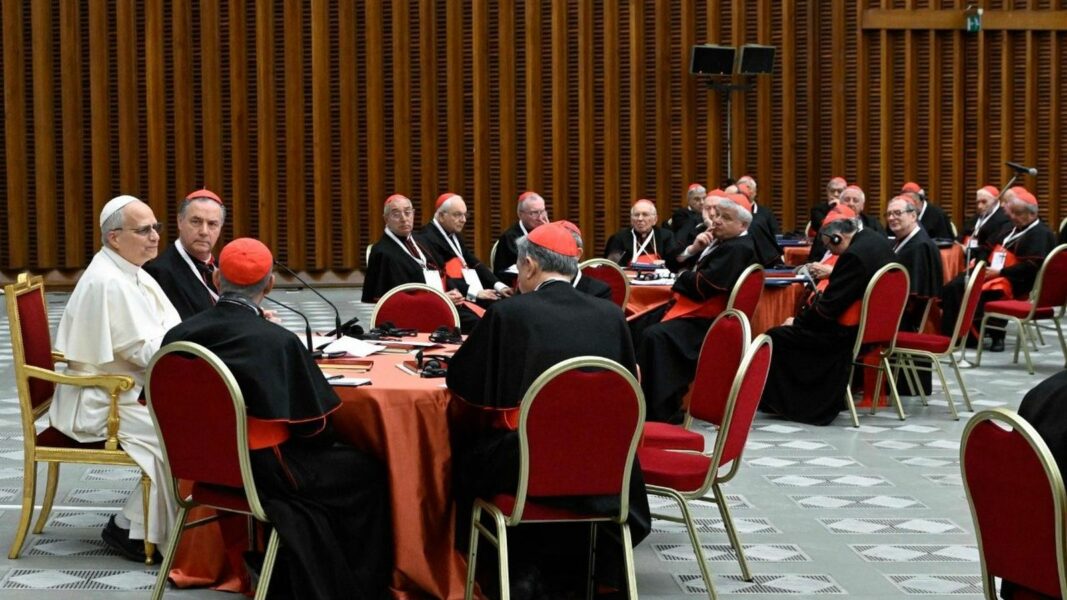
Pope Leo XIV inaugurated the work of the extraordinary consistory this Friday with a direct appeal to the College of Cardinals to strengthen ecclesial communion and accompany him in the governance of the Church. In his opening address for the two-day meeting, the Pontiff asked the cardinals for “strong, explicit, and public” support for the Petrine ministry and encouraged them to exercise episcopal co-responsibility with freedom, frankness, and a spirit of service. He also insisted that the evangelizing mission must remain the criterion guiding the Church’s discernment in the face of today’s global challenges.
The Pope calls for the active collaboration of the College of Cardinals
Before the cardinals gathered in the Paul VI Hall, Leo XIV recalled that ecclesial communion is not a reality acquired once and for all, but a task that demands daily conversion, mutual trust, and the capacity to listen.
For this reason, he wished to address a particularly personal request to the members of the College of Cardinals. The Pontiff stated that the ministry he has received “cannot be lived in solitude” and affirmed that he needs the pastoral experience of those who govern the particular Churches throughout the world.
“I need your support: strong, explicit, and public. I need to feel sustained by you as by brothers,” he declared.
Alongside this backing, Leo XIV also called for sincerity in counsel and freedom to express opinions, convinced that “sincere counsel is always an act of communion.” He likewise encouraged the cardinals to help him recognize both the signs of hope present in the various Churches and the difficulties and resistances that may hinder the evangelizing mission.
The mission, the criterion of all discernment
One of the central themes of the address was the insistence that the consistory should not focus solely on internal Church matters.
“We are not here, above all, to reflect on the internal life of the Church,” the Pope stated.
In his view, all the issues to be addressed during these days—the situation of the world, peace, the common good, or synodality—converge in a single question: how to help the particular Churches today proclaim the Gospel “with greater fidelity, freedom, and credibility.”
Leo XIV recalled that the mission is not merely one activity among many carried out by the Church, but its very reason for being. Precisely for this reason, he maintained that every pastoral decision and every process of discernment must always be guided by this evangelizing horizon.
Four major themes for two days of work
The Pontiff also explained the structure of the extraordinary consistory, organized around four major blocks of reflection.
The first session will be devoted to contemplating the reality of the world with the eyes of faith before proposing pastoral responses. “Before asking ourselves what to do, we must pause before reality,” he noted.
Subsequently, the cardinals will address the relationship between the so-called “culture of force” and the “civilization of love,” taking as reference the encyclical Magnifica humanitas. Leo XIV expressed his interest in learning how this document is being received in the various particular Churches and what challenges it raises in contexts marked by war, violence, or polarization.
The third session will explore the contribution of the Church’s social doctrine to the building of the common good, while the fourth will focus on the development of the synodal process and its application in ecclesial life.
A synodality understood as an attitude
At several points in his address, Leo XIV sought to clarify what he means by synodality, a concept that, he acknowledged, has been interpreted in various ways.
The Pope stated that synodality “is not primarily a set of procedures,” but a spiritual attitude that involves listening, discerning, and jointly assuming responsibility for decisions affecting the Church.
He also rejected the idea that this path diminishes the authority of those who exercise governance responsibilities.
On the contrary, he explained that authority exists to safeguard communion, foster the participation of all, and guide the common journey of the People of God.
“We too learn synodality by practicing it”
As a novelty in the methodology of this consistory, Leo XIV announced that a large part of the work will be carried out in groups, a format uncommon in previous meetings of the College of Cardinals.
The Pontiff acknowledged that for many cardinals this way of working represents a new experience, but he invited them to approach it with confidence, convinced that the pastors of the Church are also called to learn the synodal style by exercising it in practice.
Nevertheless, he clarified that space will remain for personal interventions and for conveying reserved observations, thereby preserving each cardinal’s freedom of expression.
We include below the full text of his words:
Dear brother cardinals:
I welcome you and thank you from the heart for once again accepting my invitation. Your presence expresses the solicitude for the whole Church that we share in the service of the People of God and the mission the Lord has entrusted to us.
At the Consistory last January I expressed a simple desire: that these gatherings would help us learn ever more how to “work together in the service of the Church” and to continue “a conversation that assists me in serving the mission of the whole Church.” These were not merely introductory words. I continue to believe that this is one of the most important responsibilities entrusted to the College of Cardinals. We too, like the whole Church, learn by walking. Communion is never a result acquired once and for all: it remains a daily conversion, taking shape in prayer and through concrete attitudes, relationships of trust, and a willingness to listen to one another.
In recent months I have had occasion to recall several times that we are called to be builders of Christ’s communion, a communion that takes shape in a synodal Church in which all cooperate in the same mission, each according to his own charism and ministry.
As I told the Roman Curia, this communion “is built more by words and documents than by concrete gestures and attitudes that must be manifested in daily life, including in the workplace” (Address to the Roman Curia on the occasion of the Christmas greetings, 22 December 2025). We are not guardians of particular interests, but “disciples and witnesses of the Kingdom of God, called to be in Christ a leaven of universal fraternity” (ibid.).
For this reason I have desired that our work focus on four themes deeply interconnected.
First, we are invited to contemplate the world in which the Church is called to proclaim the Gospel. Before asking ourselves what to do, it is necessary to pause before reality, to look at it with the eyes of faith, and to allow ourselves to be challenged by listening to our brothers and sisters. As I recalled a few weeks ago, “Jesus walks the streets, crosses the squares, visits our neighborhoods, dwells in the places of our daily life. He is the God who is near, who walks with his people, the Lord of history” (Homily in “Plaza de Cibeles,” Madrid, 7 June 2026). Even today the Lord continues to precede us in history, and the Church is called above all to recognize his presence.
Next, we will reflect together on the culture of power and the civilization of love. Many of you come from lands marked by war, violence, social or religious polarization. Yet none of us is untouched by the many forms of conflict, abuse, and fracture that run through our societies today. Therefore, the discernment we are called to make concerns us all and challenges the Church’s mission in every context. The encyclical Magnifica humanitas offers us some precious keys for reading this time. Above all, I am interested in hearing how these pages resonate in your Churches, what questions they raise, what perspectives they open, what steps they suggest. Indeed, an encyclical continues its journey when it is received, interpreted, and embodied in the concrete life of the Churches.
The third session will again explore Magnifica humanitas, questioning the contribution the Church can offer to the building of the common good. We live in a time when the temptation of fragmentation grows and particular interests easily prevail. The Church’s social doctrine reminds us that the common good does not arise spontaneously but requires shared responsibilities. For the Church, this takes a very precise form: a synodal style at the service of the mission of the Kingdom. The encyclical Magnifica humanitas recalls this in no. 86, adding that it requires attention to the way decisions are made and responsibilities exercised, in transparency, evaluation, and co-responsibility.
Finally, we will dedicate a session to the path of implementing the Synod. This last session does not open a new topic but gathers and relates what we will have shared in the previous sessions. In the face of the world’s wounds, the building of the common good, and the Church’s mission, synodality indicates a way of proceeding: to listen, to discern, and to assume together the responsibility for the decisions the Lord entrusts to us. Synodality is not primarily a set of procedures; as I have had occasion to say several times, synodality is an attitude, an openness, a willingness to understand. At times it has been interpreted as a diminution of authority. In reality, it helps us to understand more deeply the meaning of authority itself, which exists to safeguard communion, to foster the participation of all, and to guide the common path of the Church.
These four sessions find their unity in the missionary perspective we shared at the last Consistory and which I recalled in the letter of last April. We are not here above all to reflect on the internal life of the Church.
All the themes we will address—the gaze upon the world, peace, the common good, synodality—converge in a single question: how can we help our Churches today to proclaim the Gospel with greater fidelity, freedom, and credibility? The mission is not one of the Church’s many tasks. It is its reason for existing and, precisely for that reason, it also becomes the criterion that guides our discernment. When we learn to listen to one another, to bear responsibilities together, to recognize the action of the Spirit in the various Churches, we are not merely improving our way of working; we are becoming a Church more capable of encountering the men and women of our time and bearing witness to them of the joy of the Gospel.
Therefore I wish to ask you for particular help. The ministry the Lord has entrusted to me cannot be lived in solitude. It needs your experience, your pastoral wisdom, your knowledge of the Churches and the peoples entrusted to you. I count on you to help me discern what the Spirit is saying to the Church today. I need your support: strong, explicit, and public. I need to feel sustained by you as by brothers.
I therefore ask you to accompany me not only during these days of work but also in the daily service of the communion of the universal Church. Help me to listen to what emerges in the Churches, to recognize the signs of hope that often grow in silence, but also not to ignore the hardships, misunderstandings, and resistances that may slow the journey. I need your freedom, your frankness, and your loyalty. Sincere counsel is always an act of communion.
I also ask you to sustain, each in his own Church and ministry, this style of ecclesial discernment. I know it requires patience and at times raises questions. Nevertheless, I am convinced that the Lord is teaching us a more evangelical way of living together the responsibility he has entrusted to us. The credibility of our witness and the fruitfulness of our mission also depend on this.
I therefore wish to encourage you to live the group work with conviction. I am well aware that for many of us this is not the usual way of conducting a Consistory. Yet this too forms part of the path by which the Lord is leading us. Naturally, space will also remain for personal interventions and, as always, each one may freely send me reserved observations or reflections. But I ask you to enter this ecclesial exercise with confidence. We too learn synodality by practicing it; we learn together to grow in communion. I thank you already for your availability, your interior freedom, and your love for the Church.
Let us entrust these days to the Holy Spirit, that he may make us docile to his voice and grant us the grace to seek together what best serves the Gospel and the good of the People of God.
Thank you.