


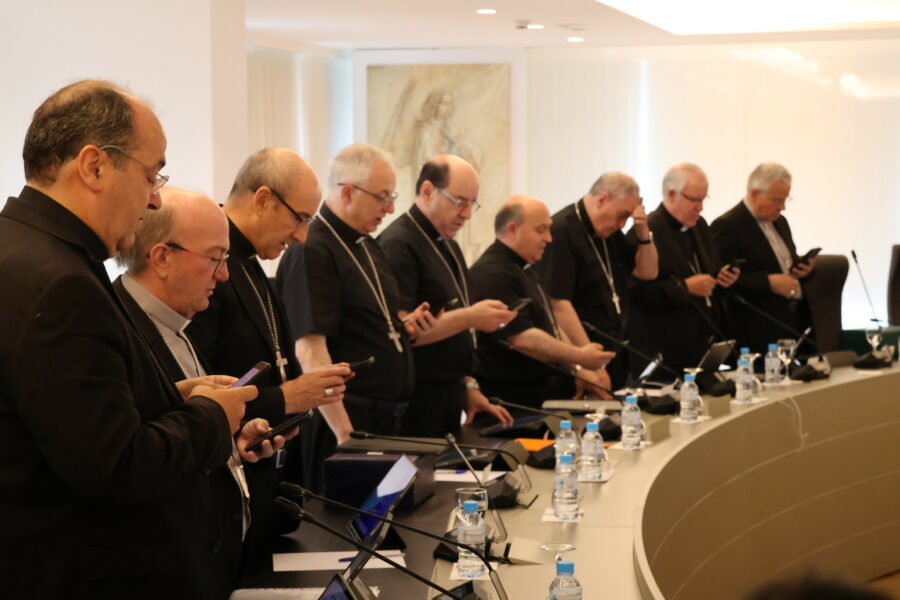
The Standing Committee of the Spanish Episcopal Conference (SEC) has examined the first report prepared by the Office for the Reception of Complaints of Hate Crimes and Offenses for Religious Reasons against Catholic faithful, a document that arrives at a time of growing political debate following the agreement between PSOE and Sumar to remove the offense against religious feelings from the Criminal Code.
During the press conference after the meeting of the Standing Committee, held on June 22 and 23 in Madrid, the secretary general of the SEC, Monsignor Francisco César García Magán, expressed his concern about the legislative proposal promoted by the government partners.
The episcopal spokesperson stated that it is striking that the elimination of legal protection for religious freedom and religious feelings is being proposed while other criminal provisions are maintained. “It is noteworthy that the glorification of terrorism is not included,” he pointed out, adding that it is also “strange” that protection is to be withdrawn from institutions such as the Crown or religious beliefs. “In a healthy and mature democracy, it is striking that such changes occur,” he affirmed.
The report shows that Catholics are the most affected
The Office for the Reception of Complaints of Hate Crimes and Offenses for Religious Reasons was created by the Episcopal Conference in June 2025 with the aim of collecting data on attacks, discrimination, and acts of hostility directed against believers on account of their faith.
The report, which must still be examined by the next Plenary Assembly before its publication, includes an analysis of the cases registered during the past year.
During the press conference, García Magán revealed that the data collected show that the highest percentage of offenses for religious reasons affects Catholics. In light of this fact, he argued that freedom of expression cannot become a justification for gratuitous offense.
“There is no freedom to offend,” stated the secretary general of the Episcopal Conference, demanding for Catholics the same social respect that is required when it comes to other religious confessions.
Asked about some specific cases that have reached the courts as possible offenses against religious feelings, García Magán acknowledged that, personally, certain actions are offensive to him. “One thing is humor and another is offense; they are different limits,” he stressed.
The bishops review the reception of Amoris Laetitia
The Standing Committee also devoted part of its work to analyzing the reception that the apostolic exhortation Amoris Laetitia, published by Pope Francis in 2016 after the synods on the family, has had in Spain.
The review responds to the invitation made by Leo XIV to commemorate the tenth anniversary of the document and will serve as the basis for the meeting that will bring together next October the presidents of the episcopal conferences from around the world.
The Spanish bishops studied the pastoral work carried out during this decade and the initiatives promoted in the dioceses to accompany families in an increasingly complex social and cultural context.
The bishops do not issue a new statement on political corruption
The Spanish political situation was also present during the appearance of the secretary general of the SEC.
Asked about the recent corruption cases affecting the national political landscape, García Magán described the problem as “serious” and recalled that Pedro Sánchez came to power through a motion of no confidence based precisely on the need to combat corruption.
Without entering into partisan assessments, the episcopal spokesperson recalled that the Spanish Constitution provides for various institutional mechanisms to address situations of political crisis and noted that it is up to the powers of the State to assess the tools provided by the legal system.
At the same time, he ruled out that the Episcopal Conference will prepare a new specific document on the current political situation and invited a rereading of texts already published by the Spanish bishops that remain fully in force.
Preparations for the Synodal Assembly continue
The Standing Committee also received information on the preparations for the future Synodal Assembly of the Church in Spain, scheduled for the second half of 2027.
Monsignor Francisco Conesa presented to the bishops the developments arising from the document recently published by the General Secretariat of the Synod, which sets out the stages and criteria for the implementation phase of the synodal process in the local Churches.
New president of Cáritas Española
In the chapter on appointments, the Standing Committee approved the designation of Luis Ayala Cañón, a layperson from the Archdiocese of Madrid, as the new president of Cáritas Española, replacing Manuel Bretón Romero, who has held the position since 2017.
The bishops also ratified various appointments in ecclesial associations and devoted part of the meeting to evaluating the recent apostolic visit of Leo XIV to Spain, on which they have made public a message addressed to the faithful and a letter of thanks to the Pontiff.