


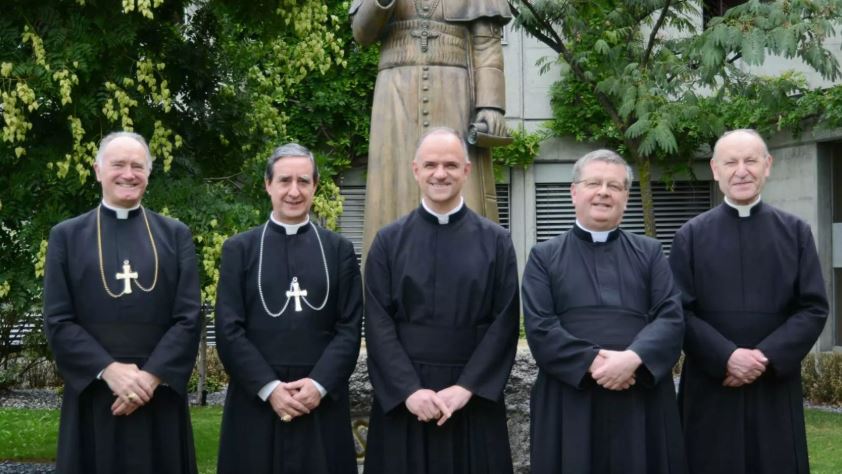
The Priestly Fraternity of Saint Pius X (FSSPX) has made public on June 24 an open letter addressed to Pope Leo XIV and to all the cardinals of the Church, accompanied by an extensive 28-page profession of faith in which it systematically sets out its doctrinal positions and its diagnosis of the crisis facing the Catholic Church.
The news was first reported by the Italian portal Messa in Latino, which initially published the letter signed by the Fraternity’s leadership and announced the forthcoming release of the complete doctrinal document. Subsequently, the FSSPX made the full text public, presenting it as a “profession of Catholic faith to enlighten souls in the face of modern errors.”
The publication comes just days before the episcopal consecrations scheduled for July 1 in Écône and on the eve of the consistory convened by Leo XIV for the end of June.
A profession of faith addressed to Rome
The letter is signed by the Fraternity’s Superior General, Fr. Davide Pagliarani, together with his principal collaborators: Bishop Alfonso de Galarreta, Christian Bouchacourt, Bishop Bernard Fellay, and Franz Schmidberger.
In the text, the signatories explain that they consider the time has come to present an “integral profession of the Catholic faith” in light of the situation the Church is currently experiencing.
“The Church today suffers under the pressure of new forces, coming both from within and from without, that push her in every possible direction except —in our view— the right one,” they state.
The Fraternity maintains that the response to this crisis cannot be found in new pastoral solutions or adaptations to the contemporary world, but rather in a return to Catholic Tradition.
“Tradition contains all the remedies for the deepest ills afflicting the Church and the world,” the authors of the document affirm.
At the same time, they express the hope that the text may one day serve as the basis for a doctrinal discussion that is “frank, peaceful, fraternal, and charitable” with the Holy See.
A text against “modern errors”
The profession of faith is structured in seventeen chapters and 154 doctrinal propositions addressing topics such as Revelation, the Trinity, grace, original sin, the Redemption, the Virgin Mary, the Church, the Magisterium, morality, liturgy, the sacraments, and the last things.
Throughout the document, the Fraternity reaffirms the traditional teachings of the Magisterium prior to the Second Vatican Council and explicitly rejects doctrines and currents it considers incompatible with the Catholic faith.
Among these it mentions modernism, religious liberalism, indifferentism, laicism, and certain forms of ecumenism.
The text further maintains that the current ecclesial crisis “cannot be reduced to a mere conflict of sensibilities, liturgical preferences, or pastoral options,” but rather affects “the very foundations of faith and morality, of the priesthood and of worship.”
An explicit critique of the Second Vatican Council and subsequent reforms
The Fraternity asserts that “modern errors” have entered the life of the Church “through the Second Vatican Council and the post-conciliar reforms,” provoking a crisis of great magnitude.
According to the text, agnosticism has weakened the sense of God; naturalism has obscured the need for grace; relativism has attacked the immutability of dogma; and collegiality and synodality have affected the Church’s hierarchical constitution.
Likewise, the document attributes to these transformations phenomena such as the weakening of doctrinal preaching, the trivialization of sin, the crisis of the family, the loss of the sense of God, the decline in vocations, and doctrinal confusion among the faithful.
Defense of the traditional Mass
The FSSPX reaffirms traditional doctrine on the sacrifice of the Mass, the real presence of Christ in the Eucharist, and the formative value of Catholic liturgy.
The document maintains that the traditional Roman Mass expresses “with incomparable clarity” Catholic doctrine on the eucharistic sacrifice, the priesthood, and the real presence.
It also states that the liturgical reforms following the Council departed from the Church’s centuries-old tradition and contributed to a loss of the sacrificial sense of worship.
The Fraternity concludes that an authentic Catholic restoration must necessarily pass through the restoration of traditional divine worship.
Ecumenism, religious liberty, and morality
The text also devotes extensive sections to issues that have been particularly debated since the Second Vatican Council.
Among other statements, it rejects the idea that non-Christian religions can be considered paths of salvation in themselves, criticizes ecumenism understood as a relativization of the uniqueness of the Catholic Church, and defends traditional doctrine on the social kingship of Christ.
In moral matters, it reaffirms Catholic teaching on marriage, rejects any legitimization of abortion, euthanasia, and contraception, and criticizes the possibility of presenting situations objectively contrary to divine law as compatible with God’s plan.
It also rejects the admission to the sacraments of those who publicly persevere in situations the Church has always considered incompatible with Catholic morality.
On the eve of a new chapter
With this initiative, the Fraternity formally presents to Rome a complete doctrinal synthesis of its positions, insisting that its intention is not to offer its own proposal for the future of the Church, but to call for a return to Catholic Tradition as the criterion for addressing the current crisis.
“We can do nothing against the truth, but only for the truth,” the letter concludes, citing the Second Letter of Saint Paul to the Corinthians.