


The Vatican has rejected the request from the German Episcopal Conference to allow lay faithful to deliver the homily during the celebration of Mass under certain exceptional circumstances. The decision, communicated by the Dicasterio for Divine Worship and the Discipline of the Sacraments, represents a new setback for some of the proposals promoted by sectors of the German Church in recent years.
Read also: German bishops will ask the Vatican to authorize lay preaching at Mass
According to a note released on June 23 by the dicastery presided over by Cardinal Arthur Roche, the request had been submitted on March 30 and sought an indult allowing a duly authorized layperson to preach in place of the homily during the Eucharistic celebration.
The homily is not a mere disciplinary norm
In a letter dated June 17 and addressed to the president of the German Episcopal Conference, Bishop Georg Bätzing, the prefect of the dicastery, Bishop Heiner Wilmer, communicated that it was not possible to grant the requested dispensation.
The main reason cited by Rome is liturgical and theological in nature. The document states that reserving the homily to the priest or deacon “is not a mere disciplinary norm, but derives from the very nature of the liturgy.”
The Vatican recalls that the homily is an integral part of the Liturgy of the Word, is intrinsically linked to the proclamation of the Gospel, and constitutes an exercise of the munus docendi —the teaching mission— entrusted to ordained ministers through the sacrament of Holy Orders.
Therefore, it maintains that this discipline cannot be modified through a simple indult or administrative exception.
A new limit on German reform proposals
The request is part of a broader context of debates within the Church in Germany regarding the role of the laity and the structure of ecclesial ministries.
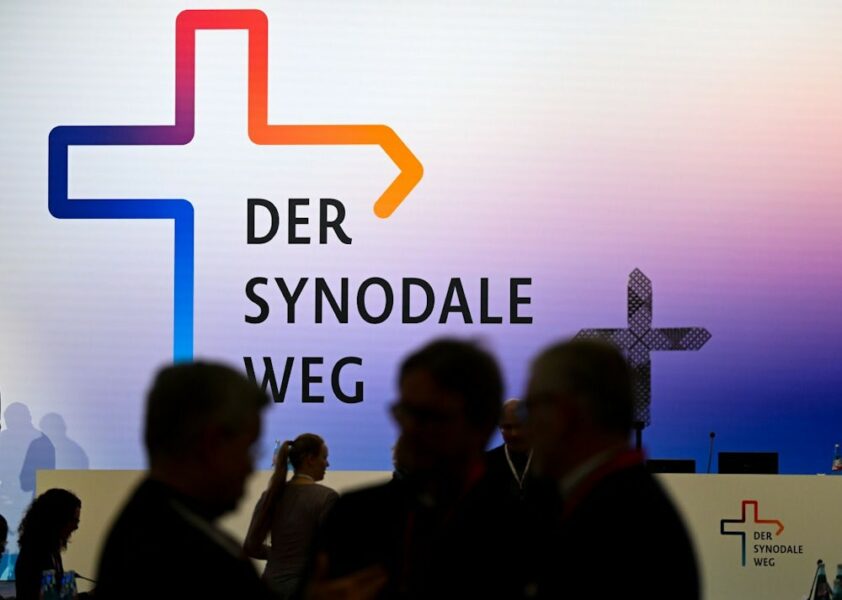
In recent years, various bishops and bodies linked to the so-called Synodal Way have promoted reforms aimed at expanding the responsibilities of the lay faithful in areas traditionally reserved to the clergy.
The possibility of laypeople delivering the homily during Mass was among the issues raised in some of those debates, especially in light of the shortage of priests affecting numerous German dioceses.
However, the response from the Dicasterio for Divine Worship explicitly closes that avenue, considering that the matter affects the very nature of the liturgical celebration.
Other forms of preaching are possible
The Vatican note emphasizes, however, that the Church’s current legislation already provides for numerous forms of proclamation and preaching that may be entrusted to the laity outside the homily and outside the Eucharistic celebration.
In this regard, Rome recalls that the faithful can play a significant role in evangelization, catechesis, and other forms of proclaiming the Word of God, always respecting the proper nature of each ministry within the Church.
The document concludes by stressing the importance of promoting ongoing formation for priests and deacons so that the homily may fully develop its pastoral and spiritual effectiveness.
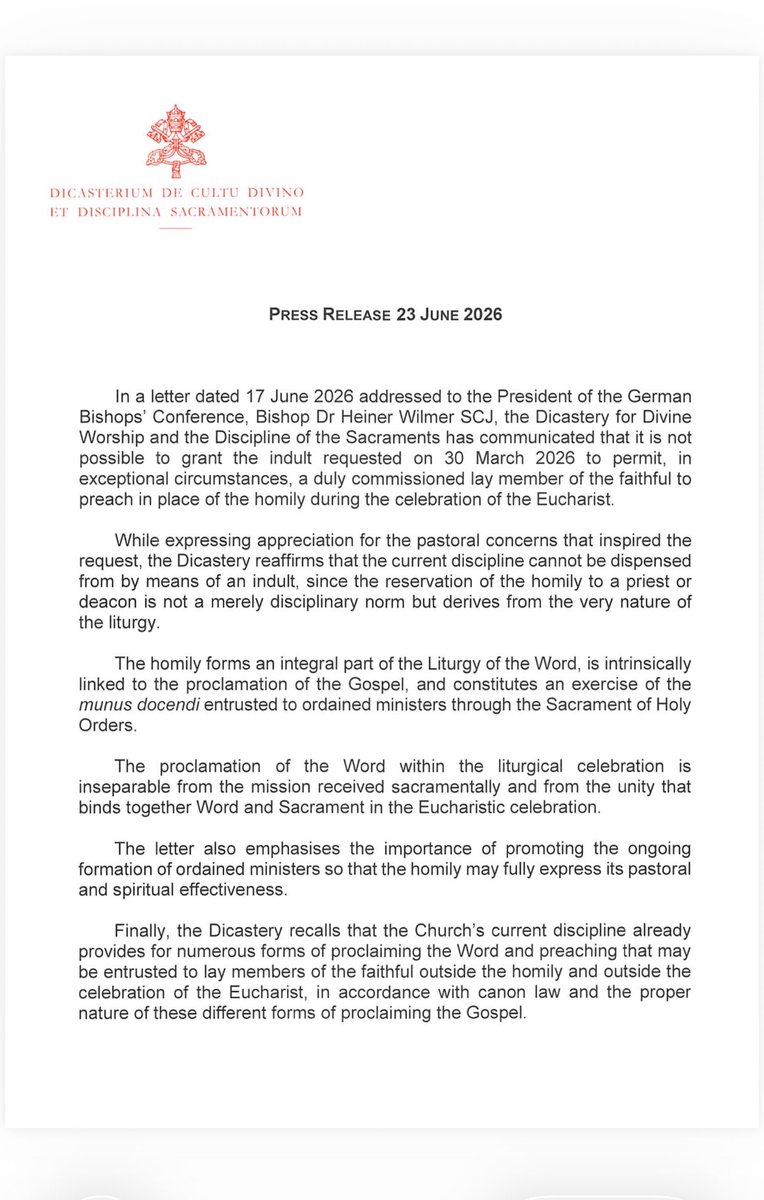
Translation:
DICASTERY FOR DIVINE WORSHIP AND THE DISCIPLINE OF THE SACRAMENTS
PRESS RELEASE – JUNE 23, 2026
In a letter dated June 17, 2026, and addressed to the president of the German Episcopal Conference, Bishop Dr. Heiner Wilmer SCJ, the Dicastery for Divine Worship and the Discipline of the Sacraments has communicated that it is not possible to grant the indult requested on March 30, 2026, to allow, in exceptional circumstances, a duly authorized lay faithful to preach in place of the homily during the celebration of the Eucharist.
While expressing appreciation for the pastoral concerns that inspired the request, the Dicastery reaffirms that it is not possible to dispense from the currently applicable discipline through an indult, since the reservation of the homily to the priest or deacon is not a mere disciplinary norm, but derives from the very nature of the liturgy.
The homily is an integral part of the Liturgy of the Word, is intrinsically linked to the proclamation of the Gospel, and constitutes an exercise of the munus docendi (teaching ministry) entrusted to ordained ministers through the sacrament of Holy Orders.
The proclamation of the Word within the liturgical celebration is inseparable from the mission received sacramentally and from the unity that links the Word and the Sacrament in the Eucharistic celebration.
The letter also emphasizes the importance of promoting ongoing formation for ordained ministers so that the homily may fully express its pastoral and spiritual effectiveness.
Finally, the Dicastery recalls that the Church’s current discipline already provides for numerous forms of proclamation of the Word and preaching that may be entrusted to lay faithful outside the homily and outside the celebration of the Eucharist, in accordance with canon law and the proper nature of these different forms of announcing the Gospel.