


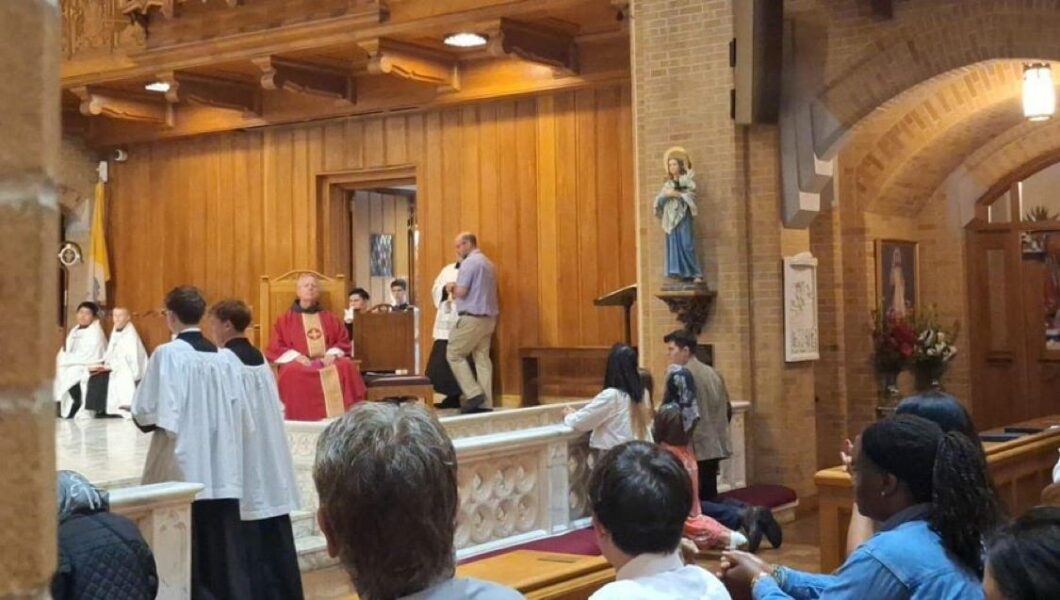
A family from the Diocese of Charlotte has brought its case before the Vatican after reporting that it was denied Holy Communion on several occasions for receiving it kneeling. The appeal, addressed to Cardinal Arthur Roche, Prefect of the Dicastery for Divine Worship and the Discipline of the Sacraments, marks a new chapter in the growing liturgical controversy that has affected this U.S. diocese since the arrival of Bishop Michael Martin.
The information, published exclusively by AdVaticanum, reveals that the appeal was filed on June 20 and requests Rome’s intervention to examine what the family considers a violation of their rights as Catholic faithful.
Three refusals to administer Communion
According to the document sent to the Vatican, the father of the family states that he, his wife, and their two children were denied Communion on three separate occasions—April 30, May 10, and May 17—at Our Lady of Grace parish in Greensboro.
The appeal maintains that the family approached to receive the Eucharist in exactly the same manner they had done for years: kneeling at the communion rail. However, it claims that on each of those occasions the minister of Communion passed by without administering the Sacrament.
The petitioner further emphasizes that all members of the family are Catholics in full communion with the Church and that none is subject to canonical censure or any impediment to receiving the sacraments.
A controversy rooted in restrictions imposed by the bishop
The controversy stems from a pastoral letter issued by Bishop Michael Martin in December 2025. Through that directive, the diocese prohibited the use of communion rails, kneelers, and other aids that facilitate receiving Communion kneeling.
The measure provoked a strong reaction among many of the faithful, especially in parishes where the practice of receiving Communion kneeling was deeply rooted.
According to the appeal presented in Rome, the consequences of that policy began to surface when some of the faithful continued to approach to receive the Eucharist in their customary manner and were met with refusals by the ministers distributing Communion.
The appeal cites the Church’s universal law
The father invokes Canon 912 of the Code of Canon Law, which states that every baptized person not prohibited by law must be admitted to Holy Communion. He also cites Canon 843 §1, which forbids denying the sacraments to those who request them at an appropriate time and are properly disposed.
The appeal further recalls number 91 of the instruction Redemptionis Sacramentum, which expressly states that it is not lawful to deny Communion to a member of the faithful solely because he or she wishes to receive the Eucharist kneeling.
It also mentions a 2002 response issued by the then Congregation for Divine Worship and the Discipline of the Sacraments, which described as a grave violation of the fundamental rights of the faithful the denial of Communion based solely on the kneeling posture.
A situation aggravated by the mother’s pregnancy
The appeal also includes a particularly sensitive element. The petitioner’s wife is pregnant with their third child, and, as the document explains, as the pregnancy progresses it will become increasingly difficult for her to rise from a kneeling position without physical assistance.
Therefore, the removal of communion rails and other supports affects not only a matter of personal devotion but also concrete circumstances that physically hinder receiving Communion in the accustomed manner.
Rome must issue a ruling
After submitting various petitions to the diocese and receiving negative responses, the family decided to appeal formally to the Holy See through the procedure provided by Canon Law.
Among other measures, the appeal asks Cardinal Roche to provisionally suspend the directive issued by Bishop Martin while the case is under review, to examine whether the reported refusals violated Church law, and to state explicitly that no member of the faithful may be denied Holy Communion solely for choosing to receive it kneeling.
The Dicastery for Divine Worship has not yet indicated whether it will formally accept the appeal. Nevertheless, the case highlights an issue that has generated growing concern among many Catholics: the possibility that fully disposed faithful may be denied the Eucharist because of a posture that the Church’s universal law expressly recognizes as legitimate.