


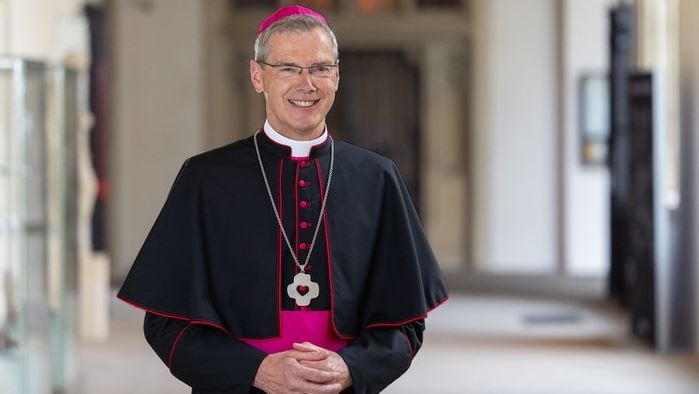
The Diocese of Münster has had a new bishop since Sunday. Bishop Heiner Wilmer officially assumed the governance of this ecclesiastical jurisdiction, the largest in Germany with around 1.6 million Catholics, during a celebration held in St. Paul’s Cathedral.
Wilmer’s installation ends more than a year of vacancy following the resignation due to age of Bishop Felix Genn. The new bishop will also combine this responsibility with the presidency of the German Bishops’ Conference, a position to which he was elected last February.
The ceremony was attended by representatives of the Church, civil authorities and various institutions of German society. During the celebration, the papal bull by which Pope Leo XIV appointed him Bishop of Münster was read.
A call to persevere in the faith
In his first homily as head of the diocese, Wilmer focused his message on faith, hope and Christian witness in a society marked by uncertainty.
The new bishop explained that in the days leading up to his installation he had made a pilgrimage through various parts of the diocese, meeting with groups of the faithful and residents from different regions. According to his account, he asked the same question to the people he encountered: what had been their experience of faith.
From those encounters, he highlighted three expressions he heard repeatedly during the journey and used them as the axis of his preaching: “Do not be afraid. Stand firm. Remain in the faith.”
“Our time has become restless,” he stated during the homily. “We are torn between a deep desire for meaning, permanence and eternity, and a reality that often gets lost in the immediate.”
Wilmer pointed out that professing the faith does not consist only in affirming certain convictions, but also in living in a manner consistent with them. In that context, he encouraged the faithful to give witness to their faith in everyday life.
References to victims of abuses of power
During his homily, the new bishop evoked several figures linked to the history of Münster. Among them he mentioned the writer Annette von Droste-Hülshoff, whose work he used to reflect on the suffering of those who have been marginalized or silenced.
In that context he referred to the victims of abuses of power.
“These are stories of survivors of abuses of power. Stories that for a long time were not heard. Stories that must not leave us at peace,” he stated.
Wilmer also recalled Maria of the Divine Heart and Blessed Maria Eutimia, presenting them as examples of service to others and of Christian commitment in difficult circumstances.
Participation of civil and ecclesiastical authorities
Among those attending the celebration was the Minister-President of North Rhine-Westphalia, Hendrik Wüst, who highlighted the role of the Churches in a society undergoing profound changes.
According to Wüst, Christian communities can help provide guidance, foster social cohesion and strengthen commitment to democratic values. The regional leader also expressed his confidence in the new bishop’s ability to carry out his ministry at a time marked by significant challenges for the Church and for society.
The German Bishops’ Conference was represented by its vice-president, the Bishop of Fulda, Michael Gerber, who spoke on behalf of the German bishops. Gerber highlighted Wilmer’s pastoral trajectory and referred to the responsibilities he assumes by combining the governance of the Diocese of Münster with the presidency of the Bishops’ Conference.
A process with lay participation
One of the notable aspects of the day was the participation of lay faithful at various moments of the celebration.
Representatives of a group of laypeople carried the crozier of St. Ludger, the first Bishop of Münster, to the altar, following a tradition proper to the diocese. Their presence also had special significance, as they had taken part in the preparatory phase of the process that led to the election of the new bishop, something that occurred for the first time in this diocese.
The crozier was subsequently handed over to Wilmer by his predecessor, Bishop Felix Genn.
At the end of the celebration, the new bishop confirmed the vicar general Klaus Winterkamp in his post.
The Diocesan Council of Catholics, the body that brings together associations, movements and lay representatives of the diocese, also took part in the welcome events. Its representatives presented the new bishop with a rainbow-colored umbrella, offered as a symbol of the diversity of people and realities present in the local Church.
From Hildesheim to Münster
Until now, Wilmer had exercised his ministry as Bishop of Hildesheim, a diocese he had led since 2018.
Born in 1961 in the German region of Emsland, he entered the Congregation of the Priests of the Sacred Heart of Jesus, known as the Dehonians, at the age of nineteen. He studied theology and humanities in Germany, France and Italy and later held various responsibilities within his religious congregation.
Between 2015 and 2018 he served as Superior General of the Dehonians in Rome before being appointed Bishop of Hildesheim by Pope Francis.
President of the German Bishops’ Conference
Wilmer’s arrival in Münster comes only a few months after his election as President of the German Bishops’ Conference.
In recent years he has participated in the German Synodal Way, the process of reflection promoted by the Church in Germany following the abuse crisis. In that context he supported various proposals related to the participation of women in ecclesial life, the discipline of priestly celibacy and blessings for same-sex couples.
At the same time, he has repeatedly stressed the importance of maintaining communion with the universal Church and of developing any initiative within the framework of canon law.
Since his election to lead the German episcopate, he has maintained contacts with the Holy See and has taken part in conversations about the future synodal structures planned in Germany.
A new stage for the diocese
In his final address, Wilmer thanked those present for their welcome and expressed words of recognition for those who had participated in organizing the ceremony and for the people who followed the celebration from the cathedral square or via the live broadcast.
“The Church is beautiful, it is attractive, especially when people gather, believe together, sing together and hope together,” he stated.
The new bishop also thanked his predecessor for the work he had carried out during the sixteen years he led the diocese and acknowledged the efforts of those who assumed responsibilities during the period of vacancy.