


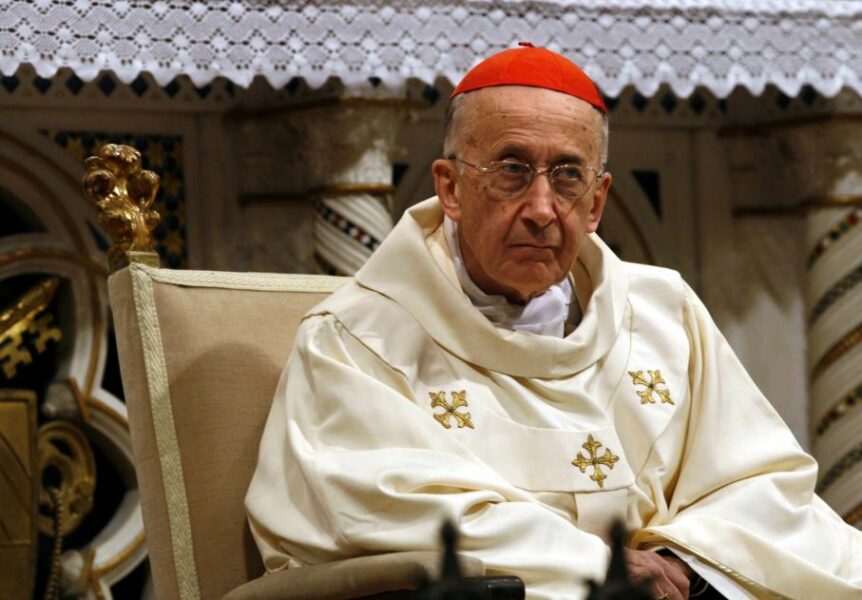
The spiritual testament of Cardinal Camillo Ruini, one of the most influential figures in the Italian Church in recent decades, has been published in full by the Italian portal Messainlatino.it after the document was cited by Pope Leo XIV during his homily at the Funeral Mass.
The text, dated June 3, 2016, the Solemnity of the Sacred Heart of Jesus, offers a broad personal reflection on the life, priesthood, and episcopal service of the former president of the Italian Episcopal Conference and Vicar of the Pope for the Diocese of Rome for more than two decades.
Gratitude for a life at the service of the Church
Throughout his testament, Ruini conducts an extensive examination of conscience marked by gratitude to God for the faith received, the priestly vocation, and the years of ministry. The cardinal recalls with special affection his family members, formators, and closest collaborators, as well as the many priests and laypeople with whom he shared his ecclesial service.
He also dedicates words of recognition to the Second Vatican Council, which he states he lived “with joy,” while at the same time asserting his opposition to what he considers the “post-conciliar deviations” that emerged in some ecclesial circles.
Ruini further presents his episcopal appointment as an unexpected grace that revitalized his vocation and especially recalls his close collaboration with Saint John Paul II for more than twenty years.
The memory of John Paul II and Benedict XVI
The cardinal describes John Paul II as a decisive figure in his spiritual and pastoral life. In his testament, he states that he experienced in him a concrete manifestation of God’s presence, highlighting his life of prayer, his strength in faith, and his capacity to love and forgive.
He also expresses his gratitude toward Benedict XVI, with whom he collaborated during the early years of his pontificate and for whom he manifests an affection that, as he writes, remained alive when he drafted the document.
The words about Pope Francis
Regarding the pontificate of Francis, Ruini recalls that he received his election in 2013 with joy and sought to support him from the beginning.
“Even today I rejoice and thank him for his extraordinary evangelizing impulse,” the cardinal writes.
However, he then acknowledges a personal unease regarding some decisions and ecclesial orientations promoted during that pontificate.
“I must confess, however, that I find myself in a situation of discomfort, not certainly for personal reasons, but because I find it difficult to understand some orientations that seem to me to reopen wounds that, after the Council, had barely been healed,” he states in the document.
An examination of conscience marked by humility
The document is marked by numerous personal confessions. Ruini acknowledges the insufficiency of his response to God’s love, the weakness of his spiritual life, and the temptations against faith that he claims to have experienced throughout his life.
He also admits that at times he acted with excessive harshness in the exercise of his responsibilities and asks forgiveness from those who may have been hurt by his decisions.
In one of the most personal passages of the text, the cardinal acknowledges that his faith, although constant since childhood, never reached the depth he would have desired to fully sustain a life dedicated to God and others.
Preparing for the definitive encounter with God
The testament concludes with a meditation on old age, the progressive loss of strength, and preparation for death. Ruini views this stage as a providential opportunity to prepare for the definitive encounter with God.
“Father rich in mercy, grant to me and to all my brothers and sisters in humanity the grace of final perseverance,” he writes in the final lines of the document.
The full publication of this spiritual testament offers a privileged glimpse into the thought and inner life of one of the most relevant protagonists of Italian Catholicism in recent decades, whose reflections continue to arouse interest both inside and outside the Church.
We leave below the complete testament:
Spiritual Testament of Camillo Ruini
Thanksgiving and petition for repentance to God and to the brethren.
In the name of the Father and of the Son and of the Holy Spirit.
I give you thanks, Lord, for the long life you have given me, for having made me a Christian, for the call to the priesthood, and for my many years as a priest and then as a bishop. I give you thanks for having been and for continuing to be so loved, by my parents Francesco and Iolanda, by my sister Donata, by my grandparents Idelberto and Maria and by my uncle Guido, with whom I lived: their affection gave me strength and security throughout my life. I give you thanks for the other grandmother, Emma, for my uncles Riccardo and Tina, for my cousin Carlo and his wife Carla, and for the rest of my family. I give you thanks for being loved and cared for with such dedication by my most faithful Pierina, loved and attended with great generosity by my secretary Don Mauro, now bishop of Tivoli, by Mara, who wished to remain by my side even after the end of my mandate as Cardinal Vicar, by Don Nicola, Angela, Claudia of the CEI, and many other collaborators of mine. And, in domestic life, by Palmizia, Sergio, and Raffaella.
I give you thanks, Lord, for my friends in Sassuolo, for my parish priest Mons. Zelindo Pelluti, for Don Dino Carretti, who guided and accompanied me in welcoming the priestly vocation. I give you thanks for the years of formation at the Capranica College and at the Gregorian University, for the superiors, professors, companions, and friends I had, in particular the late Don Osvaldo Ronzon, Don Valerio Massucci, Don Nicola Battarelli, and Don Nicolino Barra. I give you thanks for my service as a priest and professor in Reggio Emilia, for my bishops Beniamino Socche and especially Gilberto Baroni, from whom I received so much and learned so much, for the many priests and laypeople, men and women of various generations, especially for those who are still closest to me: from them I received no less than what I tried to give. I give you thanks for the Second Vatican Council, for having lived it and contributed to making it lived with joy in Reggio Emilia, and also for having given me the lucidity and strength to oppose post-conciliar deviations.
Later, Lord, when a certain weariness threatened to weigh down my priesthood, you had mercy on me and, with surprise and bewilderment, you called me to the episcopate: it was a grace as great as it was undeserved, a renewal and strengthening of my vocation. From then on, those who pray for me and according to my intentions multiplied, making up for the poverty of my prayer. From then on, in a short time, I became a public figure, although I always tried to remain a simple person: in this sense, to remain as I was before.
A completely special grace for me was John Paul II. From the beginning of his ministry I saw fulfilled in him what I dimly perceived within myself and what Paul VI had already pointed out, amid many resistances and misunderstandings. Never, however, would I have imagined becoming a direct collaborator of his, as I was for more than twenty years, from the autumn of 1984, when the Congress of Loreto was being prepared, until his death. In John Paul II I experienced your presence, Lord; I was able to touch with my hands the union in prayer, the inseparability between prayer, life, and apostolate, the value of faith that guides history, the capacity to love and to forgive. Through my own fault, Lord, I tried to follow his example in what corresponded to my inclination, but much less in what would have remedied my gravest shortcomings.
Specifically, during the twenty-two years of my Roman ministry, in the CEI and in the Vicariate, I hope, Lord, to have acted not for personal interests but for the objectives entrusted to me and which I shared wholeheartedly: thus I overcame not insignificant resistances and hostilities, especially at the beginning, both in the CEI and in the Vicariate. I recognize and confess, however, that at times I acted with underlying harshness, under generally—though not always—kind forms: for this I ask forgiveness from the Lord and from all the people, living and deceased, to whom I caused pain. But I must give you thanks, Lord, for the people with whom I had the joy of collaborating: in particular Mons. Giovanni Battista Re and Mons. Stanislao Dziwisz, the secretaries of the CEI Mons. Dionigi Tettamanzi, Mons. Ennio Antonelli, and Mons. Giuseppe Betori, the vicegerents of Rome Mons. Remigio Ragonesi, Mons. Cesare Nosiglia, Mons. Luigi Moretti, Annick Johnson, Dino Boffo, Sergio Belardinelli, Vittorio Sozzi, the late Mons. Giuseppe Cacciari, Cardinal Angelo Scola, but also many others, among them the parish priests of Rome and the directors of the offices of the CEI and the Vicariate: with not a few of them I have maintained a lasting bond.
Now I have been emeritus for eight years and I give you thanks, Lord, for having granted me all this time to prepare for the supreme encounter with you, but I also ask your forgiveness for having made very little use of this time for that purpose. In truth, until now I have been a very busy emeritus, due to various assignments I have received and especially because I have devoted myself to the passion for study that was born in me during adolescence and that has always accompanied me since. The themes I have chosen, God and life after death, by themselves dispose one to the encounter with you, and the two books in which I have condensed them intend to be a contribution, albeit minimal, to evangelization. However, in practice, the work of writing has not favored the freedom of my spirit for prayer.
But the causes of this lack of freedom are above all my sins and the weakness of my response to the Lord’s love: these things I would like to confess, hoping not to scandalize anyone, but to encourage prayer for me and to do it better than I do. I confess above all the smallness of my faith. From childhood I had the gift of faith and prayed my prayers; faith has accompanied and sustained me always until today, particularly in welcoming the call to the priesthood. I dedicated myself to defending the faith, already from my high school years, without timidity or fear. I tried to deepen through study its contents and its reasons, to propose and defend it with passion and conviction. Despite all this, however, in the secret of my heart I was always tempted precisely in faith, although, by the grace of God, I believe I never yielded to temptation. Specifically, my faith was and remains insufficient to sustain and animate a life that should be totally dedicated to God and to the brethren. Lord, have mercy on me and strengthen me in faith, in the last and decisive stage of my earthly journey.
Virgin Mary, our sweet Mother, intercede so that the love of God may fill my heart and grant me true freedom. “It is more blessed to give than to receive” (Acts 20:35): this word of Jesus has always been for me almost an evidence and a natural inclination, also linked to the fact that I never found myself in need. Thus, thanks to the great generosity of my parents and my sister, during all the time I was a priest in Reggio I was able to work practically for free. Later I received a lot of money, but I did not increase the family’s assets, allocating the surplus to help people in difficulty. Here too, however, I did not put into practice the Lord’s invitation to leave everything to follow him and did not renounce a simple but comfortable standard of living.
I have always been a “papalist” and I give thanks for it to the Lord and to my formators, in particular to the professors of the Gregorian. After John Paul II, I collaborated for three years with Benedict XVI and I thank him wholeheartedly, also for the affection he still shows me today. When Pope Francis was elected I rejoiced and, to the extent of my possibilities, I was immediately one of his supporters. Even today I rejoice and thank him for his extraordinary evangelizing impulse. I must confess, however, that I find myself in a situation of discomfort, certainly not for personal reasons, but because I find it difficult to understand some orientations that seem to me to reopen wounds that, after the Council, had barely been healed. I humbly ask the Lord to convince me interiorly that the Church is his and that he himself takes care of it, beyond our human perspectives.
Lord, help me to accept the small cross of my decline, for now physical, and the progressive disappearance of my role: it is the grace you now give me to prepare better for the encounter with you.
Lord, only you know why you called me; your love is totally gratuitous, undeserved, and creative. Make me not reject it; forgive me also for having evaded and disappointed it already too many times. Lord, faithful God, do not tire of loving me and calling me, of converting me. Father rich in mercy, grant to me and to all my brothers and sisters in humanity the grace of final perseverance.
Rome, June 3, 2016
Solemnity of the Sacred Heart of Jesus
Camillo Card. Ruini