


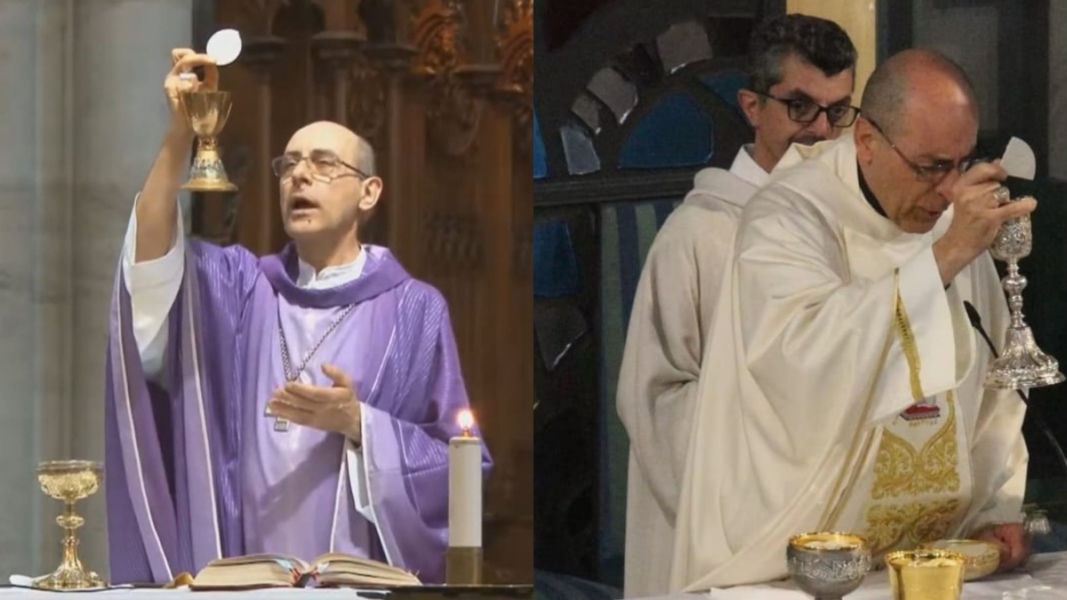
There are images that summarize a way of understanding the liturgy better than a hundred treatises. The photographs of Víctor Manuel Fernández, «Tucho,» elevating the host while holding the chalice with the same hand, inserting his fingers inside the chalice with the same naturalness with which anyone would hold a cup at a party, is scandalous not only because of a question of rubrics, but because of a question of Catholic common sense.
For centuries, priests were educated in a true pedagogy of reverence. After the consecration, they kept their thumb and index finger together while elevating the chalice to prevent the loss of the smallest particle of the Host. They carefully purified the chalice so that no drop of the Most Precious Blood would be left on its walls. They treated the sacred vessels with a delicacy that many today consider exaggerated. But the Church never thought it was exaggerated. If we truly believe that the Body and Blood of Christ are there, how could reverence be excessive?
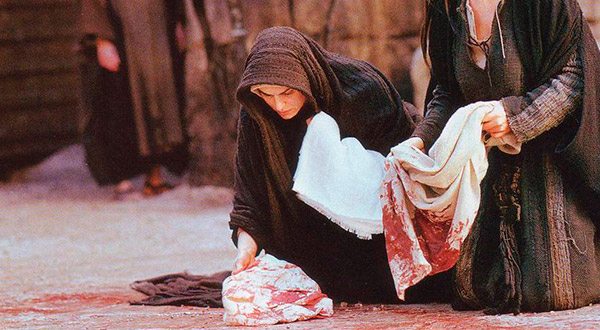
Mel Gibson perfectly understood this reality in one of the most moving scenes of The Passion of the Christ. After the scourging, the Virgin and Mary Magdalene carefully clean from the ground the blood shed by Our Lord. It is a visual catechesis. The same logic that leads Mary to collect Christ’s blood from the pavement, Gibson said, is what should lead priests to purify the chalice with care after communion, wishing to remind them of this in this cinematic scene.
That is why it is so shocking to see the principal sacred vessel of the altar held in such a careless manner by a cardinal Prefect of the Dicastery for the Doctrine of the Faith. Any priest minimally aware of what he has in his hands seeks to convey exactly the opposite: stability, security, respect, and veneration.
It is enough to see other celebrations of Cardinal Fernández to confirm that we are dealing with a habit. A habit that reflects an excessive familiarity with that which should inspire the utmost respect.
Perhaps some may consider all this insignificant details. But the history of Catholic liturgy is built precisely on the opposite conviction: details matter because they speak of what is essential.