


Less than two weeks before the episcopal consecrations announced by the Priestly Fraternity of Saint Pius X for next July 1, one of the texts published during the years of doctrinal dialogue between Rome and the Fraternity is once again relevant.
The article reproduced below was published in December 2011 in L’Osservatore Romano and signed by Msgr. Fernando Ocáriz Braña, then Vicar General of Opus Dei and one of the representatives appointed by the Holy See in the doctrinal conversations with the Priestly Fraternity of Saint Pius X.
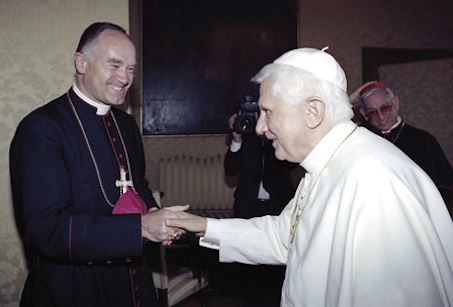
The text appeared a few weeks after the meeting between Benedict XVI and Bishop Bernard Fellay, Superior General of the Fraternity, at a time when discussions on the interpretation of the Second Vatican Council were at the center of negotiations between the two parties.
Ocáriz addresses one of the fundamental questions of the debate: what degree of assent the teachings of the Second Vatican Council require, how its doctrinal novelties should be interpreted, and in what way its continuity with the Church’s previous Magisterium can be understood.
Fifteen years after its publication, on the brink of a schism between Rome and the Priestly Fraternity of Saint Pius X, this text retains an undeniable historical and doctrinal interest for understanding the position the Holy See then defended regarding the reception and interpretation of the last ecumenical council.
On Adherence to the Second Vatican Council
The upcoming celebration of the 50th anniversary of the convocation of the Second Vatican Council (December 25, 1961) is a cause for joy, but also for renewed reflection on the reception and application of the conciliar documents. Beyond the more directly practical aspects of this reception and application, both positive and negative, it seems appropriate also to recall the nature of the intellectual assent due to the Council’s teachings. Although this is a well-known doctrine on which there is an extensive bibliography, it is useful to review its essential points, given the persistence—also in public opinion—of misunderstandings about the continuity of certain conciliar teachings with the Church’s prior Magisterium.
First of all, it is worth recalling that the pastoral motivation of the Council does not mean that it was not doctrinal, for all pastoral action is necessarily founded on doctrine. But above all, it is important to emphasize that precisely because doctrine is oriented toward salvation, its teaching forms an integral part of all pastoral work. Moreover, the Council’s documents contain numerous strictly doctrinal teachings: on divine Revelation, on the Church, etc. As Saint John Paul II wrote:
«With the help of God, the conciliar Fathers were able, in four years of work, to elaborate a considerable body of doctrinal expositions and pastoral norms which were presented to the whole Church» (Apostolic Constitution Fidei Depositum, October 11, 1992, Introduction).
The Assent Due to the Magisterium
The Second Vatican Council defined no dogma, in the sense that it proposed no doctrine by a definitive act. However, the fact that the Magisterium proposes a teaching without directly invoking the charism of infallibility does not mean that such teaching must be considered “fallible,” in the sense of a provisional doctrine or a mere authoritative opinion. Every authentic expression of the Magisterium must be received for what it truly is: a teaching imparted by pastors who, in apostolic succession, speak with the “charism of truth” (Dei Verbum, n. 8), “endowed with the authority of Christ” (Lumen Gentium, n. 25), and “with the light of the Holy Spirit” (ibid.).
This charism, this authority, and this light were certainly present in the Second Vatican Council. To deny them to the entire episcopate gathered to teach the universal Church cum Petro et sub Petro would be to deny something that belongs to the very essence of the Church (cf. Congregation for the Doctrine of the Faith, Declaration Mysterium Ecclesiae, June 24, 1973, nn. 2-5).
Naturally, not all the statements contained in the conciliar documents have the same doctrinal value and, therefore, do not all require the same degree of assent. The various levels of adherence due to the doctrines proposed by the Magisterium were set forth in the constitution Lumen Gentium (n. 25) and later summarized in the three clauses added to the Nicene-Constantinopolitan Creed in the formula of the Professio fidei published in 1989 by the Congregation for the Doctrine of the Faith and approved by Saint John Paul II.
The statements of the Second Vatican Council that recall truths of faith naturally require the assent of theological faith, not because they were taught by this Council, but because they have already been taught infallibly by the Church, either by a solemn judgment or by the ordinary and universal Magisterium. Likewise, full and definitive assent is required for those other doctrines proposed by the Council that had already been taught previously by definitive acts of the Magisterium.
The other doctrinal teachings of the Council require of the faithful a degree of adherence called “religious submission of the will and intellect.” Precisely because it is a “religious” assent, it is not based solely on rational motives. This adherence does not constitute an act of faith, but an act of obedience that is not merely disciplinary, but rests on confidence in the divine assistance granted to the Magisterium and, therefore, is situated “within the logic of faith and under the impulse of obedience to the faith” (Congregation for the Doctrine of the Faith, Instruction Donum Veritatis, May 24, 1990, n. 23).
This obedience to the Church’s Magisterium does not limit freedom; on the contrary, it is a source of freedom. The words of Christ: “Whoever listens to you listens to me” (Lk 10:16), are also addressed to the successors of the Apostles; and to listen to Christ means to receive the truth that makes free (cf. Jn 8:32).
The documents of the Magisterium may contain elements that are not strictly doctrinal—as occurs in the documents of the Second Vatican Council—elements of a more or less circumstantial character (descriptions of social situations, suggestions, exhortations, etc.). These aspects must be received with respect and gratitude, but they do not require intellectual assent in the strict sense (cf. Donum Veritatis, nn. 24-31).
The Interpretation of the Teachings
The unity of the Church and the unity of the faith are inseparable, and this also implies the unity of the Church’s Magisterium throughout time, since the Magisterium is the authentic interpreter of divine Revelation transmitted by Sacred Scripture and Tradition. This means, among other things, that an essential characteristic of the Magisterium is its continuity and historical coherence.
Continuity does not mean the absence of development. Over the centuries, the Church deepens its knowledge, its understanding, and, consequently, also its magisterial teaching on Catholic faith and morals.
In the documents of the Second Vatican Council there are some doctrinal novelties: on the sacramental nature of the episcopate, on episcopal collegiality, on religious freedom, etc. These novelties in matters relating to faith or morals, although not proposed by a definitive act, likewise require the religious submission of the intellect and will, even when some of them have been or continue to be the subject of controversy regarding their continuity with previous teachings of the Magisterium or their compatibility with tradition.
Faced with these difficulties in understanding the continuity of certain conciliar teachings with tradition, the Catholic attitude, keeping in mind the unity of the Magisterium, consists in seeking a unitary interpretation in which the texts of the Second Vatican Council and the preceding magisterial documents illuminate one another. Not only must the Second Vatican Council be interpreted in the light of the previous Magisterium, but some earlier documents can also be better understood in the light of the Council itself.
This is not a novelty in the history of the Church. It suffices to recall that the meaning of fundamental concepts employed at the Council of Nicaea to formulate Trinitarian and Christological faith (hypóstasis, ousía) was later clarified by subsequent councils.
The interpretation of the novelties taught by the Second Vatican Council must therefore reject what Benedict XVI called the “hermeneutic of discontinuity and rupture,” and instead affirm the “hermeneutic of reform, of renewal in continuity” (Address to the Roman Curia, December 22, 2005).
These are novelties in the sense that they make explicit new aspects that had not previously been formulated by the Magisterium, but which do not doctrinally contradict the preceding documents. This is so even when, in certain cases—for example, in the matter of religious freedom—these novelties entail very different consequences in the sphere of historical decisions relating to juridical and political applications of the doctrine, especially due to changes in historical and social conditions.
An authentic interpretation of the conciliar texts can only be carried out by the Magisterium of the Church itself. Therefore, in theological work aimed at interpreting conciliar passages that raise questions or seem to present difficulties, it is necessary to take particular account of the sense in which those texts have been interpreted in subsequent interventions of the Magisterium.
Nevertheless, there remains a legitimate space for theological freedom, which allows for explaining in various ways how certain formulations present in the conciliar texts do not contradict Tradition and, therefore, for clarifying the correct meaning of some expressions contained in those passages.
Finally, it does not seem superfluous to recall that almost half a century has already passed since the close of the Second Vatican Council and that during these decades four Roman Pontiffs have succeeded one another on the Chair of Peter. Consideration of the teaching of these Popes and of the corresponding assent of the episcopate to that teaching should transform a possible situation of difficulty into a serene and joyful acceptance of the Magisterium, the authentic interpreter of the doctrine of the faith.
This must be possible and desirable, even when aspects remain that are not yet fully understood. In any case, there continues to be a legitimate space for theological freedom and for further appropriate deepening.
As Benedict XVI wrote:
«The essential content that for centuries has constituted the patrimony of all believers needs to be confirmed, understood, and always deepened anew, in order to give coherent witness in historical circumstances very different from those of the past» (Motu proprio Porta Fidei, October 11, 2011, n. 4).
December 2, 2011.