


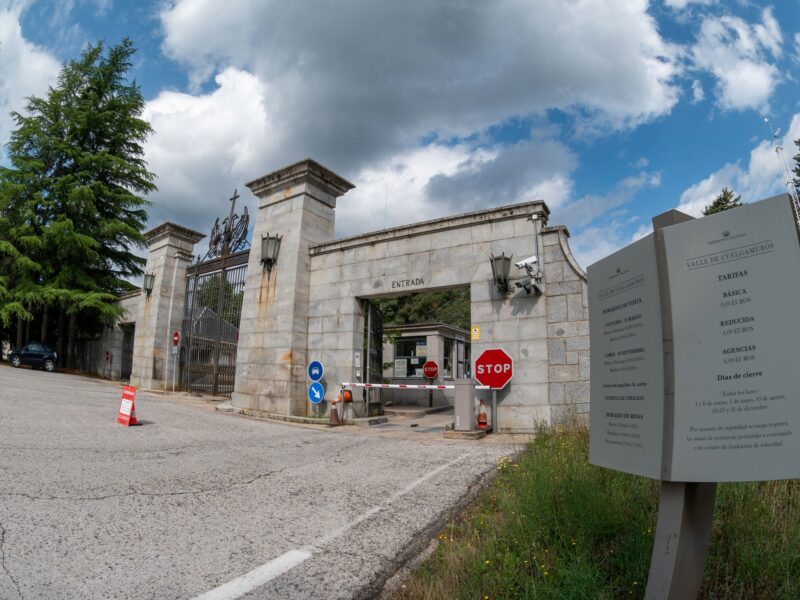
The Superior Court of Justice of Madrid (TSJM) has ordered the precautionary suspension of the drilling and works promoted by the Government in the Valley of the Fallen, an intervention begun without all the required authorizations being on record and launched precisely on the same day that Leo XIV visited Spain. The judicial decision represents the first major setback for the resignification project promoted by the Executive in one of the country’s most emblematic religious and monumental sites.
The measure was adopted following the contentious-administrative appeal filed by the Association for Reconciliation and Historical Truth (ARVH), which reported that the works were being carried out without municipal authorization and without the necessary sectoral permits having been accredited for acting on a protected complex.
The TSJM orders the halt of works questioned from the outset
According to the judicial ruling, published by La Razón, the court deems it necessary to prevent the continuation of actions whose administrative coverage would not be fully accredited.
The order states that “it is necessary to avoid works that have not, presumably, obtained the required sectoral authorizations, in order to control their scope and manner of execution.” Furthermore, the magistrates consider that the precautionary suspension causes no harm to the general interest, since the measure must be ratified, modified or lifted within a short period once the State Attorney’s Office submits its allegations.
The decision provides initial support to the complaints made by those who had been warning for weeks about the lack of transparency surrounding the start of these works and the risks they could pose to a site of special historical, artistic and religious significance.
The machinery entered the Valley on the same day Leo XIV visited Spain
The intervention began on June 8, a date hardly attributable to chance. While Leo XIV was carrying out a historic visit to Spain and addressing the Cortes Generales, the machines began operating in the Valley of the Fallen to take the first steps of the government’s resignification project.
As El Debate reported at the time, the entry of the machinery took place amid great media expectation due to the Pope’s presence in Spain. The temporal coincidence and the resolution of the case so far point to a deliberate decision by the Executive to advance a controversial operation while public attention was focused on the papal visit.
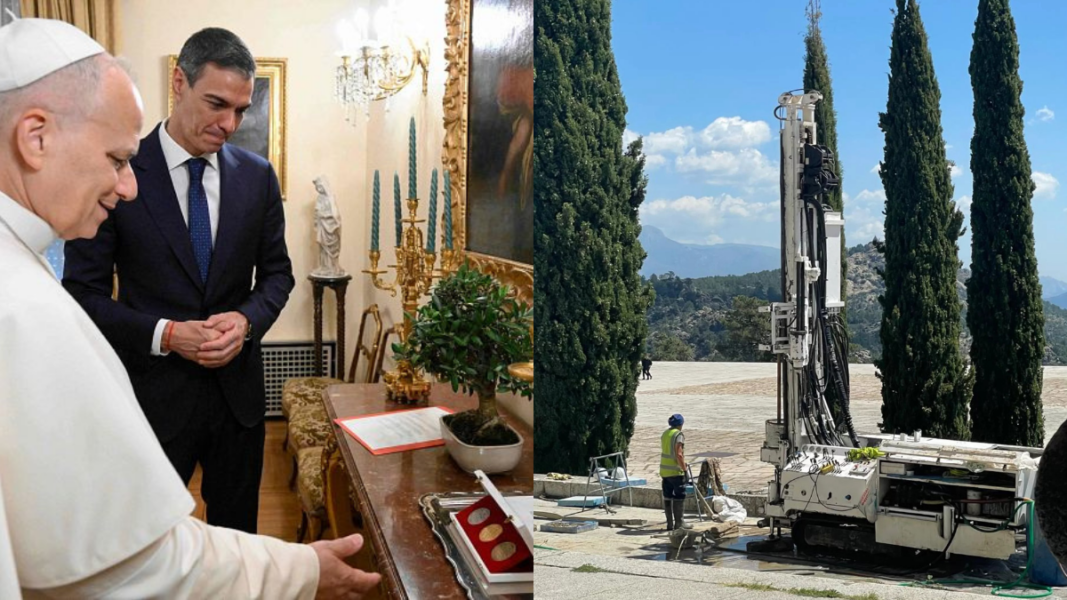
Those initial drillings were intended to gather technical information for future actions on the surroundings of the Cross, one of the most representative elements of the monumental complex.
An action denounced for lack of permits
The Association for Reconciliation and Historical Truth maintained from the outset that the surveys were being conducted without municipal authorization and without the corresponding technical project having been submitted.
The organization also warned that the works could cause irreparable damage to the protected heritage existing in the Valley of the Fallen, arguments that have now been taken into account by the TSJM in ordering the precautionary halt.
The judicial ruling also raises a particularly delicate issue for the Government: the possibility that actions may have begun on one of Spain’s most important monumental complexes without all the authorizations required by current regulations having been fully accredited.
Vandalism against the machinery and the Government’s response
The controversy increased the day after the works began. On June 9, the machinery used for the soundings appeared with various graffiti, including messages such as “The Valley must not be touched,” “Long live Spain,” and others directed against the Prime Minister.
The Minister of Territorial Policy and Democratic Memory, Ángel Víctor Torres, denounced the incidents on social media and claimed that the graffiti constituted an exaltation of Francoism.
“One day after the start of the ground surveys, the machinery in ‘Cuelgamuros’ appeared vandalized with graffiti exalting Francoism and insults against the Prime Minister,” the minister wrote at the time.
Torres also reiterated the Executive’s intention to turn the Valley of the Fallen into “a place of democratic memory where truth, justice and reparation prevail.”
The courts halt, for now, the government project
The suspension ordered by the TSJM returns the immediate future of the Valley of the Fallen to the courts and questions the way the Executive has tried to advance a project that continues to generate intense social, cultural and legal opposition.
For the moment, the machines have had to stop where the Government intended to accelerate the transformation of the site. The courts must now decide whether to maintain the halt of the works or allow them to resume once the State Administration’s allegations have been examined.
Until then, the resignification project promoted by the Government remains temporarily blocked by judicial decision.