


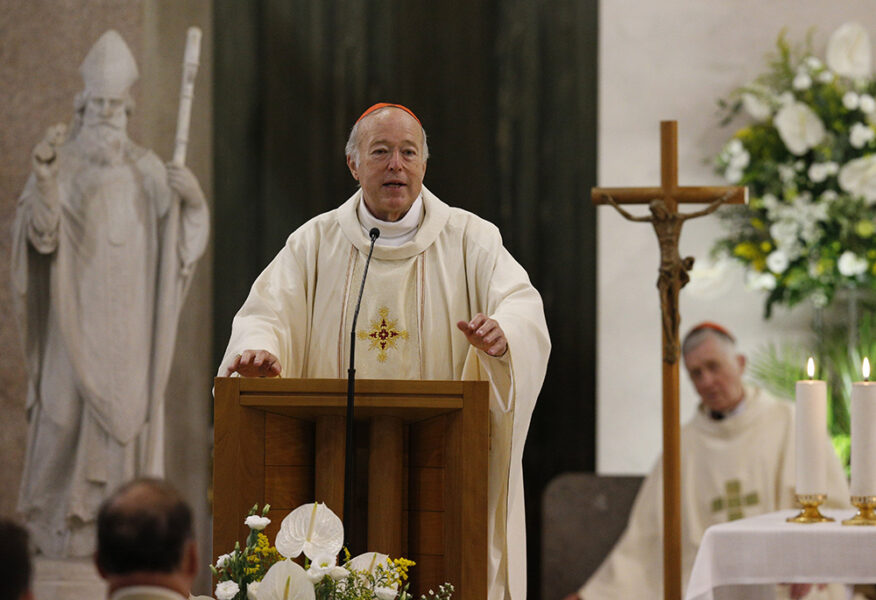
Cardinal Robert McElroy, Archbishop of Washington, has ordered that no communion rails be installed or reinstalled in the churches of the archdiocese, in a new liturgical controversy in the United States over kneeling communion and traditional forms of reverence before the Eucharist.
The alleged directive was initially reported by journalist Christine Niles of Stella Maris Media, following a recent meeting with priests. To date, the Archdiocese of Washington has not issued a formal decree or official communication regarding this measure.
No communion rails or temporary kneelers
The directive attributed to McElroy indicates that communion rails should neither be installed nor reinstalled in the churches of the archdiocese. The use of temporary kneelers for receiving Holy Communion is also discouraged.
Among the arguments presented during the meeting, according to the information circulated, were the possible disruption of the communion procession and the risk that the use of kneelers could turn an individual choice of the faithful into a more widespread practice.
The issue directly affects the manner of receiving communion. In the United States, the norm approved by the Episcopal Conference and confirmed by the Holy See establishes that the faithful receive communion standing, after making a gesture of reverence.
However, the universal law of the Church also makes clear that Holy Communion must not be denied to a member of the faithful for the sole reason of kneeling to receive it.
A controversy that already erupted in Charlotte
The possible decision in Washington comes after a similar controversy in the Diocese of Charlotte, North Carolina. There, Bishop Michael Martin ordered that communion rails, kneelers, or individual kneelers not be used for receiving communion in public celebrations.
Martin defended in a pastoral letter published in December that the norms approved by the United States Conference of Catholic Bishops do not contemplate the use of communion rails or kneelers for receiving communion, and maintained that their use would contradict the normative stance established by the American bishops.
The measure provoked a strong reaction within the diocesan clergy. More than thirty priests formally submitted dubia to the Vatican to clarify the extent of a bishop’s authority to restrict these practices.
McElroy, once again at the center of controversy
The information about the possible prohibition in Washington has drawn particular attention because it involves one of the most prominent archdioceses in the United States and because of the profile of its current archbishop.
McElroy was installed as Archbishop of Washington in March 2025, after governing the Diocese of San Diego for a decade, and is considered one of the most influential figures in the American episcopate.
The controversy also comes shortly after another decision that made headlines. In early June, the cardinal removed Msgr. Stephen Rossetti as exorcist of the Archdiocese of Washington and ended the diocese’s affiliation with the St. Michael Center for Spiritual Renewal, following statements linking UFO phenomena with demonic activity.
McElroy stated at the time that those declarations “seriously undermine the very precise teaching of the Church on the devil, demons, and exorcism.”
Now, attention is once again focused on a fundamental liturgical question: whether a diocese can prevent the installation of elements that facilitate kneeling communion when the Church recognizes that the faithful must not be deprived of the Eucharist for choosing that posture.