


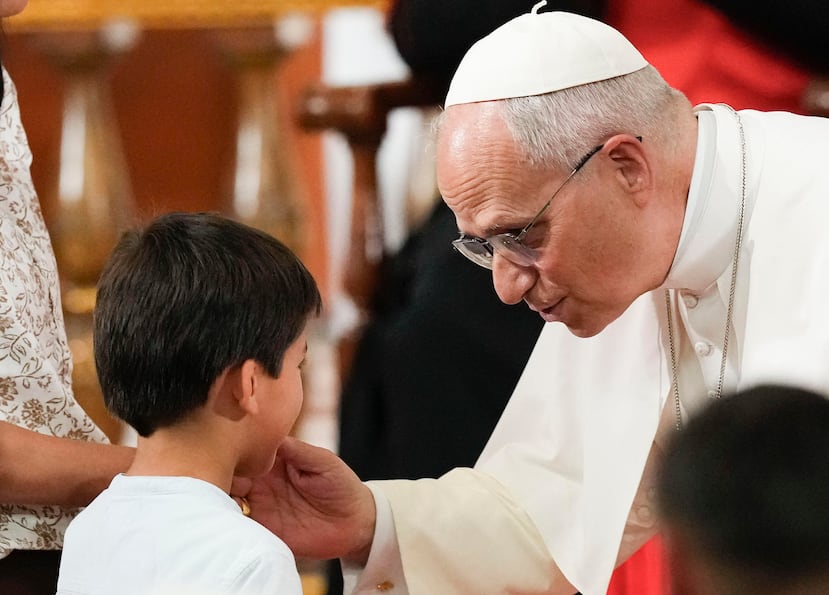
The best thing to come out of Pope Leo XIV’s trip to Spain did not happen in the Congress of Deputies or on any of the platforms where he was expected with notebook and headline already prepared. It happened on Wednesday in the church of San Agustín, in Barcelona’s Raval district, when a six-year-old boy named Renzo asked the Pope whether one must always forgive. And the Pope, instead of brushing the question aside with photogenic tenderness, did theology. Always forgive, yes, seventy times seven; but one must understand what forgiveness is. It is not saying that the evil was right, nor allowing someone to keep doing harm, nor forcing oneself to forget as if nothing had happened. “To forgive means not letting hatred become the master of our heart.” He added that Jesus asks it of us because it is the only way to experience God’s peace and heal the wounds of the soul; that by forgiving we imitate the Crucified One, who forgave his executioners; and that our willingness to forgive is the condition for the forgiveness we receive from God.
That is Catholic preaching. It distinguishes, corrects the sentimental misunderstandings that surround forgiveness, anchors it in the Gospel and ends with what matters most: your salvation is at stake. Any baptized person who heard those words left with a task. We all have someone we have not forgiven, and we all know who it is. The Pope, answering a child, addressed every soul present and every soul absent.
The problem is that this moment was the exception. Let us do the cold count: twenty-two addresses in six days, speeches, homilies and greetings, before parliamentarians, authorities, the diplomatic corps, bishops, the world of culture, social organizations. And of that torrent, how much was directed at the ordinary Catholic, the one who pays for the trip with his collection and sustains the Church with his faith? A minimal part. The rest spoke of migration, peace, polarization, human dignity as the foundation of the legal order, the throwaway culture. Some speeches were correct, others unfortunate, a few notable; all aimed at interlocutors who were not in the pews: “Europe,” “the international community,” governments, the media that would extract their quote the next day. The faithful attended as spectators to a conversation between the Pope and the powers of this world.
And here returns the question no organizer of the trip would want to hear: what can a Catholic from Zamora, or from Móstoles, or from Telde, do to keep the Atlantic from filling with dead? He does not negotiate with Frontex, does not legislate in Brussels, does not dismantle mafias in Nouakchott. His real sphere of action measures a few kilometers and contains a woman, some children, an elderly mother, an unbearable colleague, a waiter, a confessional and a tabernacle. When he is exhorted not to remain indifferent to the migration drama, he is, at best, assigned a state of mind: diffuse indignation, declarative solidarity, the comfortable feeling of being on the right side at the modest price of nodding along. No one has named his sin, his own, the concrete one he knows.
Let no one twist the thesis: it is not that these issues do not matter. They do, and the Church’s social doctrine illuminates them. But precisely because they matter they admit a thousand nuances—legal, prudential, of sovereignty and of ordered charity—that the proclamatory genre cannot contain. Reducing them to a formula any MEP, any presenter, any NGO living on subsidies, or any beauty queen would sign without blinking is, in supernatural terms, almost nothing. Not because it is false or not, but because it is too little for a vicar of Christ. The successor of Peter possesses an arsenal no politician has—sin, grace, judgment, eternal life—and to renounce it in order to compete in the market of moral commonplaces is a bad deal even in terms of effectiveness: for geopolitical analysis the world already has better firms, and so on.
The ancients called the four last things the novissima: death, judgment, hell and glory. Generations of Spaniards were evangelized with that grammar, which had a defect, they say, and an indisputable virtue: it addressed each soul by name. You will die, you will be judged, you can condemn yourself, you are called to glory. No one could delegate his particular judgment to the international community. Today that preaching has disappeared from the pulpit so cleanly that its mere mention sounds like archaeology, replaced by horizontal eschatologies—the climate, the migration pact, the future of the planet—where salvation and condemnation are always collective, always political and always someone else’s responsibility. What happened in the Raval shows that the old register is still available and still works: it took only a child asking about forgiveness for the Pope to speak of God’s peace, the wounds of the soul and the condition of our own forgiveness. That is, of the novissima through the service entrance.
What, then, can the Catholic from Zamora do for the dead in the Atlantic? He can pray for them, which is no small thing. And he can convert today: forgive the brother he has not spoken to since the inheritance, visit the grandmother fading in a nursing home, treat the waiter with patience, not shout at his wife, go to confession, pass in front of the Blessed Sacrament and enter, teach his children to pray, offer suffrages for his dead. It is not in his power to solve the dramas of the world; it is in his power to return to God this afternoon. The Pope told it to a six-year-old boy in Barcelona’s poorest neighborhood, and it was the greatest thing he said all week. If the pastoral care of great causes does not spring from that concrete conversion, it may continue to reap applause and headlines. But it will sound like what it sounds like: a slogan.