


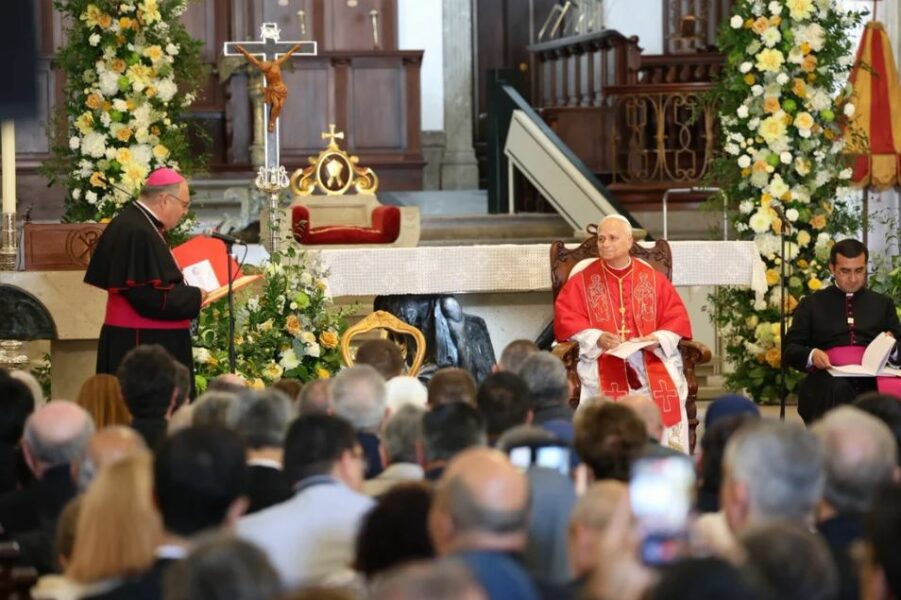
After his visit to the port of Arguineguín, where he met with entities dedicated to the reception of migrants, Pope Leo XIV traveled this Thursday to the historic center of Las Palmas de Gran Canaria to meet with bishops, priests, deacons, religious brothers and sisters, seminarians, and pastoral agents at the Cathedral of Santa Ana.
Before arriving at the church, the Pontiff rode in the popemobile through the streets of the Vegueta neighborhood, where he was greeted by thousands of people gathered along the route. He then entered the Cathedral of Santa Ana, the main church of the Diocese of the Canary Islands, where he was received by the Bishop of the Canary Islands, Monsignor José Mazuelos Pérez.
Mazuelos warns about secularization
In his words of welcome, the Bishop of the Canary Islands thanked the Holy Father for his presence and highlighted the importance of the visit for the local Church.
“Your presence among us strengthens our faith, confirms our communion with the universal Church, and renews our hope as the people of God who are on pilgrimage in these Atlantic lands,” he affirmed.
During his address, Mazuelos described some of the main pastoral challenges facing the diocese, including the advance of secularization, the weakening of sacramental practice, and the difficulties in transmitting the faith within families, especially among young people.
Nevertheless, the prelate insisted that this situation also represents a call to strengthen the Church’s evangelizing mission and asked the Pope to confirm the faithful of the Canary Islands in faith and hope.
A call to renew missionary impetus
After the proclamation of the Gospel, Claretian priest Santiago Cerrato Cáceres spoke, thanking the Pontiff for his visit and describing it as a stimulus for the Church in the Canary Islands.
The priest referred to the difficulties faced by priests, religious, and committed laypeople in their pastoral work and asked the Holy Father to pray for the local Church so that it may continue to develop its evangelizing mission.
He also highlighted the collaboration existing among the various ecclesial realities of the diocese and evoked the figure of Saint Anthony Mary Claret as a model of missionary zeal for the present time.
A call to unity and charity
In his address, Leo XIV invited those present to remain firmly rooted in Christ, to strengthen ecclesial communion, and to cultivate a spirituality centered on the cross and the Eucharist.
The Pontiff also encouraged the faithful to continue offering others the love they have received from God, especially through welcome, listening, closeness, and care for the most vulnerable.
Below is the complete address of the Holy Father:
Dear brother bishops, dear priests and deacons, religious brothers and sisters, seminarians, brothers and sisters all in Christ Jesus:
It is a great joy for me to share this meeting with you. Thank you for the warm welcome, for your kind presence and your testimonies, which reflect a living Church, in whose heart resound “the joys and the hopes, the griefs and the anxieties of the men of our age, especially those who are poor or in any way afflicted.”
I come to these islands as Father and brother in the faith: “with you I am a Christian, and for you I am a Bishop.” Each of us has received different gifts and ministries for the building up of the body of Christ, as we have heard in the reading from the Letter to the Ephesians. And this is the Lord’s call that today vibrates anew in our hearts and confirms our vocation and mission: to build the Church together, founded on Christ, the “cornerstone,” to build in goodness, to harmonize our differences, and to work united for the good of all.
I would like us to reflect together on two attitudes of our Christian life that we must keep in mind in order to be “wise architects” in the building of the civilization of love.
You, native or adoptive Canary Islanders, the People of God on pilgrimage in lands surrounded by the Atlantic, have the privilege of enjoying every day the majestic presence of the sea. It is said that in the eyes of an islander this image—which tastes of homeland and home—remains forever engraved in their pupils, and that it is greatly missed when far away, “inland.” This feeling corresponds to a healthy nostalgia for immensity, for open sky and sea stretching to the horizon, without limits or borders; and to a sensitive heart ready to bid farewell with a tear to those who leave and to receive with open arms those who arrive. In this sense, the sea can sometimes also be synonymous with distance and separation, with challenge and a path to be traveled.
In this regard, Saint Augustine tells us: “If someone from afar were to glimpse his homeland, but a sea lay between the two: he sees where to go, but does not know the way. So it is with us: we long to reach our stable condition, […] but the sea of this world lies in between […] to teach us the way, the very one we wished to reach came to us. And what did he do? He placed before us the wood by which we might cross the sea. No one can cross the sea of this world unless he is carried by the cross of Christ.” This is the first attitude that guides us to navigate the waters of life and reach our destination, our heavenly homeland: to embrace the cross of Christ.
Dear brothers and sisters, the saints experienced nostalgia for God and, when facing the storms of existence, knew how to carry Jesus in their boats, trusted in Him, embraced the cross, and thus calmed the waves of uncertainty and fear.
An example of this in these blessed lands, among many others, is the Venerable Antonio Vicente González, a diocesan priest also known as “the good shepherd of the Canary Islands.” His life, transfigured by divine grace, encourages us to take up the cross of Christ and follow Him, being faithful witnesses of the Gospel in this new time of history, not without turbulence and contradictions, so as to reach the promised goal.
The first “navigational guideline,” therefore, is to embrace the cross of Christ; and you do so daily, for example, as Cyrenians, accompanying and helping to carry the burdens of so many brothers and sisters crucified by the dramas of life. I thank you for this generous work of charity and mercy.
I would also like to highlight another attitude: cultivating a eucharistic spirituality. This is related to the ancient tradition preserved in this beautiful cathedral: the shower of flower petals before the Blessed Sacrament that takes place on the feast of the Ascension, as a sign of the spiritual and heavenly goods that the Lord pours out as He ascends into heaven. This gesture of devotion by so many generations throughout time holds a profound meaning: in our pilgrimage, the goal is the encounter with Christ, who is the center of Christian life, toward whom our knees bend in adoration, around whom we gather as one body, and with whom we offer ourselves as “a living sacrifice, holy and pleasing to God.”
As the Council tells us, the faithful, “by participating in the eucharistic sacrifice, the source and summit of the whole Christian life, offer to God the divine Victim and offer themselves along with It. And so, […] they concretely manifest the unity of the People of God.” Therefore, cultivating a eucharistic spirituality means deepening “a spirituality of ecclesial unity in love.” Let us make our life a response to Jesus’ desire: “That they may all be one […] so that the world may believe.”
A concrete way to manifest this spirituality of communion is Christian solidarity, because “union with Christ is at the same time union with all the others to whom He gives Himself.” For this reason, I encourage you to continue offering everyone the love that you, in turn, have received from the Lord, a love that becomes nourishment in welcome, in listening, in closeness, and in the care of the most fragile: “For I was hungry and you gave me food, I was thirsty and you gave me drink, I was a stranger and you welcomed me, I was naked and you clothed me, I was sick and you visited me, I was in prison and you came to me.”
Dear Church on pilgrimage in the Canary Islands, following in the wake of holiness of so many men and women who have preceded you, who have offered their lives in communion with the sacrifice of Christ on the cross and on the altar, I encourage you to move forward, firmly rooted in Him, to continue navigating with courage in this new time of history. When you encounter difficulties, lift up your gaze and ask the Holy Spirit for the grace to live united in faith, hope, and charity, virtues that “are like three stars shining in the sky of our spiritual life to guide us toward God.”
May the Blessed Virgin Mary, Stella Maris, guide us on our journey, help us to “put out into the deep,” and thus reach the safe harbor of the definitive encounter with her Son Jesus Christ.