


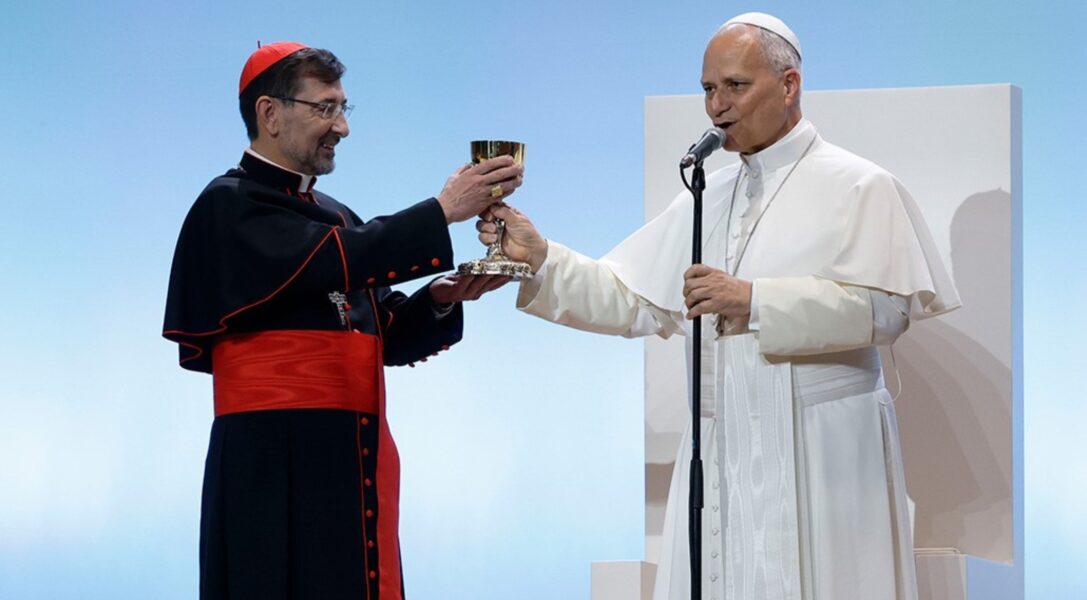
The visit of Leo XIV to Spain leaves, alongside the massive images, an involuntary X-ray of the country’s two great archdioceses. And the data—stubborn as they are—paint a contrast that is hard to ignore: Cardinal José Cobo has turned every Madrid event into an opportunity for his own platform, while Cardinal Juan José Omella has played in Barcelona the role that protocol assigns to the host: open the door, yield the floor and keep a discreet position.
In an apostolic journey, the ordinary of the place has a precise and limited function: to receive the Pope in his diocese and offer him a welcome greeting. Nothing more. The absolute protagonist of every celebration, every shot and every headline is—and must be—the Successor of Peter, the one the crowds have come to see and to hear. The two hosts of this visit also started from very different situations: Omella, at 80, is an archbishop in the final stretch of his mandate, with his resignation already submitted and nothing to gain; Cobo, vice-president of the Episcopal Conference and a cardinal in full ascent, had in this week the greatest “showcase” of his career, and the anxiety to seize it was all too evident in the man from Madrid.
The numbers
The Archbishop of Madrid took the floor on six occasions over three days: at the CEDIA centre in Carabanchel, at the vigil in Plaza de Lima, at the Corpus Christi Mass in Cibeles, at the “Tejer Redes” encounter in the Movistar Arena, at the prayer to the Virgin of la Almudena and at the diocesan gathering in the Bernabéu. He climbed into the popemobile, handed out gifts and constantly positioned himself at the Pope’s side. The Archbishop of Barcelona spoke four times over two days: the cathedral, the Estadi Olímpic, Sant Agustí del Raval and the Sagrada Família.
Yet the difference lies less in the number of interventions—Madrid had one extra day—than in their nature. The speeches speak for themselves: Cobo’s greetings were genuine programmatic pieces, mini-homilies of four, five and even six minutes with their own thesis, systematically unfolded in the instant before the Pope spoke and at moments of maximum audience. The accumulated speaking time of the Cardinal of Madrid—between twenty and twenty-five minutes before the Pope and the cameras—easily doubles that of his Barcelona counterpart, who totals barely ten or twelve minutes throughout his leg of the journey.
Omella dispatched the welcome in the cathedral in barely two minutes, bilingual and without pretensions. His greeting at the Estadi Olímpic—the only one somewhat longer, devoted to explaining to the Pope the symbolism of the castells—was described by Vatican News itself as “very brief but significant.” And at the event of greatest international projection of the entire trip, the centenary Mass of Gaudí in the Sagrada Família, with the blessing of the Tower of Jesus Christ circling the globe, the cardinal limited himself to a few brief closing words of thanks in which, moreover, he had the elegance to acknowledge the merit of his predecessor, Cardinal Lluís Martínez Sistach, in the completion of the basilica. The man who had the perfect stage for self-promotion renounced it.
The content
Nor was the content innocent. Cobo was, by a wide margin, the more ideological of the two. In Carabanchel he theorised about “invisible cities”; in Cibeles he proclaimed that the Church “is not called to raise walls, but to open doors”; at the Movistar Arena he expounded on the “crises and threats that undermine the Civilisation of Human Rights and Democracy.” Read in sequence, the thread becomes clear: an immigrationist alignment so insistent that it bordered on overacting, as if the host needed to demonstrate to the guest, act after act, that he had done the homework of the pontificate. A political-pastoral speech with the author’s stamp, repeated before the guest like someone seizing the best audience of his life to place the house ideology.
To the overacting of the message was added that of the staging. The Madrid events were wrapped in a soft, infantilised aesthetic—catalogue-of-Ikea, one might say: pastel colours, animator-style dynamics, scripted testimonies aligned with the speech’s agenda—more suited to a school gathering than to the visit of the Vicar of Christ. The comparison with the liturgy of the Gaudí centenary at the Sagrada Família, sober, vertical and worthy of the mystery, needs no comment.
Omella’s brief speeches, by contrast, spoke of the Pope, of Gaudí, of the Cross and of the poor of the Raval. No thesis of his own, no message for the gallery, no ecclesiastical-political positioning taking advantage of the microphone. “We are eager to hear his words,” he said at Montjuïc. That is, exactly, the host’s function when Peter comes.
No one will accuse us of complacency toward Cardinal Omella, whose governance we have criticised when there was reason. Precisely for that reason it can be said without suspicion: in this visit, Barcelona has given a lesson in style. The archbishop who is leaving has understood that when the Pope comes, the local bishop makes himself small. The vice-president of the Episcopal Conference, on the other hand, has used every spotlight, every camera angle and every turn to speak to project himself as the true political-pastoral co-host of the pontificate in Spain, to the point of making more than a few of those present uncomfortable.