


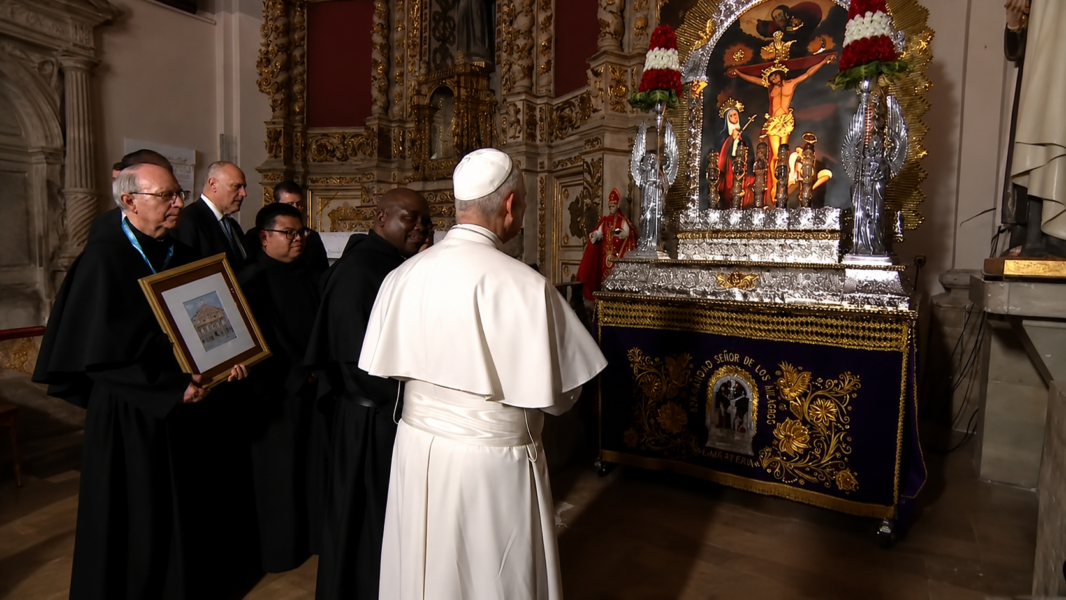
Pope Leo XIV visits this afternoon the church of Sant Agustí, right in the heart of Barcelona’s Raval neighborhood, one of the city’s most socially complex and multicultural areas. Known as the “cathedral of the poor” for its close ties to realities of exclusion, poverty, and immigration, this historic Baroque church will host an encounter between the Pontiff and representatives of Cáritas and various social organizations.
The visit took place in a warm atmosphere and was marked by dialogue between the Pope and those present. One of the most notable moments was the conversation with Renzo, a six-year-old boy who asked the Holy Father several questions about sports, vocation, suffering, the loneliness of the elderly, and forgiveness.
Below is the full message from Leo XVI:
Estimats germans i germanes, Bona tarda!
I thank Cardinal Archbishop for his warm welcome and the words he has offered me, as well as the delegate for social pastoral care and those who have shared with us their testimonies about the realities of diocesan charity and assistance. I would like to thank Renzo for his letter and the questions he asks me; I will try to answer some of them.
The one I already answered is that I did not want to be Pope, neither as a young man nor as an older one, but when the Lord calls, one must say yes. Before answering the questions, I just want to say thank you very much for the welcome and that here I truly feel at home. And thank you for everything you represent.
The reason you might think—obvious, evident—is because it is Saint Augustine, but let me tell you that the first time I came to this church—when this Archbishop was not here beside me—it was 1984; I was traveling by land from Rome to León, I arrived and said: look, in Barcelona there is a church of Saint Augustine, let’s visit it. It was closed; today it is open. And how beautiful it is to find a church with a community of Augustinians and with so many people who live, who praise God, who find community, welcome, and integration in this church and in this social pastoral care. Thank you all very much, truly.
As for the question about soccer, everyone knows that now I play tennis; as a young man I played soccer, but American football, a bit more violent, and also with the seminarians when I was in Trujillo I played soccer, as a defender, if you want to know; I wasn’t a great goal scorer, but when I was first in Rome, where I lived my first World Cup experience, in 1982, which was here in Spain. Later, in Peru with the seminarians, I followed the local teams a lot; but I also played with the seminarians; a bit of sport is good for everyone; we have to find ways, so to speak, to stay healthy: body, mind, and soul. So yes, that has been part of my life. Soccer also helps us remember something very important: that life is not a race to be lived in a solitary way; it is something played as a team, and we must learn to run together. So, in that sense, someone who may be a star but never passes the ball does not let others enter the game and will probably lose. And so, also thinking about ourselves and how to integrate into a team, I want to recognize and congratulate everything you are doing here. Second question, I already answered, but I’ll follow the text a bit so we don’t get lost and end at 8:30.
Em preguntes si de petit volia ser Papa. Bé doncs, Renzo, crec que no. Crec que mai ho vaig pensar. Però si que puc dir una cosa: des de petit vaig sentir el desig d’entregar la meva vida a Déu. No sabia encara del tot, el com ni per on em portaria el Senyor. Amb el temps vaig descobrir que Jesús em cridava a seguir-lo com a sacerdot, i que aquest camí passava per l’ordre de san Agustí. Però això no val solament per a mi. Cada nen és un somni de Déu. Tu Renzo també ho ets. Déu desitja la felicitat de tots i vol que, des de petits i durant tota la vida, conservem un cor com el dels nens (cf. Mt 18,3): capaç de confiar, ple de bondat; vol que siguem els seus amics i que no ens apartem d’Ell. Per això, més important que preguntar-nos si un serà sacerdot, metge, mestre, pare de família o qualsevol altra cosa, cal preguntar-se si vols ser amic de Jesús. Perquè l’amistat amb Jesús ens dóna alegria, ens fa lliures i ens ajuda a veure, pas a pas, la vocació i el camí que Déu ha pensat per cadascú de nosaltres.
[You ask me if as a child I wanted to be Pope. Well, Renzo, I think not. I think I never thought about it. But I can tell you something: from a young age I felt the desire to give my life to God. I did not yet fully know how or where the Lord would lead me. Over time I discovered that Jesus was calling me to follow Him as a priest, and that this path passed through the Order of Saint Augustine. But this is not only for me. Every child is a dream of God. You, Renzo, are too. God desires the happiness of all and wants us, from childhood and throughout life, to keep a heart like that of children (cf. Mt 18,3): capable of trust, full of goodness; He wants us to be His friends and not turn away from Him. Therefore, more important than asking whether one will be a priest, doctor, teacher, father of a family, or anything else, is to ask whether you want to be a friend of Jesus. Because friendship with Jesus gives us joy, makes us free, and helps us to see, step by step, the vocation and the path that God has planned for each one of us..]
It is not easy to find, Renzo, the answer to your question about why some people have bad things happen to them and others do not. Thinking about the life of Jesus may help us. The Word of God tells us that our Lord “went about doing good and healing all who were oppressed by the devil” (Acts 10,38), and yet we know He was crucified. But that was not the end of the story, because He rose on the third day and conquered evil, conquered death. Through the life of Jesus Christ, God shows us that, although there is suffering, He never abandons any of His children, because He has prepared for us an eternal joy where there will no longer be sadness or pain. Let us have confidence; Jesus is with us, He helps and accompanies us, and gives us strength to get through the difficult moments we may encounter in life.
Regarding grandparents, yes, grandparents are very important in the life of families. They should never be left alone. Often, they are the ones who take care of their grandchildren while the parents go to work, and so, with affection and dedication, they help children to know the love of God and of neighbor, so that it takes root in their hearts and one day they may become good men and women. And how should we respond to love? With love. That is what Jesus wants us to do. To care for and accompany our grandparents in their old age, just as they, in their time, cared for us. Let us not allow loneliness and abandonment to become normalized in the lives of older adults. That is very sad. Let us keep our hearts open to all of them; and even if they are not our grandparents, let us not allow them to feel alone or unprotected. Because if we do not want loneliness for ourselves, we should not allow it for others either.
Regarding whether we should always forgive, Jesus tells us yes. One day Peter asked Him: “Lord, if someone harms me, how many times must I forgive him? Up to seven times?” And Jesus answered: “I do not say to you up to seven times, but up to seventy times seven” (Mt 18,21-22). And with that Jesus meant: forgive always. But we must understand well what it means to forgive. Forgiving does not mean saying that what was wrong was right, nor allowing someone to continue doing harm. It does not mean forgetting by force, as if nothing had happened. Forgiving means not letting hatred become the master of our heart. Jesus asks us to forgive because it is the only way to experience the peace of God and to heal spiritual wounds. When we forgive, we imitate the example of Jesus, who forgave those who crucified Him. Our willingness to forgive is a condition for the forgiveness we receive from God.
Germans i germanes,
Estar aquí, en aquesta església de Sant Agustí, obre el nostre cor a una veritat que el sant Bisbe de Hipona ens indica: ser cristians és abans que res, un regal, una gràcia. Fonamentats en Crist, que és la pedra vida, experimentem l’acció de l’Esperit Sant, amb la convicció de que tot esforç realitzat sincerament per a cooperar amb Ell a favor del proïsme serà beneit pel Pare celestial, en qui posem la nostra esperança. Com a membres del Cos Místic de Crist, estem realment units al destí d’aquells a qui Déu estima i convida a participar de la seva vida.
Cridats a estimar Déu, i per amor a Ell, als nostres germans, som també enviats a sortir per trobar-nos amb tothom. El cristià, a més de ser bondadós i amable, ha de ser compassiu, estimar sense interès i buscar el bé dels demés, sabent que en cada germà i germana que sofreix hi trobem el mateix Senyor qui demana i rep, qui és acollit o rebutjat, estimat o menyspreat.
[Brothers and sisters:
Being here, in the church of Sant Agustí, opens our hearts to a truth that the holy Bishop of Hippo points out to us: being Christian is, above all, a gift, a grace. Founded on Christ, who is the living stone, we experience the action of the Holy Spirit, with the conviction that every effort sincerely made to cooperate with Him for the good of our neighbor will be blessed by the heavenly Father, in whom we place our hope. As members of the Mystical Body of Christ, we are truly united to the destiny of those whom God loves and invites to share in His life.
Called to love God, and for love of Him, our brothers and sisters, we are also sent to go out to meet everyone. The Christian, besides being kind and gentle, must be compassionate, love without self-interest, and seek the good of others, knowing that in every brother and sister who suffers we find the same Lord who asks and receives, who is welcomed or rejected, loved or despised.]
Evangelical charity, founded on Jesus Christ and nourished by His love, gives shape and identity to the personal and communal life of every Christian. Hence every diocesan ecclesial community, moved by charity and instructed by the Holy Spirit, is called to approach, according to its own possibilities and capacities, with discretion, gentleness, and perseverance, the wounds and needs of the smallest and most vulnerable, to relieve their sufferings and remedy their poverty. It does so by imitating the generosity of our Lord Jesus Christ who, for love of us, though rich, became poor to enrich us with His grace and salvation, and also calls us to recognize and assist Him in the most needy (cf. Mt 25,40).
That is why it is a joy to meet you this afternoon, all of you who, in different ways, are concretely linked to the assistance, accompaniment, and promotion of those most in need, especially in the times we are living, in which it seems the sense of the sacred dignity of the human person has been lost.
I would like to emphasize that as Christians we are called to the task of making present the love of God for every man and every woman, in the concrete fabric of history. The Book of Genesis tells us that God created “man in His image, in the image of God He created him; male and female He created them” (Gn 1,27). In this lies the inalienable dignity of every human being, which does not depend on the abilities one possesses, the wealth one accumulates, or the role one plays, but on the gift that precedes and surpasses us, given by God as an expression of His love that never fails (cf. Magnifica humanitas, 50).
The Lord, therefore, invites us to welcome every woman as a sister and every man as a brother. As children of the same Father, every person is constitutively made for relationship; each has been thought and willed by God to enter into a history of communion with Him, with others, and with creation (cf. ibíd.). A singular expression of this divine longing is constituted by the diocesan realities of charity and assistance of which you are part and which you carry forward with effort and dedication, with the awareness that the human person is at the center of the Church’s action (cf. Gaudium et spes, 24) and that charity is “the greatest social commandment” (CCE, 1889).
Us encoratjo, units amb els vostres pastors, a continuar animant aquests apostolats, donant testimoni de l’Evangeli i mostrant al món la bellesa de la vida cristina, que anticipa aquí i ara la justícia i la pau que seran plenes en el Regne de Déu. Sigueu, doncs, testimonis creïbles de l’esperança cristiana en el servei sol·lícit dels germans i germanes que, en una condició de vida precària, marcada per la privació, la fragilitat o la marginació, a més de l’ajuda material i el sosteniment moral, necessiten Déu, la seva amistat, la seva benedicció, la seva Paraula, els seus Sagraments i la proposta d’un camí de creixement i de maduració en la fe (cf. Evangelii gaudium, 200).
[I encourage you, united with your pastors, to continue animating these apostolates, giving witness to the Gospel and showing the world the beauty of the Christian life, which anticipates here and now the justice and peace that will be full in the Kingdom of God. Be, then, credible witnesses of Christian hope in the solicitous service of the brothers and sisters who, in a condition of precarious life, marked by deprivation, fragility, or marginalization, in addition to material help and moral support, need God, His friendship, His blessing, His Word, His Sacraments, and the proposal of a path of growth and maturation in the faith (cf. Evangelii gaudium, 200).]
I place at the feet of Our Lady of Good Counsel your work and your dedication, so that her intercession may accompany you and the Lord may abundantly bring to fruition all the good you seek. May God bless you. Thank you very much.