


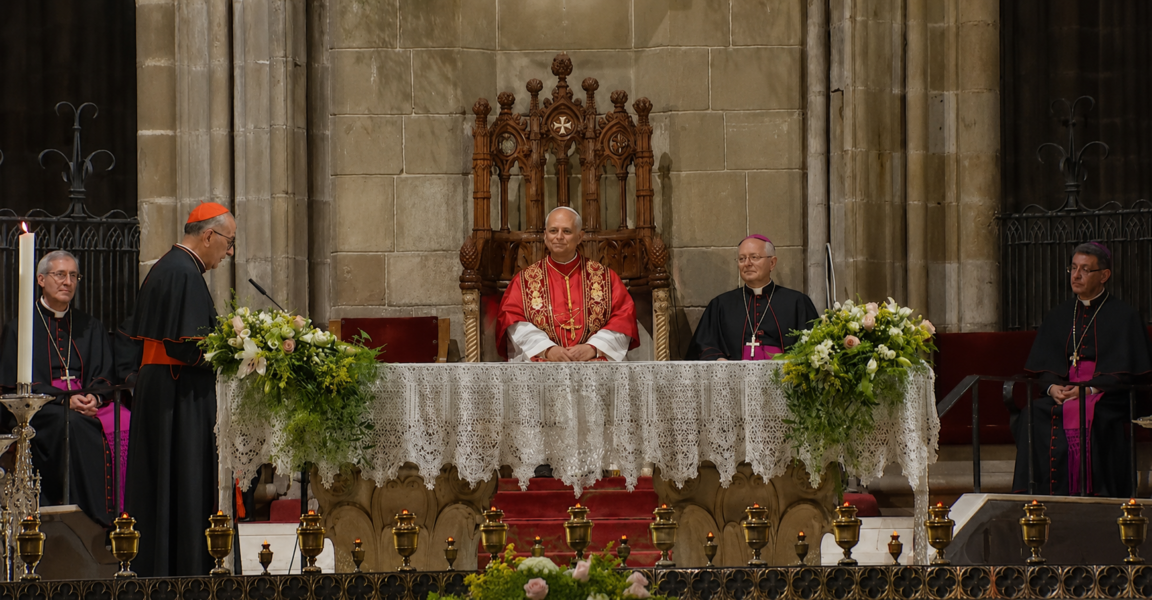
Pope Leo XIV began his agenda in Barcelona this Tuesday with a visit to the Cathedral of the Holy Cross and Saint Eulalia, where he presided over the recitation of the Little Hour together with Cardinal Juan José Omella and prayed before the tomb of the city’s patron saint. The event marked the Pontiff’s first official engagement in the Catalan capital after landing shortly after midday at Josep Tarradellas Barcelona-El Prat Airport.
Coming from Madrid, where he concluded his program of events with a meeting with volunteers at IFEMA, the Holy Father arrived in Barcelona accompanied by members of the Vatican delegation. Upon his arrival at the airport, he was welcomed by various civil authorities, including the President of the Generalitat, Salvador Illa, before heading directly to the Cathedral.
The bells announced the Pope’s arrival
Pope Leo XIV’s arrival at the cathedral was accompanied by the ringing of the bells, which began to sound minutes before the papal vehicle entered the area around Plaça de la Seu.
At the doors of the Cathedral, the Pontiff was received by the Cardinal Archbishop of Barcelona, Juan José Omella, and by members of the cathedral chapter. After receiving the cross and holy water according to the prescribed ceremonial, he entered the church to spend a first moment of prayer before the Blessed Sacrament.
He then walked down the central nave while the choir performed the welcome chants prepared for the occasion.
Recitation of the Little Hour with the clergy of Barcelona
The Cathedral then hosted the recitation of the Little Hour, one of the liturgical hours of the Church’s official prayer. The celebration brought together priests, religious, seminarians, and faithful of the Archdiocese of Barcelona around the Successor of Peter.
The historic Gothic temple, dedicated for centuries to the Holy Cross and Saint Eulalia, thus became the setting for Pope Leo XIV’s first liturgical act on Catalan soil.
During the celebration, the Holy Father delivered a homily addressed to the faithful present, interspersing phrases in Spanish and Catalan.
Full Homily of Pope Leo XIV at Barcelona Cathedral:
Estimats germans i germanes,
Amb gran goig començo la meva visita resant l’Hora sexta en aquesta Catedral amb tots vosaltres.
[Dear brothers and sisters:
With great joy I begin my visit by praying the sixth hour in this Cathedral together with you.]
The Second Vatican Council defines the Divine Office as “the voice of the Bride herself speaking to the Bridegroom” (Sacrosanctum Concilium, 84) and “the prayer of Christ with His Body to the Father” (ibid.). The Reading we have heard also emphasizes that we “were all baptized in one Spirit to form one body” (1 Cor 12:13). We can therefore allow ourselves to be guided in our reflection precisely by these two images: the Bride and the Body.
The first reminds us that the Church, and in particular this assembly, rich in gifts and charisms and in the variety of each person’s stories, is above all a beloved Bride. God has desired you here because He loves in you and in your being together a unique and sacred beauty and goodness. He has chosen you to represent today the “community of saints” (cf. 1 Cor 1:2) that is in Barcelona. And it is with this awareness that I invite you to renew, in harmony, the resolve to walk together, all of us, faithful and Pastors, in the footsteps of Christ, toward the fullness of life. The Church is the fruit of an act of love that precedes it and comes from God, and above all it grows by allowing itself to be loved by Him, united, with a humble and grateful heart, because only those who allow themselves to be loved by God can build, with others, the works of love.
In this regard, Pope Francis, not many years ago, urged this diocesan community to begin “from the encounter with Christ” in order to grow “in fraternity, in the proclamation of the Good News of the Gospel” (Video message on the occasion of the inauguration of the tower of the Virgin Mary of the Basilica of the Sagrada Família, 8 December 2021), and, a year later, repeated to the seminarians of this same Archdiocese, pilgrims in Rome: “Never cease to taste and remember this love of predilection that is poured out and will continue to be poured out abundantly in your heart […]. Never extinguish that fire that will make you intrepid preachers of the Gospel” (Address to the community of the Barcelona Seminary, 10 December 2022).
His words indicate the climate we are called to spread in our surroundings, in families, in parishes, in workplaces and places of formation, in the environments of the Curia and in every other sphere of life: a family climate, in which we live together, aware of our filiation and common calling, in solidarity, open, capable of mercy, sacrifice, mutual attention, and forgiveness.
Estimats amics, Barcelona, in this sense, has a great tradition as a Church. This was recalled by Saint John Paul II when, during his visit here, he praised “the welcoming spirit that throughout history has led Barcelonans and Catalans, all of you, to share human and Christian citizenship with countless people” (Angelus, Barcelona, 7 November 1982), and encouraged you to “proclaim before the Church that this city and this region are a broad and open place for Christian fraternity” (ibid.).
In his words we find the faces of so many brothers and sisters who among you have given and continue to give themselves to build harmony and communion, beyond all polarization. And today we also find confirmation in the vitality of so many works of proclamation, formation, and charity of which all of you are animators and protagonists.
[Dear friends: Barcelona, in this, has a great tradition as a Church. This was recalled by Saint John Paul II when, during his visit here, he praised the “welcoming spirit that throughout history has led Barcelonans and Catalans, all of you, to share human and Christian citizenship with countless people” (Angelus, Barcelona, 7 November 1982), and encouraged you to “proclaim before the Church that this city and this region are a broad and open home for Christian fraternity” (ibid.).
In his words we find the faces of so many brothers and sisters who among you have given and continue to give themselves to build harmony and communion, beyond all polarization. And today they are also confirmed in the vitality of the numerous works of proclamation, formation, and charity of which all of you are animators and protagonists.]
This leads us to the second image on which we wish to dwell: that of the body, the immediate subject of the reading we have heard (cf. 1 Cor 12:12-13). If Christ is the Bridegroom who loved us first, He is also the Head to whom we are united as members of a single organism, at the service of one another, “people of every tribe, tongue, people, and nation” (Rev 5:9), all animated by the action of the same Spirit, all called to the same holiness. This too is important, because it reminds us that for us to work together is not a matter of “style,” but a physiological necessity, founded on the grace given to each one “according to the measure of Christ’s gift” (Eph 4:7), and to which we respond by putting into play the charisms received in respect of the ministries entrusted. It is the Spirit who, as parts of a single living structure, impels us not only to give ourselves without reserve wherever Providence calls us, but to do so according to God’s designs, in obedience and trust.
As in a body, so among us there are stronger members and weaker ones, some visible, performing evident functions outwardly, others hidden, acting from within, in some cases without ever stopping and fulfilling vital functions, without anyone even noticing.
There are many images with which we could illustrate the variety and importance of the roles and missions we find among us, but the message is always the same: in the richness of the gifts received, we are strong because we are united, and we are united because we are animated by the same Spirit, the Spirit of Christ, who is the Spirit of communion for the salvation of all (cf. Eph 4:4). Therefore, it is important for each of us not to allow anything to destroy the unity in which God has constituted us and toward whose fullness He leads us day by day.
Barcelona és anomenada “Cap i Casal de Catalunya”. Això dóna a aquesta comunitat, i a tots vosaltres, barcelonins i catalans, una vocació i una responsabilitat especial per convertir-vos, amb l’ajuda de Déu, en constructors d’unitat.
Ara venerarem les restes de santa Eulàlia copatrona d’aquesta Catedral, d’aquesta Arxidiòcesi i d’aquesta Ciutat.
[Barcelona is called “Cap i Casal de Catalunya.” This gives this community, and all of you, Barcelonans and Catalans, a special vocation and responsibility to become, with God’s help, builders of unity.
Soon we will venerate the remains of Saint Eulalia, co-patroness of this Cathedral, of this Archdiocese, and of this City.]
Saint Augustine, speaking of the Martyrs, said: “Let it not seem a small thing to us to be members of Him of whom those were members with whom we cannot compare ourselves […] we obey the same Lord […], we pursue the same charity and embrace the same unity” (Sermon 280, 6).
Dear brothers and sisters: with this spirit, we too, in a world torn by wars and divisions, in an increasingly fragmented and individualistic society, wish to be “martyrs,” that is, witnesses and prophets of unity, welcome, harmony, and peace, even at the cost of sacrifices and renunciations. Like the virgin Eulalia and so many other martyrs, we wish to respond with our “yes,” ready, if necessary, to die to ourselves, to lose ourselves in order to find ourselves again, to renounce the superfluous in order to build on what is essential and lasts forever (cf. Mt 16:24-26).
Això ens ensenya el Crucificat, a això ens conviden l’apòstol Pau i els exemples dels sants, això volem fer plegats, segons l’oració de Jesús al Pare, durant el l’ Últim Sopar: « Que jo estigui en ells i tu en mi, perquè siguin plenament u. Així el món reconeixerà que tu m’has enviat i que els has estimat a ells com m’has estimat a mi» (Jo 17,23).
Que Maria, Mare de l’Església i Mare de la unitat, ens ajudi a ser fidels a aquest compromís i a aquesta missió. «Mare de Déu de la Mercè, pregueu per nosaltres».
[This is what the Crucified One teaches us, to this the Apostle Paul and the examples of the saints invite us, this is what we wish to do together, according to the prayer of Jesus to the Father during the Last Supper: “I in them and you in me, that they may be completely one, so that the world may know that you have sent me and have loved them even as you have loved me” (Jn 17:23).
May Mary, Mother of the Church and Mother of unity, help us to be faithful to this commitment and to this mission: “Holy Mary of Mercy, pray for us.”]
Prayer before the tomb of Barcelona’s patron saint
After the celebration, Pope Leo XIV descended to the crypt to pray before the tomb of Saint Eulalia, one of the venerated martyrs of the Church in Spain and patroness of Barcelona.
Saint Eulalia was a young Christian who suffered martyrdom during the Roman persecutions and for centuries her figure has occupied a central place in the spirituality and religious history of the city.
The visit also included a meeting with a group of seminarians, as well as a tour of the Cathedral cloister, where the Pope was able to contemplate some of the emblematic spaces of the cathedral complex and greet the chapter and various authorities present.
First event of an intense day in Barcelona
The visit to the Cathedral marked the beginning of an especially intense schedule for Pope Leo XIV in Barcelona. After leaving the church, he greeted the crowd.
Finally, the Pontiff moved to the Archbishop’s House to continue with the commitments planned for the day.
Among them, the institutional meetings, the gatherings with members of the Order of Saint Augustine, and the great prayer vigil with young people scheduled for the afternoon at the Lluís Companys Stadium stand out.