


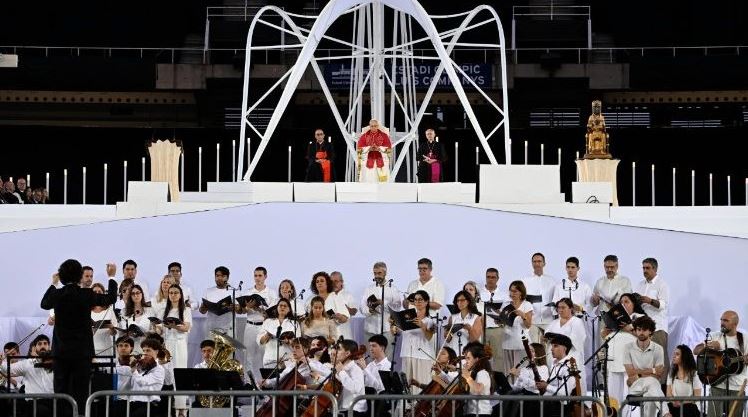
As the final act of Pope Leo XIV’s first day in Barcelona, on Tuesday evening he presided over a massive prayer vigil with families and young people at the Lluís Companys Olympic Stadium in Barcelona. Thousands of participants gathered in the venue to accompany the Pontiff in a celebration marked by prayer, testimonies of faith, and direct dialogue with the new generations.
The vigil brought to a close an intense day for the Holy Father in the Catalan capital, following his visit to Barcelona Cathedral, his meeting with the Augustinian family, and various institutional gatherings. The event took place at the emblematic Montjuïc stadium, site of the 1992 Olympic Games and a regular host of major international events.
A massive welcome for the Pope
Before the celebration began, Pope Leo XIV toured the stadium in the popemobile to greet the thousands of faithful present. The route allowed the Pontiff to draw close to the young people filling the stands, who had been waiting for hours for the vigil to start.
Upon his arrival at the venue, the Holy Father blessed around thirty ambulances, in a gesture of recognition for those who provide medical and emergency services.
The welcome was also marked by the presence of traditional castellers, one of Catalonia’s most representative cultural expressions, who took part in greeting the Pope before the liturgical celebration began.
The Cross, at the center of the celebration
The vigil was conceived as a great prayer gathering centered on the Cross of Christ. After words of welcome from the Cardinal Archbishop of Barcelona, Juan José Omella, the enthronement of the Cross took place—one of the most significant moments of the ceremony.
The celebration also included songs, moments of prayer, the proclamation of the Gospel, and various interventions specially prepared for this encounter with young people.
An introductory video titled The Crosses of the World served to introduce the evening’s spiritual reflection and prepare for the subsequent dialogue between the Pontiff and several young participants.
A direct dialogue with young people
Three young people had the opportunity to ask the Holy Father questions related to faith, the Christian life, and the challenges of the contemporary world, drawing from their personal experiences.
Based on their questions, the Pontiff addressed topics such as the need to cultivate an interior life in a society focused on performance and image, the importance of paying attention to mental health issues affecting many young people, and the difficulty of forgiveness after experiences marked by suffering and violence.
Below is the dialogue between the Pope and the young people:
1. Holy Father, we grow up hearing that the only goal in life is to produce, succeed, and take care of our image. I tried that myself, but I only found an immense emptiness. Seeking answers, my life took a turn, and this past Easter I received Baptism. Now that this path is new to me, I ask you: How can we keep our eyes lifted toward what truly matters, when society constantly pushes us to look down or only at ourselves? How can we discover our true vocation amid this current?
Gràcies per aquest testimoni. Gràcies per permetre’m participar en la teva alegria i en la de tots aquells que en la Pasqua d’aquest any han rebut el sagrament del Bateig.
[Thank you for this testimony. First of all, I would like to share in your joy and in that of all those who received the sacrament of Baptism at Easter this year.]
Many young people and adults are rediscovering the Christian faith, perhaps after a period in life when they had drifted somewhat away from God. This is a truly important step. Indeed, everything we discover, welcome, and gradually live along the way certainly contributes to our growth, our maturity, and the expansion of spaces of life within us; but at the same time, amid joys, successes, and failures, we realize that we need another kind of water to quench our deeper thirst. Our desire for truth and happiness needs a greater horizon. And this restlessness is a gift that God Himself has given us: we are made for the infinite, and therefore every finite horizon, every step, every achievement, while satisfying us, also urges us onward and invites us to keep seeking—advancing, but above all, “descending inwardly,” that is, going deeper.
I aquí torno a la pregunta amb dos breus idees. La primera: és necessari cultivar una sana inquietud. En les nostres societats, de fet la idolatria del benefici i del rendiment, l’afany de produir sempre i de ser guanyadors, així com el culte a la pròpia imatge, no són més que anestèsics per endormiscar la nostra consciència i adaptar-la a una certa idea de societat. Quan les persones aprenen a aturar-se, a donar valor a les coses importants, a apreciar el temps de manera nova i a pensar en la pròpia vida deixant-se il·luminar per l’Evangeli, desenvolupant també un pensament crític respecte a un sistema social que no posa a la persona en el centre i provoca situacions d’injustícia i de pobresa existencials a diversos nivells. És per això que la inquietud fa por, així com el descobriment de la interioritat, de la espiritualitat i encara més de l’Evangeli.
[And here I return to the question with two brief ideas. The first: it is necessary to cultivate a healthy restlessness. In our societies, the idolatry of profit and performance, the constant drive to produce and to be winners, as well as the cult of one’s own image, are nothing more than anesthetics meant to numb our conscience and adapt it to a certain idea of society. When people learn to stop, to value what truly matters, to appreciate time in a new way, and to reflect on their own life in the light of the Gospel, they also develop a critical perspective toward a social system that does not place the person at the center and generates situations of injustice and existential poverty at various levels. That is why restlessness is feared, as is the discovery of interiority, spirituality, and even more so, the Gospel.]
Second idea: it is in this world that we must cultivate this restlessness, not in another. It is within this society that you and so many others have discovered the value of a more human, more fulfilling life, open to encounter with God and to the joy of faith. This means that, despite the difficulties, the place where God makes Himself present and where we must seek His traces is always in the reality where we find ourselves. We believe that the Holy Spirit acts and works silently in all situations of life and history, even in those that seem most difficult. But we must cultivate this restlessness and make space for it; as I said, “seek within,” trying not to be overwhelmed by external rhythms and seductions, cultivating spaces of silence, perhaps pausing a few minutes each day to read the Gospel and speak with God, and also trying to walk this inner path together with others, allowing ourselves to be accompanied in ecclesial journeys and engaging with priests, religious, and others who, like us, have embarked on this path.
2. Holy Father, in a world where things are shouted, there are aspects of life that remain silent, out of shame; like depression, a silent illness that affects many people, young and old, and brings darkness, isolation, and immeasurable pain. Sometimes this pain is so overwhelming that the idea of disappearing seems like the only way out. I myself struggled to emerge from this illness, in silence for years, and one Friday night I lost the battle and tried to take my own life. I am here because God gave me a second chance, and I will be eternally grateful, but there are many others who continue to face this darkness. That is why I ask you from the bottom of my heart: Where can we see God when the darkness is absolute and we can no longer go on? How can we trust in God when it seems that nothing, not even oneself, is worth it?
First of all, thank you for sharing your experience of suffering today. It moves me that you can speak about it, that you are here among us, and that you have found the strength to embrace this second chance the Lord has given you. You have risen and resumed your journey, and this is a wonderful miracle that we see in many characters of the Gospel: in contact with Jesus, even those who feel lost regain confidence in life, are healed of their illness, and can rise again to live anew.
En la teva pregunta, t’has referit en primer lloc a la “malaltia silenciosa” que és la depressió, i és important prendre consciència de com la salut mental es veu cada vegada més amenaçada en el context de societats que es consideren avançades. És un senyal de que hi ha quelcom profundament equivocat en una certa idea de creixement que sotmet a les persones a pressions i tensions que comprometen equilibris fonamentals. Per això es necessita un sistema sanitari que inclogui entre les seves prioritats aquest malestar invisible i generalitzat, que afecta també als joves.
Les teves paraules, tanmateix, ens han mostrat que el dolor posa a prova la fe i el sentit que li donem a la vida. Això és cert per a tothom, no solament per aquells que en algun moment travessen la prova de la malaltia.
[In your question, you first referred to the “silent illness” that is depression, and it is important to recognize how mental health is increasingly threatened in the context of societies that consider themselves advanced. It is a sign that something is deeply wrong with a certain idea of growth that subjects people to pressures and tensions that compromise fundamental balances. That is why a healthcare system is needed that includes among its priorities this invisible and widespread distress, which also affects young people.
Your words, however, have also shown us that pain tests faith and the meaning we give to life. This is true for everyone, not only for those who at some point go through the trial of illness.]
As I listened to you, I thought of those hours of darkness, anguish, and pain that Jesus experienced as His death approached. The Gospels, in the moments of the Last Supper and the prayer in Gethsemane, emphasize that evening was falling, that night was coming on, and just before He died on the cross, they tell us that “darkness came over the whole land.” But in reality, this was not only a personal suffering; the Son of God was taking upon Himself in His own flesh all the anguish, loneliness, and suffering of humanity. In those dark hours, dying on the cross, Jesus shares our pain and reveals to us the face of a compassionate God, who bears our sorrows, who suffers with us, who weeps our tears, and who remains by our side with His presence full of love and mercy.
Going through this experience is difficult; Sacred Scripture attests to it many times. There are moments of darkness and suffering that our society silences, because certain cultural models always want us to be winners and perfect, and therefore limitation, fragility, and pain must be eliminated or confined to the deafening silence of loneliness or even shame. And in these moments, we may instinctively think that God has also abandoned us. But the cross of Jesus tells us that God does not abandon us, that He remains crucified with us in moments of pain and extreme loneliness, that He gathers not only our tears but the cry of our suffering that others do not hear—a cry that Jesus made His own on the cross, saying, “My God, my God, why have you forsaken me?”
There is a catechesis on the final hours of Jesus in which Benedict XVI says that His suffering becomes prayer and cry, and that this also applies to us: in the face of the most difficult and painful situations, when God seems absent, we must once again entrust to Him the burdens we carry in our hearts, even crying out to Him, even protesting like Job, confident that in some way He is present and near even when He appears silent. But I think we cannot do this alone. In hours of pain, as much as possible, we must open ourselves to someone who can help us express a simple prayer, who accompanies us with discretion without rushing to explain that pain, who takes us by the hand and helps us move beyond that cry.
These experiences also offer a message to us believers, to the whole Church: we must not spiritualize pain by superficially attributing it to the “will of God” or some mysterious plan of His, because this risks minimizing that suffering, silencing it, and wounding people. God does not want suffering; He bears it with us and invites us to trust in Him perseveringly. Let us remember what Pope Francis said: with God, life is always reborn.
3. Good evening, Holy Father. I come from a very humble neighborhood in Barcelona. When I was little, my father tried to kill my mother, and she was saved because a boy intervened and died. My father went to prison, and my mother entered the world of drugs. At ten years old, social services took charge of me and brought me to the San José de la Montaña juvenile center. At first it was hard, because I had built a wall to protect myself, not letting anyone in. But little by little I experienced family love for the first time, and my heart began to open. There they spoke to me about Jesus, I began to pray, and I was baptized. But in my adolescence I rebelled against God many times. I was invited to a retreat, and there I experienced God’s love for the first time. But a few months have passed, and I still find it hard to forgive my father. And sometimes I look up to the sky and ask Him, where were You when I was a little girl? Holy Father, how can I forgive my father, who almost left me without a mother? How can I truly reconcile with God?
Gràcies pel teu testimoni i gràcies també per la pregunta sobre el perdó. És realment un signe de la gràcia de Déu que aquesta pregunta sorgeixi d’un passat tant marcat pel sofriment i que, a pesar del dolor, es tingui la valentia de preguntar com és possible perdonar a qui ens ha fet mal. Voldria dir dues coses aquí.
La primera complementa el que deia abans sobre la presència de Déu en les hores del nostre sofriment; en el fons també tu expresses aquesta pregunta respecte a la teva infància, però el context en el que han passat els fets de la teva vida ens demanen ampliar el radi d’influència de la nostra pregunta: ¿ens hem de preguntar “on estava Déu” o hem preguntar-nos sobre l’home i sobre la humanitat, sobre com a vegades som presoners del mal fins a arribar a ser violents amb els demés, sobre com no aconseguim cultivar l’amor i respectar als demés en la seva dignitat i llibertat?
[Thank you for your testimony and also for your question about forgiveness. It is truly a sign of God’s grace that this question arises from a past so marked by suffering and that, despite the pain, there is the courage to ask how it is possible to forgive someone who has hurt us. I would like to say two things here as well.
The first complements what I said earlier about God’s presence in our hours of suffering; in essence, you too express this question regarding your childhood, but the context in which the events of your life took place invites us to broaden the scope of our question: should we ask “where was God,” or should we question humanity and human nature—how at times we become prisoners of evil to the point of becoming violent toward others, how we fail to cultivate love and respect others in their dignity and freedom?]
Many police reports still today reflect a poisoned climate in family relationships marked by abuse and oppression, and in particular violence against women, which too often tragically ends in femicides. This dramatic reality, rooted in anthropological and cultural factors, calls all of us to address it—both personally and as a society—because it is our responsibility to confront it in all its dimensions.
We cannot attribute to God what has been entrusted to our responsibility; we cannot imagine that God from on high will automatically respond to our needs or miraculously prevent evil from happening. He has endowed us with intelligence and will, given us a conscience, clothed us with dignity and freedom, and above all has come to meet us to show us, in His Son Jesus Christ, the path to follow so that our life may be fully human and so that justice, peace, and fraternity may reign in our society. He has given us His very Spirit, precisely so that love may be the key to all our human relationships. If violence exists, if selfishness triumphs, if even love between family members turns into hatred, we must ask questions of ourselves, of the dynamics of our society, of the culture of individualism, of the temptation to violence—and not of God.
A second point concerns forgiveness. We must learn to see forgiveness—a powerful medicine against evil that heals our inner wounds—as part of a process, a journey. If we read the Gospel merely as a book of instructions, commandments, and duties, we risk becoming deeply discouraged and frustrated, because Jesus invites us to forgive, yet we experience that we are not capable. But that is not how it is. Above all, we must invoke forgiveness from the Lord; we must keep asking—perhaps throughout our whole life—that the Lord expand within us the space of love precisely where we have been wounded, that He help us reconcile with ourselves and with that part of our history marked by suffering, that He slowly transform resentment into mercy and compassion.
It is a long journey, a process that requires great patience, a work we must do with ourselves, both personally and through paths of accompaniment and inner reconciliation. And it is necessary not to be discouraged: in forgiveness we advance with small steps. Reconciliation with our history is gradual, and above all we must not think that forgiveness always and in every case means returning to the previous situation or living a full relationship with those who have wounded us, especially when the event was also marked by violence. One can remain in a disposition of goodwill toward the person, reject all forms of hatred or revenge, strive to repair the relationship as much as possible, and perhaps pray for him or her: tot això ens ajuda a entrar cada cop més en la dinàmica del perdó i a reconciliar-nos amb Déu i amb els demés. Som pecadors perdonats, pacificats i capaços de perdonar. Capaços de ser portadors de pau.
[All of this helps us enter more and more into the dynamic of forgiveness and to reconcile with God and with others. We are forgiven sinners, at peace, and capable of forgiving. Capable of being bearers of peace.]