


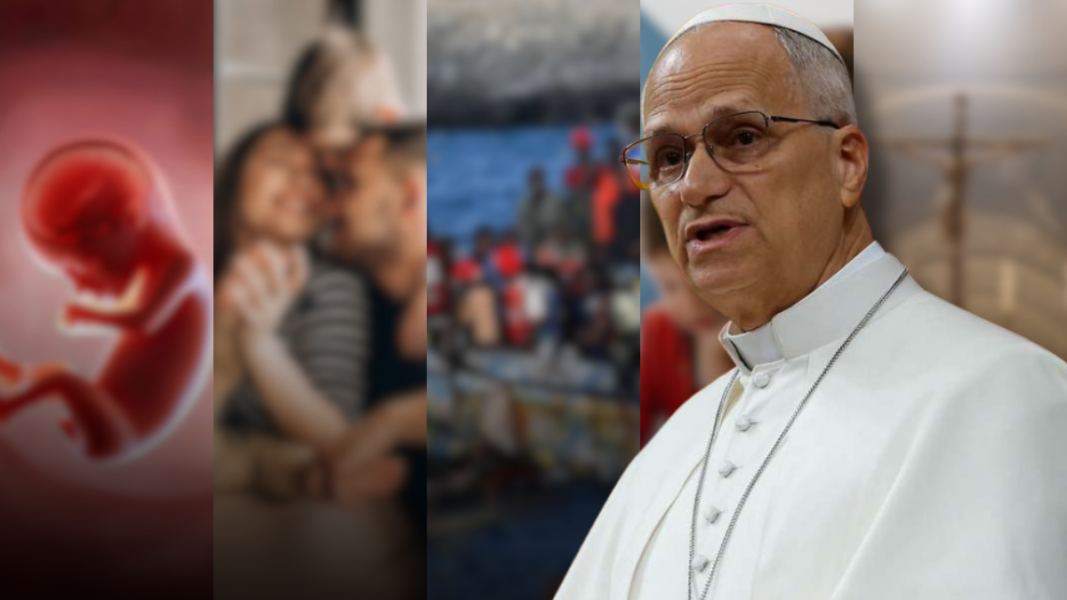
The historic address by Leo XIV before the Spanish Parliament has pleasantly surprised those of us who heard it—perhaps not everyone—because his words were not limited to an institutional reflection on democratic coexistence. Throughout a speech rich in anthropological and moral content, the Pontiff addressed some of the most sensitive issues in Spain’s public debate and political agenda.
From the defense of life to educational freedom, the role of the family, the seal of confession, and the fight against criminal networks trafficking migrants, we present here five of the most forceful statements made by the Holy Father before deputies and senators.
1. The defense of life “from conception to its natural end”
Faced with a government that has legislated in favor of abortion and euthanasia, Leo XIV directly addressed the question of the dignity of human life and warned against the so-called “throwaway culture.”
The Pope made an explicit defense of life from conception to natural death:
“If life ceases to be recognized as a fundamental value, what future can our societies have? Can a community that leaves in the shadows the unborn child, the elderly, the sick, those who suffer in silence, or those who depend entirely on the care of others, truly be called just? The defense of human life is not a partial issue or a confessional interest: it is a goal of civilization. Every human life must be recognized and protected from conception to its natural end, in every circumstance of its existence.
When this certainty is obscured, the most vulnerable are the first victims, and the law loses its deepest meaning: to serve and protect every person. That is why the moral greatness of a nation is shown above all in its capacity to accompany, protect, and love those lives that pass through greater fragility.”
2. The family as the foundation of society
In a country with an extremely low birth rate, where the number of pets exceeds the number of children, the Pontiff also devoted part of his address to reaffirming the role of the family as the basic institution for transmitting values and ensuring social stability.
Leo XIV recalled that no structure can fully replace the formative function of the home:
“Of particular importance is the family, the first human reality and the natural foundation of the community. In the home, generations are intertwined and a living memory is transmitted that gives inner continuity to society. Where the family is supported, the spiritual and social stability of nations is also strengthened.
The family will always be the first school of humanity, where one learns, before anywhere else, the basic grammar of coexistence: receiving life, caring for others, forgiving, serving, and belonging.”
3. Parents’ right to choose their children’s education
Another highlight of the speech was the defense of educational freedom and the role of parents in the formation of their children.
Before the Spanish Parliament, Leo XIV recalled that education cannot be separated from the convictions of families:
“Educational institutions occupy a decisive place in this task (the defense of the common good). In them, new generations can learn to seek and love the truth, to question the meaning of life and the dignity of every person. That is why many parents, eager for their children to learn to relate to others, to think critically, and to acquire solid values, place great hopes in them as valuable allies in their education.
This collaboration must always respect the “primary and inalienable right” of parents to “choose the type of education and formation their children receive, in accordance with their own moral, cultural, and religious convictions”
(cf. Magnifica humanitas, 143; cf. International Covenant on Civil and Political Rights, art. 18.4)
4. A call against criminal networks trafficking migrants
Addressing the issue of migration, Leo XIV urged avoiding approaches that are exclusively economic or statistical and focused instead on the suffering of people trapped by criminal networks.
“The situation of migrants and refugees requires a response that looks at persons, addresses the causes that force them to leave, and goes beyond the mere management of flows. From this arises a double demand of social justice: to offer safe and legal pathways, respectful reception, and real possibilities of integration; and at the same time, to promote the right to remain in one’s own land, working so that no one has to leave their home for lack of peace, security, or dignified living conditions, including economic inequalities and the effects of the climate crisis.”
(cf. Magnifica humanitas, 81).
Furthermore, the Pope explicitly denounced the actions of traffickers and smugglers who exploit the desperation of those seeking a better future:
“In recent years, increasingly dangerous routes have revealed the extremely high cost of this reality, so often hidden or ignored. Many people continue to fall prey to traffickers and smugglers who exploit their desperation. It is necessary to strengthen prevention, rescue, and assistance to victims, especially within the framework of regional and multilateral cooperation.”
5. The defense of the seal of confession
In contrast to a purely individualistic conception, the Pontiff defended an idea of freedom linked to truth, goodness, and personal responsibility:
“Freedom needs a full understanding of itself. To be free does not mean only to be free from coercion or to have many choices; it means being able to recognize the good and adhere to it responsibly. That is why every truly free society also requires a just delimitation of public power, so that the freedom of persons, communities, and associations is not unduly restricted.”
(cf. Dignitatis humanae, 1)
Likewise, Leo XIV referred to the sacramental seal of confession, presenting it as a direct consequence of religious freedom and the legal protection of conscience:
“The legitimate autonomy of the temporal order must never be interpreted as hostility toward the religious phenomenon. Faith does not seek to impose itself through privileges or coercion; however, neither can it be relegated to silence as if it were irrelevant to public life.
In this context, the sacramental seal of confession holds special importance for the Catholic Church. It falls within the broader sphere of religious freedom, which guarantees believing communities their own space for life, organization, and internal discipline (cf. Conference on Security and Cooperation in Europe, Helsinki Final Act, 1 August 1975, Principle VII). To protect it legally, as is done analogously in some professions, means preserving a sacred space of interior freedom, where the believer can open their soul before God without fear of external pressures, as also recognized by international norms (cf. International Criminal Court, Rules of Procedure and Evidence, Rule 73.3).”
The common thread: the inviolable dignity of every person
Although the speech addressed very diverse issues, there is one idea that runs through Leo XIV’s entire address and serves as the foundation for all the others.
The Pope recalled that human dignity does not depend on political decisions, shifting consensuses, or circumstantial majorities:
“Every authentically just society is built upon the recognition of the inviolable dignity of the human person. Such dignity precedes any concession by the State and cannot be subordinated to changing social consensuses or the shifting majorities of each moment.”
(cf. Benedict XVI, Address to the German Bundestag, 22 September 2011)
From the defense of life to the protection of the family, educational freedom, attention to migrants, and religious freedom, Leo XIV presented before the Spanish Parliament a vision of politics centered on the human person as the ultimate foundation of any truly just coexistence.