


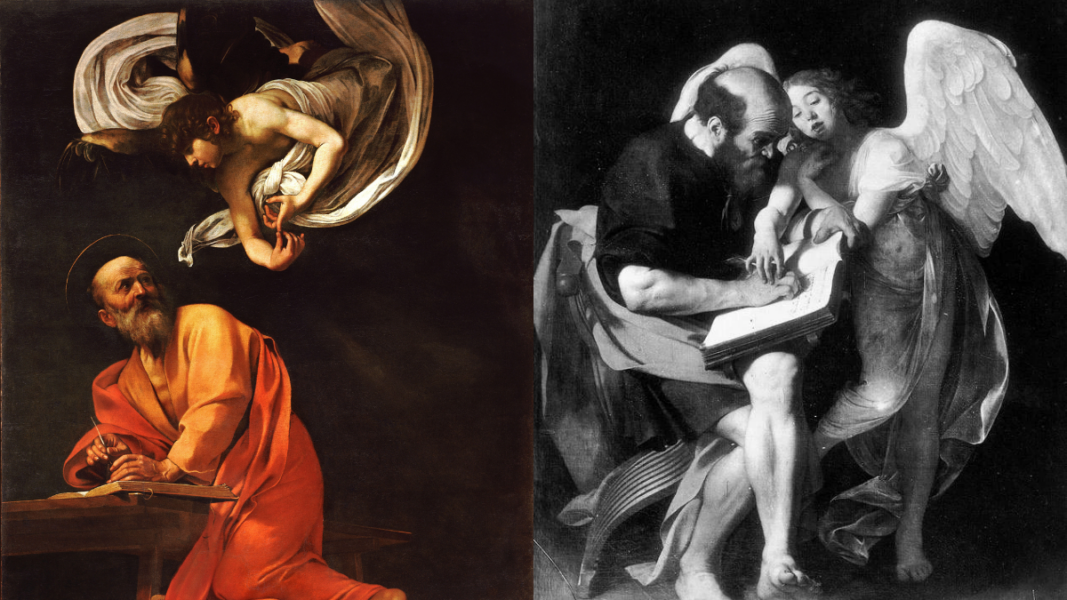
At the beginning of the seventeenth century, Caravaggio painted two magnificent canvases of the Evangelist Matthew at the very moment he takes up the pen to bequeath to the world his memories of Jesus. In both paintings a supernatural figure appears—an angel. In one, the divine messenger seems simply to whisper in his ear «arcane words that no one is permitted to utter» (2 Cor 12:4). In the other, the angel grasps his hand to guide his writing directly. Through these two representations the brilliant Italian painter offers us two perspectives on the divine inspiration of Sacred Scripture: one theologically admissible, the other incorrect. The first is Christian; the second, Islamic (significantly, the first Matthew wears a halo, the second does not).
The latter canvas was rejected by its purchasers, yet not for the usual error of eliminating the human spirit’s role in composing the Gospel, but because the image of the evangelist—with dirty feet and bare legs—struck them as disrespectful. Unfortunately that painting no longer exists; it was destroyed in 1945 by an Allied bombing raid on the Berlin museum that housed it, though photographs survive. The other version, which we can admire today in the Louvre, depicts the former tax-collector with quill in hand and eyes raised to heaven, where an angel appears to be speaking to him. Though executed in the same tenebrist style, the figures are more refined and the inspiration is conveyed more fittingly. The sacred writer lifts his gaze, and an (invisible) spirit enlightens and purifies his intellect so that he may write «all and only what God wills.» Unlike its predecessor, this canvas was enthusiastically accepted by those who commissioned it from the fiery Italian artist—not, however, because of its theological precision, but because its portrayal of the tax-collector Matthew was deemed more respectful. In fact, many critics consider the first painting (the one that no longer exists) to have possessed greater force and merit, even though, from the standpoint of inspiration, its characters evoke Muhammad and the evil spirit that revealed the Qur’an to him.
Now, that the Bible is the only book in the world we can rightly call “divine” is a truth that, in my judgment, rests not solely on the concept of inspiration as theologians have developed it. Inspiration, certainly, is the supernatural (faith-based) element and the most important one for establishing Scripture’s authority; it is what ultimately reconciles divine authorship with human composition. Historically, numerous explanations have been offered for this complex notion, yet I believe St. Thomas resolved the difficulty most acutely by distinguishing between principal cause and instrumental cause, so that the divine Spirit, while respecting the freedom and capacity of the sacred writer, elevates his mind to express what God wishes to communicate to us.
The Dogmatic Constitution Dei Verbum (1965) of the Second Vatican Council on “Divine Revelation,” taking up Dei Filius (1870) of Vatican I, affirms, first of all, divine authorship, but last but not least, the indispensable human cooperation—likewise true authorship—thereby deepening the dogmatic definition of the earlier council.
(11) “The holy Mother Church, relying on the faith of the apostolic age, holds as sacred and canonical the books of the Old and the New Testaments, because, having been written under the inspiration of the Holy Spirit, they have God as their author and as such have been handed on to the Church. In composing the sacred books, God chose men who, making use of their own powers and abilities, and acting in and through them, wrote, as true authors, all and only what He wanted.”
Yet, as I said, without appealing to arguments of supernatural authority, we can reasonably show how far, in this heterogeneous collection of books written by numerous authors of every condition and occupation (from kings and priests to laborers, shepherds, fishermen, and tax-collectors) over several centuries up to the first century of our era—that is, in an age that would be called pre-scientific—truths already affirmed are today largely accepted by the various branches of scientific knowledge, including the most rigorous empirical sciences. This was not because the sacred writers were especially clever or possessed sophisticated technical means to scrutinize the nature of things, but precisely because of their condition as hagiographers, recipients of the Word of God, who can neither deceive nor be deceived. Moreover, as we shall see, if the modern intellectual world was in some cases reluctant to accept these truths or to grant them scientific status, it was precisely because they sounded too biblical. Truths, in short, that the Bible expressed in popular—even poetic—language, yet whose meaning does not differ from the conclusions frequently reached by scientific methodology. Although our world grows ever more irrational and some revive the old nonsense of Latin Averroism (that biblical and scientific truths may contradict each other), the fact remains that St. Thomas already taught us that truth is one and springs from the adaequatio intellectus et rei. Faith and reason are distinct paths that converge at the same point and cannot be contradictory routes, because God is the source of all Truth.
In my judgment, three truths are the most important ones the Bible anticipated before they were verified by philosophical reflection or by the procedures of modern science.
The affirmation of a single founding principle; of one God who is absolutely transcendent
With the scant data at their disposal, anthropologists today debate whether, at the origins of humanity, a single God was worshipped and whether that simple piety later degenerated into polytheism (the biblical view). Various answers have been given to this question, but there is no doubt whatever that all ancient religions were polytheistic (their gods linked to forces of nature or human passions), except the Jewish religion (one God, transcendent, almighty, and unrepresentable). It is true that, although monotheistic, Israel was always tempted by the more popular henotheistic outlook—many local or lesser gods, yet only one God, YHWH—a deviation harshly condemned by the prophets long before the Babylonian exile. Already in Dt 32:17 Moses associates foreign gods with demons, and after the exile, during the Persian period, this truth became firmly established. There is only one transcendent God; He has no image, and the lesser gods of other peoples are devils—that is, creatures made by the one God yet rebellious, though compelled, against their will, not to overstep the limits set by the Creator (see Job 1:6 ff.).
Right reason also leads to monotheism through philosophical speculation. It is striking that the first Greek philosophers, who affirmed the immateriality of the first principle or Archē (that is, the first to engage in metaphysics proper), were polytheists in culture and heart. Nevertheless, from a rational standpoint they pointed toward a supreme unity with the concept of Being (Parmenides), with the idea of the Good, the highest principle in the hierarchy of ideas (Plato), or with the affirmation of the Unmoved Mover, to which, by its perfection and love, all creatures tend as their final cause (Aristotle). And something very significant: the first principle suggestively unites the metaphysical element… and the moral. In other words, by sound reason the Greeks skirted the confines of the one, transcendent, true, and holy God, although they never admitted His role in creating the universe, which they regarded as eternal (just as physicists and astronomers did until the twentieth century, incidentally). On the other hand, simply applying the master rule of Occam’s razor (entia non sunt multiplicanda praeter necessitatem, do not multiply entities beyond necessity), one may conclude that two or more beings cannot possess the absolute attributes theism associates with God; therefore He must necessarily be unique.
The Jews knew this Truth long before the greatest philosophers, yet not by reflection but by revelation. The I AM WHO I AM, emerging from a strange bush that burned without being consumed, did not manifest Himself to a sage or a powerful man, but to a poor exile from Egypt in the days of Seti I or Ramses II—a refugee in a nomadic tribe of the devastating Sinai desert, a nobody. Moreover, the original Hebrew name of God is so conceptually rich that it dynamically evokes His absolute dominion over the future as well as His unbreakable fidelity to His people—Emet (hence some, following the 1569 “Bible of the Bear,” have rendered it I WILL BE WHO I WILL BE). It also carries the most rigorously metaphysical and ontological meaning of BEING (the Septuagint translation, third century B.C.). What St. Thomas defined as Pure Act of Being, that which possesses such infinite power that it can bring things into existence ex nihilo. Thus the God of the Hebrews surpassed in every respect the God described by the philosophers, for the simple reason that the Jews received Him as He IS, because He was fully manifested to them by pure grace (not by any merit of theirs, Dt 9:4). The great Greek sages could only approach, with their intellect, the edges of the mystery of mysteries, and in a fragmentary and imperfect way. Yet at least they did so because reason led them to it—to the Truth.
The universe, composed of matter, energy, space, and time, has a beginning; it is not eternal
As we noted earlier, and however surprising it may seem, it was not until well into the twentieth century that physicists and astronomers abandoned the paradigm—long upheld by atheists (Lucretius, De rerum natura)—of the eternity of the universe (and this despite the immense philosophical problems entailed by positing such eternity). It is well known—yet worth recalling—that Einstein himself rejected the idea of a cosmic beginning as unpleasantly biblical; he therefore defended the stability of the universe and even introduced into his equations of general relativity the so-called «cosmological constant,» to reconcile his theories with that prior assumption. But being an honest man, he acknowledged his mistake and corrected it. «The worst error of his scientific career,» he is said to have remarked.
To perceive this error, it sufficed that in the 1920s a Belgian priest (Lemaître), basing himself precisely on Einstein’s equations, and an American astronomer (Hubble), who simply looked attentively through his telescope, changed the paradigm. They empirically concluded that the universe not only expands (today we even know it does so at an accelerating rate, thanks to so-called dark energy), but that it had a beginning—some consider it absolute (matter, energy, space, and time). This beginning was later called the Big Bang and dated to roughly 13.5 billion years ago, give or take a hundred million.
Yet this same scientific conclusion—origin, not eternity—is also indicated by Scripture: Bere’shit bara’ ’Elohim / In the beginning God created… (Gen 1:1). Although it is widely admitted that the Hebrew verb “bara’” implies creation in the strict sense (from nothing), some question this translation of the solemn verse with which the Bible opens and, on the basis of Gen 1:2 (and Wis 11:17), presuppose pre-existing matter that God shapes and from which He brings forth life. Even granting this second reading, one must first clarify that if such “primordial matter” had existed from all eternity, it could only exist because it is founded on the will of the transcendent and omnipotent God (that is, the God of the Jews), who sustains all things and without whom nothing would exist, because matter is not caused by itself. St. Thomas admitted, as not contrary to reason, the hypothesis of the eternity of things, yet always requiring the creative-conserving action of God (or, as St. Augustine expressed it, «omnicreantem et omnitenentem«). Whereas in the ancient theogonies the gods emerged as secondary products of an eternal chaos and patiently submitted to Fate, in the Bible the almighty God precedes all things and, without external constraints, governs that same chaos by the power of His Word, bringing it light and order to create the world. «Let there be.»
Secondly, and more importantly, the interpretation of this opening verse must take into account the hermeneutical norms set forth in Dei Verbum, namely «the content and unity of all Sacred Scripture, the living tradition of the Church, and the analogy of faith.» Proceeding further in the biblical text, we reach one of the summits of the pedagogy of Revelation, where the truth of creatio ex nihilo is confirmed by the mouth of a humble, illiterate woman, the mother of seven martyred sons (2 Mac 7:22-28). Thus the Bible closes, with this moving episode, the discussion about the absolute beginning of our universe, and it coincides moreover with what our Lord proclaimed: «I thank you, Father, Lord of heaven and earth, because you have hidden these things from the wise and the prudent and have revealed them to little ones. Yes, Father, for such has been your gracious will” (Mt 11:25).
History is not cyclical but linear and progressive
The third great Truth the Bible gives us coincides with the modern concept of History—its linearity. Of course, we do not mean that biblical history was composed according to the present methodology of scientific historiography. Obviously not; as great biblical scholars have emphasized, the way the sacred writer records history is very similar to that of other peoples of the ancient Near East and also to that of the Greeks, but with one capital difference: divine direction.
The first actor in history is the Providence of God: «I am the one who announces what is to come, and my plans shall be fulfilled» (Is 46:9). Man, though free, cannot prevent the divine Will from being accomplished—a Will summed up in saving those who take refuge in Him. This directionality implies something truly revolutionary: the conviction that humanity—not only the Jews—must reach, by the paths God establishes and at the times He determines, a final goal that the prophets understood as the Day of YHWH, when everything would be transformed. Even Jerusalem, the city of conflicts without measure or end, will attain perpetual peace: «it shall be inhabited without alarm (…) and the nations that attacked Jerusalem shall go up year after year to bow down before King YHWH of hosts and to celebrate the feast of booths» (Zec 14:11, 16). We Christians share the same finalistic and linear vision, except that the Day of the Lord will coincide with the Second Coming of Christ and the definitive establishment of His Kingdom. The Jerusalem to which the pagans will come is a metaphor for the opening of the Gospel to the Gentiles and their salvation. History, therefore, has a term, a definitively glorious end. It is directional.
For history is not determined by a fatal destiny that makes it turn perpetually in a cyclical manner; rather, it follows a linear pattern governed by the wise and benevolent hand of God with the sole purpose of saving. The circular (and pessimistic) nature of the pagan nations’ conception of history—their rise, decline, collapse, new beginning, etc.—can be explained by their religious vision of a universe without beginning or end, eternal, and ruled by inexorable fate—the sinister Moirai—the very opposite of the optimistic biblical worldview. Against that depressing vision, the Bible marks out a progressive, mysterious yet open path that has inspired modern historiography. Historians (from the sixteenth century and especially from the nineteenth, with the atheist Auguste Comte at their head) believed that history, being linear and progressive, tended toward ever greater perfection of humanity, toward a more scientific, rational, and civilized man (and, of course, a less religious one). But the twentieth century—with its world wars, the Holocaust, atomic bombs, the Gulag, and the genocidal social experiments of communism—made manifest the stupid naïveté (or something worse) of these “intellectuals” who thought technical progress would automatically bring moral development. They forgot what the Bible repeatedly reminds us: that original sin exists, affecting individuals and their social and historical structures; that by the power of Grace we can overcome it; and that man must struggle without respite and with all his strength for goodness, justice, and the Reign of Christ, even though we are but unprofitable servants and glory belongs to Him alone. With Him or without Him, history always moves forward; only with Him do we move toward the good, and without Him toward evil. In either case we remain under His dominion and Providence, so that the greater the despair we perceive, His Word assures us:
«I am YHWH your God, who takes you by the hand and says to you: Fear not, for I am with you» (Is 41:13).
After this brief survey of the Bible’s wisdom in illuminating both the paths of man (individual and historical) and the avenues of philosophy and natural theology (and even of science), one conclusion forces itself upon us: we are not dealing with just another book, but with the Book. A brief library that also provides those of us who love great literature with some of the most extraordinary and rewarding pages in history—poetry, drama, or sapiential reflection—though that is the least of it. The Bible never aimed to seek beauty for beauty’s sake with brilliant literary tropes (in fact, some of its texts are very arid); rather, it sets before us the raw truth about man, his rupture with God, and, despite that, God’s benevolent will, revealed as Abba, to seek and save what was lost (Lk 19:10; 1 Tim 2:4). It did not wish to detail the course of each civilization or the nature of things, but to focus personal or collective reality (of yesterday, today, and always) from the perspective of the one true God, with an explicitly salvific intent. For that is what the Bible announces on every page, in every sentence, in every letter: Come to Me, all you who are weary and burdened, and I will give you rest (Mt 11:28). Yet the Bible is also the politically incorrect book par excellence, and in both Testaments we are warned, without ever sweetening the narrative, of the responsibility we assume in our existence and of the dire consequences of not following or of abandoning the path our Creator has traced for us (Sir 15:17 or Mt 7:13-14). For all these reasons, because of its divine imprint, it is logical that it should have anticipated (though that was not its purpose) the achievements of the many sages the world has known, as the personified Wisdom confirms in the Book of Proverbs:
«To you, O men, I call, and my voice is to the children of Adam.
Learn prudence, you simple ones, and you fools, acquire understanding.
Listen, for I speak noble things, and from my lips come what is right;
for my mouth utters truth, and wickedness is an abomination to my lips.
All the words of my mouth are righteous; there is nothing twisted or crooked in them.
They are all plain to the one who understands, and right to those who find knowledge.
(Prov 8:4-9).
Note: Articles published as Tribuna express the opinions of their authors and do not necessarily represent the editorial line of Infovaticana, which offers this space as a forum for reflection and dialogue.