


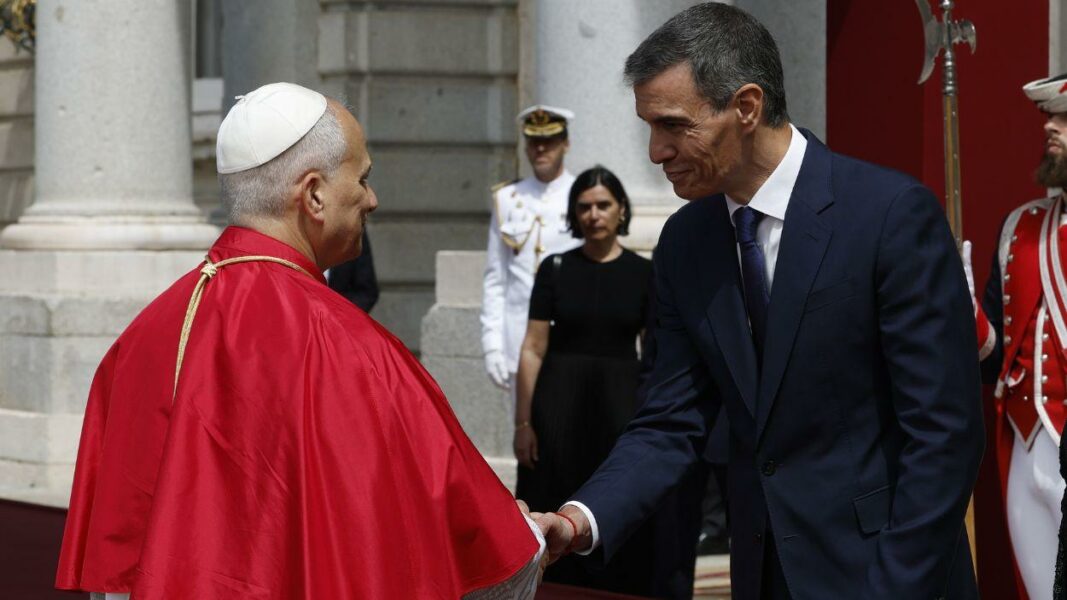
The visit of Leo XIV to Spain will likely leave positive fruits that will remain long after the headlines fade. Beyond inaccuracies about multiculturalism and a vision lacking empathy for a people deeply affected by mass immigration, the Pope has spoken on issues that touch the very heart of the Western crisis: the loss of transcendent meaning, social fragmentation, the spiritual emptying of institutions, and the need to rebuild a culture founded on the dignity of the person. These are matters too important to be reduced to the immediate consumption of daily politics.
Precisely for this reason, the political use of the visit was never a remote possibility but an almost absolute certainty. Even before Leo XIV landed in Spain, it was possible to anticipate that a government besieged by scandals would attempt to turn any photograph, any greeting, and any institutional gesture into an opportunity to rebuild a moral authority seriously eroded. It was not a particularly risky prediction. It was simply the logical consequence of the political situation facing the Executive.
What has happened in recent days has only confirmed what many had been pointing out from the beginning. As investigations, journalistic revelations, and evidence against various circles of power continue to accumulate, the Pope’s visit has been presented by the government machinery as a kind of providential lifeline. Not because the content of the trip has any relation to the political problems affecting the Government, but precisely because it allows the focus to be shifted for a few days to a much more favorable terrain from the standpoint of public image.
Spain is experiencing one of the greatest moments of institutional deterioration in its history. At the center of this situation stands José Luis Rodríguez Zapatero, who for years has become the true political and ideological totem of sanchismo. The former president is no longer seen as a retired ex-president who occasionally offers advice. His figure emerges again and again wherever obscure operations, difficult-to-explain intermediations, and structures of influence that operate outside any effective democratic control appear.
The situation has reached an unprecedented dimension. Zapatero is under investigation in the so-called Plus Ultra case for alleged crimes of criminal organization, influence peddling, and documentary falsification. The National Court has ordered searches of his offices, and investigators have seized abundant documentation, electronic devices, and a safe containing dozens of jewels, watches, and other valuable objects whose origin and valuation continue to be the subject of judicial analysis.
Added to this are the investigations of this past week in which Pedro Sánchez (P.S) has entered into a dynamic of permanent confrontation with those bodies and institutions that retain oversight capacity. The information regarding the Leire papers and the thuggish hostility toward judges, prosecutors, and critical media have fueled a concern that can no longer be dismissed as mere partisan confrontation.
In such a context, the Pope’s visit inevitably constituted a magnificent opportunity for La Moncloa. None of this invalidates the importance of the trip. None of this diminishes the value of Leo XIV’s messages. But neither does it require pretending that the Government would not attempt to exploit politically an event of such magnitude.
Perhaps for this reason some Catholics view the timing of the trip with a certain perplexity. It is not a matter of questioning the visit, which may be valuable and necessary. Nor of doubting the pastoral reasons that justify it. But it is legitimate to ask whether in the Vatican and in certain sectors of the Episcopal Conference the Spanish political context and the inevitable use that an Executive in trouble was going to try to make of the Pontiff’s presence were sufficiently considered. The problem is not the trip. The problem is that the Spanish political reality made it perfectly foreseeable that the trip would be instrumentalized.
The most caricatural confirmation of all this came from El Plural, a media outlet whose function within the government media ecosystem has long been to provide ideological cover for the communicative needs of sanchismo. Its headline, “Sánchez and the Pope turn Spain into the world capital of the fight against technofascism,” is one of those pieces that force the reader to check several times that they are not facing a parody.
It is difficult to condense into so few words such a quantity of propaganda. The photograph of an institutional meeting is transformed into a planetary moral alliance. The Pope ceases to be the successor of Peter to become a secondary actor within Pedro Sánchez’s political narrative. And the Prime Minister, cornered by scandals, suddenly emerges as the international leader of a civilizational crusade.
The choice of the term “technofascism” also deserves separate consideration. It is one of those expressions born in contemporary laboratories of political engineering, abstract enough to mean nothing concrete and alarming enough to justify any propagandistic construction. No one knows exactly what technofascism is, where it is, or who embodies it, but apparently Madrid has become the world capital of its resistance thanks to a photograph between Leo XIV and Pedro Sánchez.
The scene has something involuntarily comic about it. While the political mentor of sanchismo prepares his defense as a defendant before the National Court, while revelations affecting the government environment continue to appear, and while public confidence in institutions continues to deteriorate, certain media outlets consider that the truly important news is the creation of a moral axis Leo XIV–Sánchez destined to save the world from a technological threat of mysterious contours.
What is truly revealing is not that the Government tries to take advantage of the visit. That was perfectly foreseeable. What is revealing is the level of exaggeration reached by some of its media outlets. Reality is so unfavorable that it is no longer enough to display institutional photographs. It is necessary to construct an epic. It is necessary to present Madrid as the moral center of the planet, the Pope as an indirect legitimizer of the government project, and Pedro Sánchez as the protagonist of a historic battle for the future of humanity.