


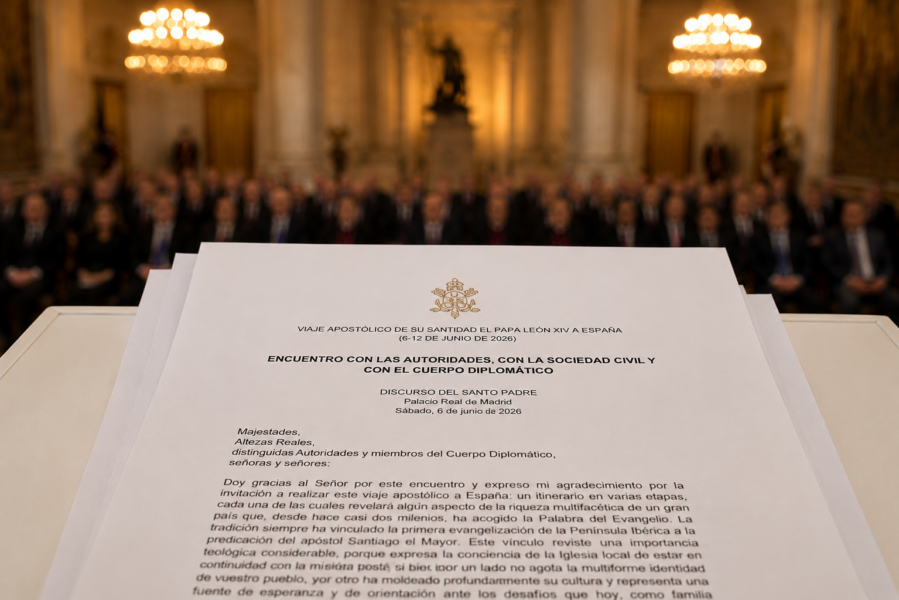
At first glance, the speech seems impeccable.
It speaks of Saint James the Apostle. It speaks of Spain’s Catholic tradition. It quotes Saint John of the Cross, Saint Teresa, and Saint Ignatius of Loyola. It speaks of human dignity, peace, religious freedom, and the value of faith.
Many Catholics will read those pages and conclude that everything is in order.
But that is precisely where the problem lies.
The great transformations within the Church are rarely brought about by explicit denials of the faith. Almost never do priests or bishops declare that they no longer believe in Christ or that the Gospel is false.
Profound transformations occur when the center shifts.
When the same words remain, but cease to occupy the primary place.
That is exactly what happens in this speech.
Because the decisive question is not what Leo XIV says.
The question is what concerns him.
And simply reading the full text reveals it.
The word sin practically disappears.
The need for conversion disappears.
The evangelizing mission barely appears.
Eternal salvation is relegated.
Instead, other concerns constantly surface: polarization, identities, dialogue, complexity, coexistence, encounter, multilateralism, and social friendship.
This is no minor detail.
It is a question of priorities.
Imagine a doctor speaking for an hour about a hospital’s décor and barely mentioning the illness of his patients.
The décor may have some importance.
But everyone would understand that something does not add up.
Something similar is happening here.
Spain is going through one of the greatest religious crises in its history.
Religious practice is collapsing.
Birth rates are plummeting.
The family is weakening.
Legislation is moving ever further from Christian morality.
Thousands of young people are growing up without even knowing the basic elements of the faith.
Yet the great danger identified by the Pope is none of these.
The great danger appears to be polarization.
And it is worth pausing here.
Because polarization is not necessarily an evil.
At times it is the consequence of a real conflict.
The early Church polarized the Roman Empire.
The martyrs polarized their societies.
Saint Athanasius polarized the Arians.
Saint Thomas More polarized Henry VIII.
Christ’s own preaching produced division.
Not because they sought confrontation, but because truth inevitably provokes a reaction.
That is why it is so troubling that polarization appears almost as the great public sin of our time.
Because then the goal ceases to be discerning who is right.
And becomes simply reducing conflict.
But reducing conflict does not always equate to defending the truth.
There is another, even more disturbing aspect.
Leo XIV invites us to flee from “identity-based approaches.”
The phrase may seem innocent.
It is not.
Because Christianity is an identity.
The Church is an identity.
Christendom was an identity.
The martyrs died precisely because they refused to renounce an identity.
When a person constantly speaks against identities, they end up questioning even those identities that deserve to be preserved.
Even more striking is the explicit praise of multilateralism.
Let us pause for a moment.
We are talking about the first major speech of a Pope in Spain.
He could have taken the opportunity to speak about the re-evangelization of Europe.
About the demographic crisis.
About the apostasy of the continent.
About the defense of life.
About the persecution of Christians.
Instead, he dedicates specific words of recognition to Spain’s commitment to multilateralism.
Why?
Because it reveals the mental framework from which he is observing reality.
It is not the language of a missionary.
It is the language of contemporary international governance.
And this appears again and again.
Also when he speaks about Islam.
The Pope recalls the spaces of coexistence and intellectual cooperation among Christians, Muslims, and Jews during the Middle Ages.
All of that happened.
But the selection is extraordinarily revealing.
Because eight centuries of Christian resistance disappear.
Covadonga disappears.
The Reconquista disappears.
The martyrs disappear.
The secular effort to recover a land that had been conquered by Islam disappears.
It is not a historical error.
It is a choice.
And choices reveal priorities.
The entire speech works this way.
It does not deny the faith.
It does not deny Christ.
It does not deny the Catholic tradition.
It simply places them in the background.
The foreground is occupied by other categories.
Coexistence.
Mediation.
Complexity.
Inclusion.
Global governance.
Social friendship.
The final result is a silent inversion of the order of priorities.
The Church ceases to appear as the institution charged with proclaiming a truth that saves.
And begins to appear as a great moral mediator destined to facilitate dialogue among social actors.
Many readers will not immediately perceive this shift because the religious vocabulary remains present.
But that is precisely why it is more dangerous.
Obvious heresies usually fail.
Gradual substitutions usually succeed.
And the question this speech leaves behind is as simple as it is troubling:
if all the religious references were removed from the text, how much would its central message really change?
The answer may explain better than anything else why this speech deserves to be read with enormous attention.