


Everything has already been said about the Pope’s visit to Spain, which begins today. This portal has published several articles highlighting the lack of meaning behind the trip, its exploitation by the Sánchez government, and the pre-designed projection of an official image of Spain and of the Church in Spain.
Yes, Leo XIV will process with the Blessed Sacrament on Corpus Christi Sunday. That is the most Catholic thing he will do. The rest is showmanship—packed stadiums (as in all previous papal visits, nothing new)—and filler until the grand finale and, in my view, the real purpose of the trip: Lampedusa 2.0 in the Canary Islands. Visits and Masses to support the Islamic invasion of Spain promoted by the government and globalist powers, which kills hundreds of people at the hands of criminal networks and degrades the lives of native Spaniards. The three cayucos (formerly called “pateras”) around the altar will be an unsurpassable display of pathos. If I lived in the Canary Islands and were suffering this invasion firsthand, I would not attend any event of a pope who is not coming to encourage Catholics amid the drama they are enduring, but rather those who are the cause of their suffering. Delusional. The Church of the N.O.M. (New World Order and Novus Ordo Missae).
More authoritative voices than mine will speak about this when it happens. They will also address the lamentable spectacle of the controversy surrounding the words the Pope is to say in Catalan in Barcelona.
For my part, I would like to focus here on one specific aspect of the Madrid leg of the Pope’s visit—four long days that Cardinal Cobo has meticulously prepared to offer a carefully pre-designed image and narrative, so that we accept it through sheer repetition, beyond what our eyes see and our ears hear. The cardinal has spent more than two months on these ant-like Goebbelsian tasks, in which Catholic influencers or digital missionaries play a key role, now turned into his army of synchronized opinion made up of digital mercenaries.
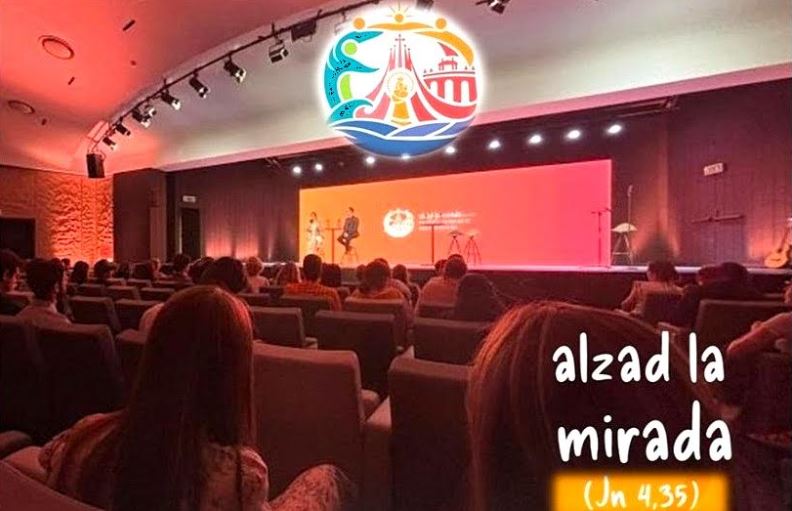
Since the end of March, the cardinal has been summoning as many well-known digital missionaries as possible; the Archdiocese’s own website reports on this. It began on March 30, when Cobo organized a marathon day in which he launched the core idea: “communicate to gather, create communion and not divide”. The following words are taken from the diocesan website: “Digital missionaries and those responsible for parish social media in Madrid gathered last weekend, convened by the Archdiocese to jointly prepare for the upcoming visit of Pope Leo XIV. A day and a half of intense work, pastoral reflection, and proposals for this visit, which has highlighted the growing role of evangelization in the digital sphere and the need to approach it in a communal, ecclesial, and missionary way (…). The cardinal began with Jesus’ fundamental question, ‘Do you love me?’ to emphasize that the mission, also in the digital environment, consists in ‘shepherding,’ caring for, uniting, and accompanying, especially in a social context marked by polarization and conflict. Faced with the temptation to use the event to gain visibility or stir public debate, the archbishop proposed the pastoral key of the verb ‘to shepherd’: to make them go together (…). Among the axes outlined for the participants’ communicative mission, he stressed the provocation of the encounter with Jesus’ question to lift one’s gaze in a world that looks downward and to show that the Church is community.”
Cobo brought to Madrid for this event Monsignor Lucio Ruiz, secretary of the Dicastery for Communication of the Holy See, who “offered a broad reflection on the identity and mission of digital communicators within the Church (…). He insisted that ‘no one is a lone sniper in the Church,’ but rather it is about walking together, ‘in tune with the bishop like the strings of a violin,’ warning that ‘public confrontations between digital missionaries are one of the greatest cancers of the digital mission: unity is defended tooth and nail, with one’s life. No doctrine justifies breaking unity’.”
There was more, because a day and a half allows for a lot: round tables and panels of experiences, with publication management and editorial calendars, shared resources, institutional identity and voice, etc. Other presentations focused on offering practical keys on how to narrate the faith during major events “to create communion.”
This was not the only meeting. There have been others, to make the message clear. But it is very easy to read between the lines: Cobo has sought to build a triumphant institutional narrative because he fears that non-apesedebrated faithful—those who love the Church and suffer for her—will disrupt the event by somehow bringing the issue of the Valley of the Fallen before the Holy Father.
Over these two months, those of us who follow social media have been bombarded with messages stemming from these meticulously orchestrated directives from websites and Instagram accounts created ad hoc (Alzad la mirada and Con el Papa), in addition to the Instagram account of the youth delegation of the Diocese of Madrid. We have seen and heard them rehearsing the puerile hymns they will sing to the Pope, how famous guests have been added to the massive evening concert; a couple of lamentable videos have been recorded that do not speak of God, but of universal fraternity, etc. And the digital missionaries, turned into digital mercenaries, delighted to be part of conveying the narrative of Leo’s visit to their tens of thousands of followers on social media. We do not know who did so ingenuously, with the best of intentions, and who did so because it suited their ego, their pockets, or both.
All of this is nothing more and nothing less than sanchismo in its ecclesiastical version. That is, the most morally corrupt element in the world applied by the Archdiocese of Madrid, led by its cardinal. We are already accustomed to the synchronized opinion teams and paid activist-commentators of the PSOE. But the fact is that sanchismo is not doing anything new either; it is merely following what Goebbels already invented, the Nazi propaganda minister, with his program based on 11 principles, some of which are clearly visible not only in the PSOE but also in Cardinal Cobo’s organization of the Pope’s visit to Madrid.
Let us see: first, the principle of simplification and the single enemy: adopt a single idea, a single symbol; individualize the adversary into a single enemy (those who want to sow division during the Pope’s visit); also, the principle of transposition. Place one’s own errors or defects onto the adversary, responding to attack with attack. “If you cannot deny bad news, invent other news to distract from it”: anticipating that the issue of the Valley will come up, he prepares all this artillery of confetti and the message of “unity.”
Another Goebbelsian principle that Cobo applies is that of vulgarization. “All propaganda must be popular, adapting its level to the least intelligent of the individuals to whom it is directed. The larger the mass to be convinced, the smaller the mental effort required. The receptive capacity of the masses is limited and their understanding is poor. If you have been following social media, the secondhand embarrassment produced by the infantilization and stupidity of the videos released by the Archdiocese speaks for itself. Another fundamental principle evident in Cobo-Goebbels’ strategy is that of orchestration. “Propaganda must be limited to a small number of ideas and repeat them tirelessly, presented again and again from different perspectives, but always converging on the same concept. Without cracks or doubts.” Just like the principle of silencing, which in the Pope’s visit is unequivocally applied to the situation of the Valley of the Fallen: to silence issues on which there are no arguments and to disguise news that favors the adversary, also by counter-programming with the help of sympathetic media. And finally, the principle of unanimity. To convince many people that they think “like everyone else,” creating the impression of unanimity. In total, six of Goebbels’ eleven principles of propaganda are being applied by Cobo to the construction of the narrative of the Pope’s visit.
As Catholics, whom the Lord commands to “watch,” to be attentive, we must unmask this or any other orchestrated narrative that seeks to convince us of something contrary to what our eyes see and our ears hear, which, following Thomistic, and therefore Christian, realism, leads us to rationally process any idea or situation.
Finally, I believe it is worth mentioning—not merely as an anecdote, but as a sign of the ecclesial times—how some of the shrewdest digital mercenaries have taken the opportunity to launch any kind of papal visit merchandise for the benefit of their own coffers. There is no need to name names, only to pay attention to those who, the first thing they do when the Pope comes, is to put a line of T-shirts up for sale and intend to run an evangelization business with people on the payroll of donations from naïve benefactors.
Little or nothing remains of John Paul II thundering to young people, “Do not be afraid to open the doors to Christ,” or of Benedict XVI recounting the feats of the Christianitas minor in Hispania, land of saints and evangelizer of half the world. In this visit, I have the feeling that the Pope allows himself to be instrumentalized by the various bishops of the dioceses he visits and, worse still, by the Sánchez government, to project the images and messages they have pre-designed, because what matters most to the Supreme Pontiff of the Catholic Church is reaching the Canary Islands to culminate the Lampedusa 2.0 that Francis was unable to carry out.