


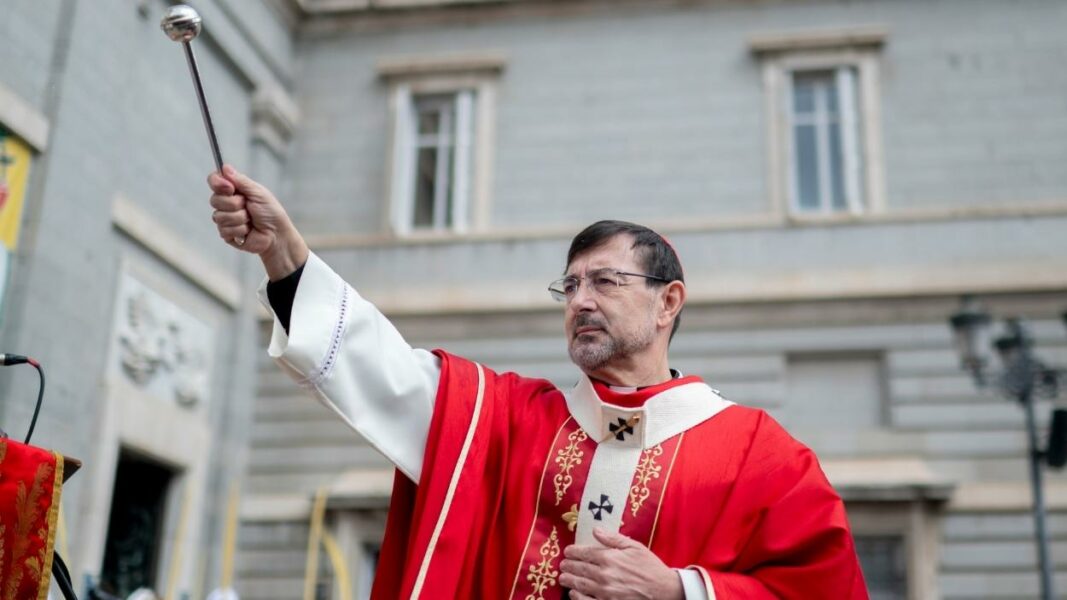
At the interview that Cardinal Cobo granted to La Nación on the eve of the Pope’s visit, all that is missing is a sash across his cassock and a final line calling for world peace. Everything else is there: the desire to bring out the best in everyone, the generic gratitude, the luminous horizon, the upward gaze. One finishes reading it and does not know whether one has heard an archbishop, a Miss Spain finalist, or the campaign director of a foundation that lives off subsidies. And here lies the problem, because there is a capital difference among the three professions, and it is that only one of them has been entrusted with souls.
It is worth saying plainly: what is painful is not that Cobo says false things. It is that he says nothing. The interview is a succession of propositions that cannot be refuted because they affirm nothing. That the Pope “brings out the best in us.” That we must “raise our gaze.” That the Church has the virtue of “elevating gazes.” That it is fitting to “thank the politicians.” No enemy of Christianity would sign the opposite; no atheist would lose sleep over it. It is the exact language a communications consultant would hand to a client who needs to appear in the press without committing to absolutely anything. And a bishop is not there to avoid commitment. He is there, precisely, for the opposite.
The most revealing moment comes when the journalist—who is doing her job—reminds him that the Pope will speak in Congress amid the government’s full decomposition, splashed by corruption scandals. The question names the context clearly. The answer makes it disappear. Cobo replies that we must “thank the politicians” because “there are good politicians” and “people who are giving their lives for politics with a capital P.” One rereads the question and the answer three times looking for the point of contact, and there is none. He is offered corruption and returns gratitude. He is offered scandal and offers horizon. It is not that he dodges the issue: it is that he has trained in a dialect in which the issue does not exist. It is the pragmatism of someone who has decided that his public function consists in never brushing against anyone.
Then there is dignity, which is where the pamphlet turns solemn. Cobo warns that “human rights are beginning to be restricted” and that “democracy is beginning to be chipped away at from many angles.” It sounds grave. It sounds brave. And it means nothing, because there is no subject. Who is chipping away? From where? Restricted by whom, against whom, in what specific law, in what vote, at what border? The phrase “from many angles” is a masterpiece of indeterminacy: an omnidirectional alarm that each reader directs toward their favorite adversary and that does not oblige the cardinal to sustain a single proper name. It is dignity as décor, not as doctrine. And a bishop who has read Dignitas infinita knows perfectly well that dignity is not a mood to invoke at press conferences, but an uncomfortable affirmation with consequences that distribute displeasure to left and right. Those consequences do not appear. What appears is the word, ironed and perfumed, ready for the event.
Where he does come down to earth is on immigration, and it is instructive. There, suddenly, there is concreteness: the Church “accompanied” the government’s regularization proposal, distinguishes between the already integrated migrant and “the issue of flows,” and delegates the question of borders to “the stance from Brussels.” That is: when it is necessary to back a concrete policy of the Executive, the cardinal suddenly finds the precise words that were missing when speaking of the corruption of that same Executive. The fog lifts exactly where it is convenient for it to lift. It is not naïveté. It is selection.
And this is where one drops the irony and is left with weariness. Because the underlying question is not why Cobo speaks this way—he speaks this way because it works for him, because it opens doors for him, because institutional applause is warmer than fidelity—but why we have to put up with it. Those of us who keep going to Mass. Those of us who financially sustain a structure that increasingly resembles an NGO with incense. Those of us who expected from a successor of the apostles something more than the emotional wisdom of a coach. We are asked for enthusiasm—Cobo repeats it, he trusts in the “enthusiasm for the Pope,” which “has a bit to do with culture”—and in return we are given a permanent homily about how beautiful it is to look upward. We raise our gaze, Your Eminence. We do it every Sunday. The problem is what we find when we lower it.