


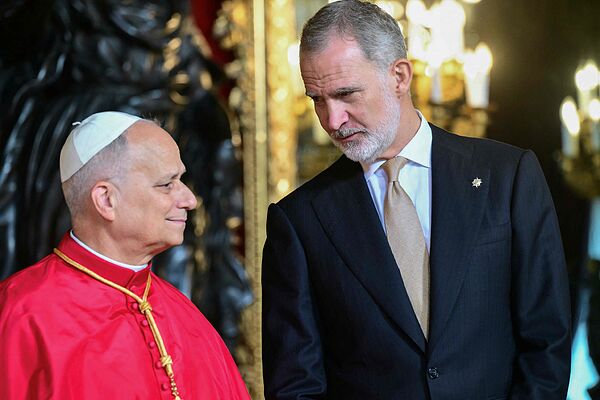
It is no longer necessary to speak in the conditional. Leo XIV set foot on Spanish soil, spoke, and the first thing he said before the King, the authorities, and the diplomatic corps was a thank-you to Spain for “its fidelity to international law and multilateralism”. He immediately invited “everyone, for the love of truth, to abandon the divisive and polarizing narratives” of Spanish social reality, urged “fleeing from those identitarian approaches that seem to clarify everything but fill the world with ghosts and enemies,” and called for an appreciation of complexity. He expressed the wish that the European Union advance “not in opposition to other powers, but as a gift.” And then, almost as if recalling a formality, “may God bless Spain.”
One must acknowledge what was also present, because the sleight of hand is only understandable if one first admits there was no secularization. Quite the opposite occurred. The address opened with Santiago and the apostolic continuity from Pentecost, spoke of the “fruitful encounter between Jesus Christ and your people,” invoked the dark night of St. John of the Cross—whose jubilee year we are celebrating—and went so far as to recite “O night that guided”; it brought in Teresa’s interior castle, Ignatius’s discernment, religious freedom, the martyrs. No one could accuse the text of having left Christ in the sacristy. He is in the stained-glass window, splendid, contemplative, jubilant.
The problem is that He is not in the single sentence the diplomatic corps and Moncloa had come to hear. Because the speech has two registers, and it is best not to confuse them. There is a sublime, mystical register, reserved for the soul: the blessed night, the soul that frees itself from what it presumed to possess. And there is an operational register, the one that descends from those heights and addresses the concrete city, the nation, the State. In the first, the Name appears. In the second—the one that truly becomes a headline and policy—other words appear: multilateralism, polarization, identitarian, complexity. The transcendent for prayer; the slogan for government.
And here lies the point, which is not one of tone but of structure. Leo invited “everyone” to abandon divisive narratives. The formula is formally universal and operationally directional. Because in the political Spanish of June 2026, “polarization” and “identitarian” are not neutral terms: they are, almost literally, the vocabulary with which the officialdom names its adversaries. The one who denounces abortion is the identitarian. The one who defends the unity of Spain is the polarizer. The Catholic who opposes Sánchez is, in that lexicon, precisely the manufacturer of “ghosts and enemies.” Thus a grammatically impeccable “everyone” lands, in tomorrow’s press, on only one half of the country. And it is not the half that governs.
The choice of historical references reinforces the meaning. Leo invoked Santiago to establish continuity—the apostle whose tomb made Spain Christian—and chose Al-Andalus to set the model: Córdoba and Toledo as “places of mediation,” the school of translators of Alfonso X, Averroes and Maimonides, the centuries of Islamic presence as a paradigm of coexistence. The apostle for the origin; the centuries of Islam for the lesson. One understands the ecumenical intention. But that the successor of Peter should propose Andalusian coexistence—a thesis as contested by historiography as it is profitable for a certain ideological reading—as the cipher of what Spain owes its past, while tiptoeing past the cross he himself embodies and that arrived via Compostela, is not an oversight. It is a criterion.
What is truly disheartening is that we already had the script. The editorial that Cardinal Cobo signed this very morning in ABC announced the speech with oracular precision: the Pope, he wrote, “does not raise a confessional question, but a profoundly human one.” Leo came to prove him right. The acclamation and the fulfillment rhymed all too well; when the choir already knows in advance the antiphon the celebrant is going to intone, one should suspect who composed the score.
The liturgy, which is wiser than the editorials, knows only two words for the one who arrives. *Benedictus qui venit in nomine Domini*: blessed is he who comes in the name of the Lord. Scripture always set the other word opposite it, *maledictus*, not as an insult but as the exact shadow of the first: cursed is he who comes in the name of anyone else. The person is not cursed—far from it, neither is it fitting nor relevant; what is noted is the name under whose invocation entry has been made. And what today entered through the door of the authorities, in the part addressed to Caesar and spoken in Caesar’s tongue, seems to have come in the name of multilateralism, of the reprobation of “identitarian prejudices,” and of non-polarization. The Name remained in the stained-glass window. The operational invocation was another.
What remains is the “seems,” and what remains is the rest of the journey. The arrival speech is for Caesar, and it spoke in Caesar; the homilies to come are for the faithful, and they have not yet been delivered. We will know which Pope came by the vocabulary that survives when the diplomats leave the room. But it is best not to deceive ourselves about what we have seen today: we asked for a priest who would come in the name of the Lord, and they have presented us, with an impeccable cassock and the Latin of St. John of the Cross, with a magnificent commissioner of cohesion. There will be time yet to conjugate the verb in the past tense. For now, one only dares to utter half the antiphon.