


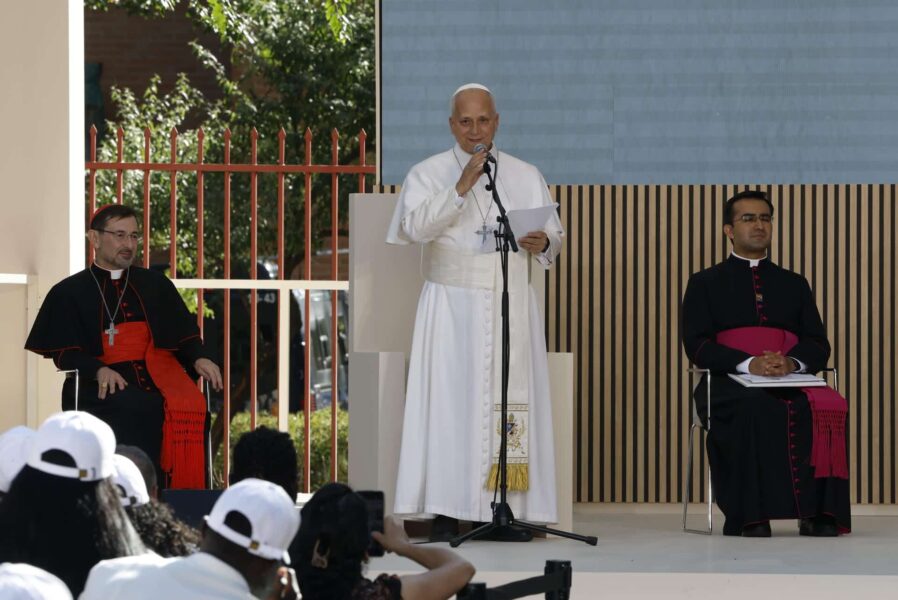
The first afternoon of Leo XIV in Madrid was marked by several encounters with people in vulnerable situations. Before visiting the CEDIA 24 Hours information and reception center, run by Cáritas Madrid, the Pontiff met at the Apostolic Nunciature with a group of people with disabilities and patients cared for by Catholic charitable organizations and the Archdiocese of Madrid. Later, at the social center, he listened to testimonies from homeless people, immigrants, and volunteers, and emphasized the centrality of charity in the life of the Church.
Meeting with the sick and people with disabilities at the Nunciature
Before heading to the CEDIA 24 Hours center, Leo XIV held a meeting at the Apostolic Nunciature in Madrid with about forty people with disabilities and patients accompanied by various Catholic charitable organizations and the Archdiocese of Madrid.
The Holy Father addressed them with words of greeting and shared a moment of prayer with them. Before greeting each of the attendees personally, he prayed the Our Father with the group.
The meeting was the first social event of the afternoon and served as a prelude to the visit the Pope would make shortly afterward to one of Cáritas Madrid’s main assistance projects.
A welcome filled with testimonies and encounters
Upon arriving at CEDIA 24 Hours, Leo XIV was received by the Archbishop of Madrid, Cardinal José Cobo, and by the project leaders. During the visit, he learned firsthand how the center operates and the services it provides to homeless people.
One of the center’s users, of Peruvian nationality, explained to the Pontiff the daily work carried out there. Afterward, the Pope toured some of the facilities, visited the dining hall, and greeted several of the people assisted before heading to the courtyard where the main gathering took place.
In his words of welcome, Cardinal Cobo presented the center as one of the concrete expressions of the Church’s presence in Madrid’s most vulnerable neighborhoods. The Archbishop highlighted that beginning the papal visit in this place is a way of recognizing the Gospel priority of the most in need and recalled that “Christ not only sends us to the most needy, but makes Himself present in them.”
Cobo also emphasized that the Church in Madrid wishes to “lift its gaze” without taking its feet off the daily reality of those who suffer exclusion, poverty, or lack of opportunities. “Looking to heaven does not distance us from the earth; rather, it teaches us to inhabit it with greater depth, greater fraternity, and greater truth,” he affirmed.
After the words of welcome and several testimonies—including those of a mother, an immigrant, and a volunteer—Leo XIV delivered a speech focused on charity, care for the most vulnerable, and the mission of the Church.
Below is the full text of Leo XIV’s speech:
Your Eminence,
Your Excellencies,
dear brothers and sisters:
I am truly very happy to begin my visit to Madrid here. As Your Eminence has said, whoever is in Madrid is of Madrid. And so I too am among you as just another Madrilenian: thank you, Madrid, for this welcome. A welcome that makes me feel part of a great and wonderful family in which, as in all families, miracles of love occur. Especially in this house, where no one is left alone.
Here, the joy and pain of each one are the joy and pain of all, and by listening to one another, we face challenges together, without ignoring the complexity of situations and, at the same time, without setting aside the demands of charity and justice, “in dialogue with all those who are seriously concerned for man and his world” (Deus caritas est, 27). Thus CEDIA follows the path of the Gospel, walking in the footsteps of Jesus, the Son of God who became man not only to heal our illnesses and miseries, but to make them His own—except for sin—living as one of us in weakness and identifying with every person who suffers, to the point of telling us: “Whatever you did for one of these least brothers of mine, you did for me” (Mt 25:40).
In this sense, we can interpret the words we have just heard in the song: “In every dream I sought You, and none was in vain.” They beautifully summarize the testimonies we have heard and the work carried out here every day.
Indeed, thanks to a dream and a small door opened—small in size, but immense in mercy, as Your Eminence has said—Niurka has given Ares and Athena life, her motherly love, the grace of Baptism, and the promise of a happy future.
Thanks to a dream and that same small door, Khadri has crossed the dark tunnel of the pandemic and a journey full of uncertainties. With the help of those who extended a hand to him, showing him that they valued him and believed in him, he has found work and, above all, has regained the desire not only to move forward, but also to support others in turn, just as others have supported him.
Thanks also to a dream and that same small door, every day Alicia and the other volunteers of the Proyecto Esperanza help so many women recover their dignity, autonomy, hope, and respect for the sacred value of their person, and begin a new life.
The symbols you have given me are also a message for all: the ribbon with the children’s names expresses the joy that every birth brings to the world; the residence permit tells a story of effort, but above all of commitment, honesty, and welcome; the sandals, recalling Moses’ encounter with God at Horeb (cf. Ex 3:1-6), evoke the “holy ground” that we are obliged to respect in every human life.
That is why I thank all of you from the heart for sharing experiences that are painful, but above all full of light, which reflect, like mirrors, the charity of God.
Your testimonies open a window for us onto an immense panorama, populated by countless mothers like Niurka, by children, by women and men, by volunteers: so many people, so many brothers and sisters, so many stories, so numerous that, as Saint John says: “If they were written one by one, I think that not even the whole world could contain the books that would have to be written” (Jn 21:25). And the comparison with the Gospel is not forced, because in these stories the “things [that] Jesus did” (ibid.) to which the Evangelist refers continue.
The Archbishop, in his address, evoked the path that leads from Bethlehem to Paradise. Madrid is also famous for the nativity scenes that adorn it at Christmas. Their beauty, however, is only a pale expression of an even greater and deeper wonder, which we find here today. The lights, voices, and sounds that during the Christmas season touch our hearts and moisten our eyes, we actually carry within us, with us and among us throughout the year, and today they are more alive and burning than ever in these spaces, around this simple and welcoming “nativity scene” that, with God’s help, you continue to prepare day by day—indeed, literally day and night—for Jesus, present in the people who appear at the Center’s threshold seeking help.
The motto chosen for this visit is the words of Jesus to His disciples: “Lift up your eyes” (Jn 4:35).
They are an invitation to contemplate the fields that, ripe, await the harvest, and they remind us that charity admits no delay. If the wheat is not harvested when it is ripe, the harvest is lost, and this is our responsibility toward those in need: a responsibility that consecrates every encounter with the other as a kairós, a unique and unrepeatable moment of grace to love, which must not be lost or postponed. The love of Christ impels us toward our brothers and sisters (cf. 2 Cor 5:14), and the charity and solicitude with which we respond to His impulses are the proof of our faith.
If we think about it, in reality, “Christians too, on many occasions, allow themselves to be infected by attitudes marked by worldly ideologies or by political and economic positions that lead to unjust generalizations and misleading conclusions. The fact that the exercise of charity is despised or ridiculed, as if it were the fixation of some and not the incandescent core of the Church’s mission, makes me think that it is always necessary to return to the Gospel, so as not to run the risk of replacing it with a worldly mentality. It is not possible to forget the poor if we do not want to go outside the living current of the Church that springs from the Gospel and fertilizes every historical moment” (Dilexi te, 15).
The words of Jesus are also an invitation to cultivate a heart sensitive to the needs of others (cf. Ps 112:1-9), keeping alive within us the desire for the good that God has placed in our own humanity and that faith liberates and strengthens. Pope Francis said in this regard: “Faced with the mystery of personal life and the challenges of society, the believer rejoices, has a passion, a dream to cultivate, an interest that drives him to commit himself personally” (Homily, Marseille, 23 September 2023), and he warned of the danger of a “bored, cold heart, accustomed to a quiet life, that shields itself in indifference and becomes impermeable, that hardens” (ibid.). A living heart is warm and beating, and gives life. A cold heart is motionless, no longer pumps blood, and causes the death of the person.
But I would like to highlight one last aspect of the Lord’s invitation: it is also a call to look those who suffer in the eyes and to make help above all an encounter of brothers and sisters united in the one embrace of the Father. On this too, Pope Francis insisted greatly. He asked: “When you give alms, do you look the beggar in the eyes? Do you touch his hand to feel his flesh?” (Angelus, 27 October 2024) and concluded: “Almsgiving is not mere charity. The one who receives more grace from almsgiving is the one who gives it, because he allows himself to be looked at by the eyes of the Lord” (ibid.). Those who truly love “do not limit themselves to giving something; they listen, dialogue, try to understand the situation and its causes […]. They are attentive to material and also spiritual needs, to the integral promotion of the person” (Message for the VII World Day of the Poor, 13 June 2023, 5).
And we could conclude by looking to Mary, in whose charity all this finds fulfillment: in her solicitous love at Cana (cf. Jn 2:1-11), longing after the steps of her Son (cf. Lk 2:41-49; 8:19-21), close and sharing to the end at the foot of the cross (cf. Jn 19:25-27). To Her I entrust each one of you and your work, in this land that is consecrated to Her, desiring that the spirit of her universal motherhood increasingly animate the cry of faith. To Her let us say: “Teach us to see you always as Mother, source of mercy, lap of forgiveness, embrace of hope, gate of Glory” (Prayer of Saint John Paul II to the Almudena, 15 June 1993).
Thank you.
Well, before giving the blessing, let us pray the prayer that Jesus Christ taught us.
Our Father
Apostolic Blessing
Congratulations to all, thank you very much for this testimony of love.