


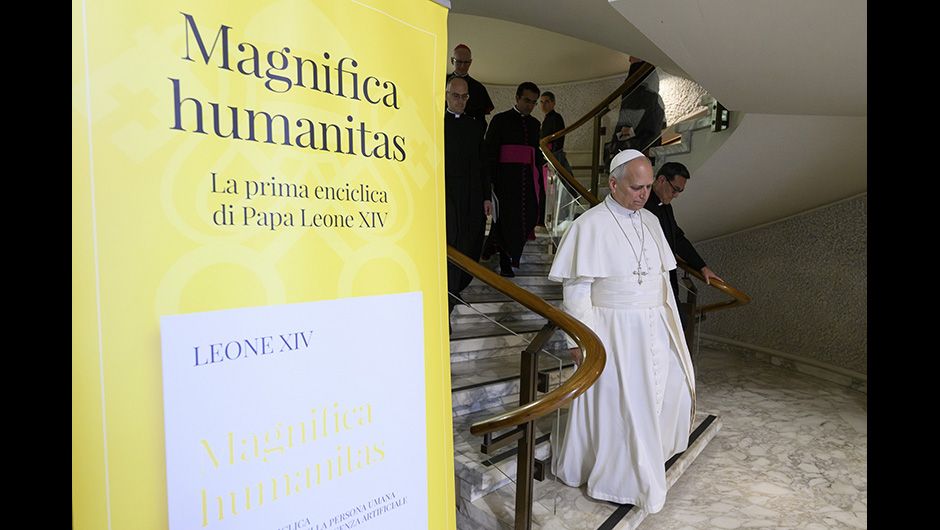
The first encyclical of Leo XIV, Magnifica humanitas, signed on May 15 and published on the 25th, incorporates the term «gender» in its development on social justice. In paragraph 79, when describing the wounds that restorative justice must heal, the text lists «wars, colonialism, racial or gender discrimination, violence against entire peoples, and exploitation.» This is the fact, and it is worth noting before any reading: the word appears in the official Spanish document published by the Holy See.
79. The idea of “social justice” helps to recognize that injustices do not arise only from mistaken decisions by individuals, but also from structures, mechanisms, economic and cultural systems that produce inequality almost automatically. Saint John Paul II spoke in this sense of structures of sin [108] that oppose the will of God and require an effort of personal and social conversion. In this perspective, justice does not concern only the equitable distribution of goods or the correction of present injustices, but also assumes a reparative dimension. It aims to restore broken bonds and reintegrate those who have been excluded, taking into account the wounds caused by injustices: wars, colonialism, racial or gender discrimination, violence against entire peoples, and exploitation. This may mean restoring dignity and voice to those who have been ignored, promoting processes of healing collective memory, combating discriminatory laws and practices, and concretely supporting those who still bear the consequences of past grievances.
Its relevance lies not in what the paragraph says in addition, but in what the vocabulary introduces. The distinction between «sex» and «gender» is not a neutral synonymy: it is the foundational operation of gender theories, which separate the sexed condition—given, biological—from a cultural and self-attributed category. Outside that theoretical framework, there is no «gender» independent of sex. The Church’s anthropology has been built on the opposite premise: «male and female he created them,» sexual difference as a received gift and not as a construct. By speaking of «gender discrimination» where previous magisterial language said «sex» or «women,» Magnifica humanitas incorporates the category that the same magisterium had treated as ideological.
The contrast with previous texts is precise. In Amoris laetitia (2016, n. 56), Pope Francis used the word «gender,» but in quotation marks and as the name of what he rejected: «an ideology, generically called gender, which denies the difference and natural reciprocity of man and woman.» The term entered the text under quarantine, as the subject of condemnation, not as an assumed concept. In 2024, the Declaration Dignitas infinita of the Dicastery for the Doctrine of the Faith expressly condemned «gender theory» (nn. 55-59) and, when listing violations of dignity, titled the corresponding section «violence against women,» not «gender-based violence.» Having the noun at hand, it deliberately chose the unmarked formula.
The institutional detail reinforces the observation: Cardinal Víctor Manuel Fernández, who signed Dignitas infinita, was one of the speakers at the presentation of Magnifica humanitas. The same dicastery, within two years, offers two opposing lexical choices: the careful demarcation of 2024 and the unqualified incorporation of 2026.
Defenders of the text will object that «gender» must be read in its colloquial and legal sense—discrimination against women—and that the encyclical affirms in other passages that male and female are in the image of God (n. 50) and that both possess equal dignity (n. 57), in addition to opposing transhumanism and reaffirming the value of limit and the body. The objection is real on the level of intention. It does not alter, however, the level of the concept: once the term enters a text of this rank without the clause that the Church had taken the trouble to attach to it for a decade, it becomes available to be cited as a magisterial ratification of a vocabulary that the magisterium itself had restricted.
The encyclical also arrives on the eve of Leo XIV’s visit to Spain (June 6–12), a country where «gender» is statutory language. The term, previously reserved for naming and condemning, now appears in a pontifical text as an assumed descriptor. This is the first time it occurs in a document of this category.