


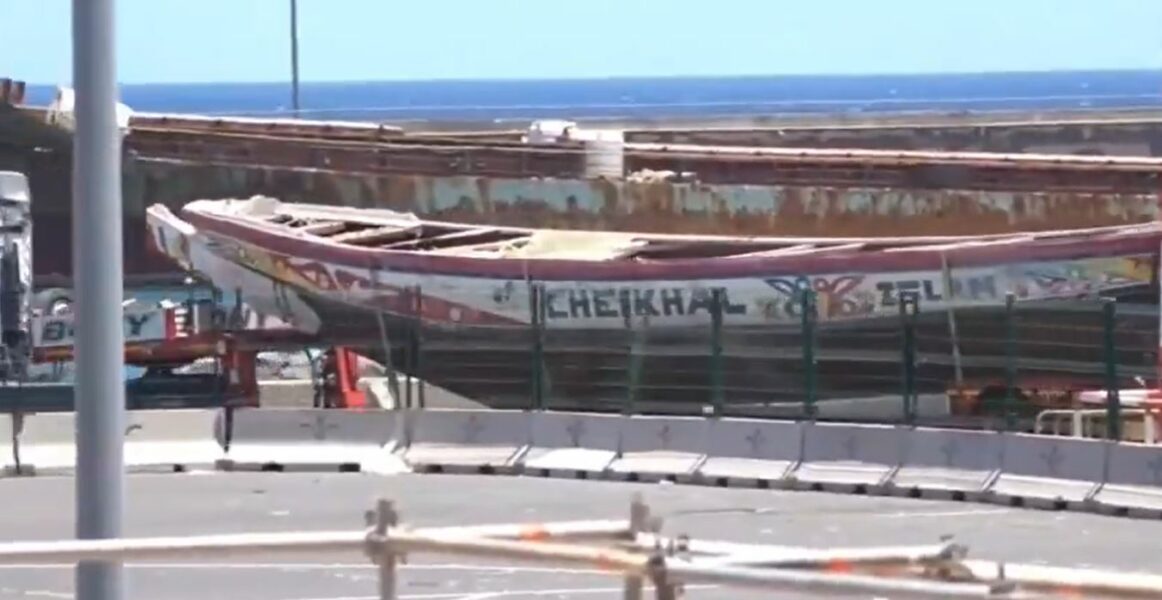
One of the three cayucos that will surround the altar from which Leo XIV will celebrate the closing Mass of his trip to Spain in Santa Cruz de Tenerife bears an inscription that has sparked curiosity. In images shared by Canario Today on the social network X, it can be seen that one of the vessels selected to form part of the papal celebration’s stage design has the name «CHEIKHAL ISLAM» painted on its hull.
The presence of these cayucos was announced this week by the organizers of the visit, who explained that the vessels have been incorporated into the altar as a symbol of the migratory reality that has marked the Canary Islands’ coasts in recent years. According to them, the intention is for the boats to remain beside the altar as a “significant and silent” presence of one of the most relevant phenomena for the archipelago.
A name with religious but not Catholic meaning
The inscription visible on one of the cayucos refers to the expression Cheikh al-Islam or Shaykh al-Islam, a title historically used in the Islamic world to designate prominent religious and legal authorities.
Translated into Spanish, the term can be understood as «Jeque del Islam».
The inscription appears clearly visible on the side of the vessel, which is already installed in the Port of Santa Cruz as part of the setup prepared for the Mass that will conclude Leo XIV’s apostolic journey to Spain.
The cayucos, protagonists of the papal stage design
The presence of this cayuco thus adds to the numerous symbolic elements that will accompany Leo XIV’s visit to the Canary Islands.
In addition to the Eucharistic celebration in Tenerife, Leo XIV will visit reception centers, hold meetings with migrants, and take part in various events related to the integration and accompaniment of those arriving on the islands via the Atlantic route.
Thus, while the organizers aspire to transform the so-called “dock of shame” into a “port of hope” and turn the cayucos into a symbol of welcome, one of them displays in perfectly visible letters an inscription that directly refers to the Islamic religious sphere.
A reflection on symbols in the liturgy
The situation takes on a particularly striking nuance when one considers—without going any further—the catechesis delivered by Leo XIV himself this Wednesday, devoted precisely to the meaning of rites, signs, and symbols in the liturgy.
The Pontiff recalled that symbols are not merely decorative or accessory elements, but realities that convey deep meanings and contribute to the spiritual formation of the faithful. Citing the Church’s teaching, Leo XIV insisted on the need to “become capable of symbols again” and to care with delicacy and without arbitrariness for the beauty of liturgical celebrations.
In light of these words, the presence of a cayuco identified with the inscription «Jeque del Islam» among the main visual elements surrounding the papal altar adds a singular detail to a celebration in which, precisely, the symbols are supposed to have been carefully chosen to convey a message.